Who?
Selected suitable cases.

In selected cases a person’s own tooth can be transplanted into another gap. It may be an option particularly in younger patients. Tooth shape, root development and the recipient site must be suitable.
For training & practice ↓
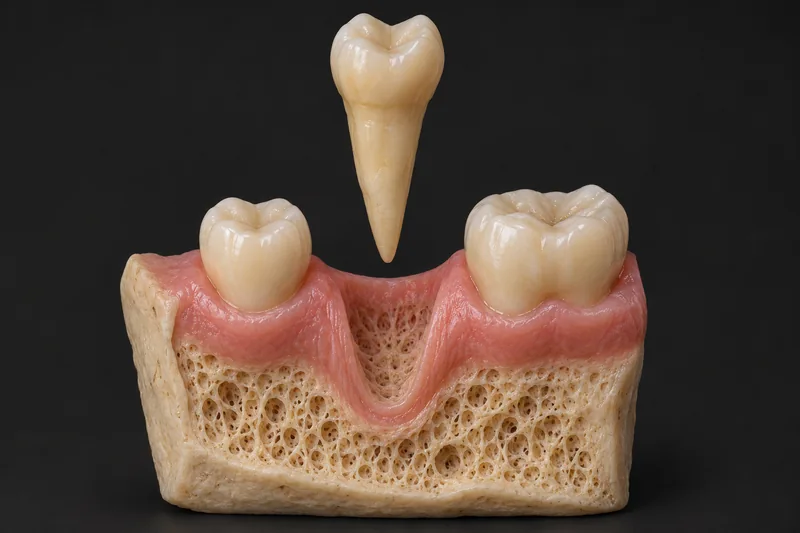
No other person’s tooth is used. Donor selection forms part of gap management.
Root-surface tissues contribute to healing and need careful surgical handling.
The pulp, root and supporting tissues need monitoring. Ankylosis or root resorption may occur.
No other person’s tooth is used. Donor selection forms part of gap management.
Root-surface tissues contribute to healing and need careful surgical handling.
The pulp, root and supporting tissues need monitoring. Ankylosis or root resorption may occur.
Selected suitable cases.
Surgical and often orthodontic.
No; long-term review matters.
Three steps. No audio.
Each scene can also be selected manually.

Silent educational film with German on-screen text and simplified teaching images. Not a patient case or a promised treatment outcome. The full English explanation is available as text.
Transplantation moves a tooth to another site; replantation returns it to its original socket.
No. An implant is an artificial root; a transplant uses a natural tooth.
No. Shape, development and space require specialist assessment.
That depends on root development and subsequent findings.
Editorially suggested question to discuss with Dr Niusha Barahmand Pour:
Which options could suit this gap?
Discuss options for a missing tooth and whether specialist assessment would be appropriate.
Discuss a missing toothAppointment selection at DoctolibTransplantation moves a tooth to another site; replantation returns it to its original socket.
Editorial research: . General information, not an individual diagnosis or treatment recommendation. Teaching illustrations are simplified and do not depict a patient case.