Endodontics · Cologne

Root canal treatment.Assessing the chance of saving your tooth.

If the tissue inside a tooth is inflamed or infected, root canal treatment may help preserve it. We assess the findings, the prospects of success and the possible alternatives.

Discuss root canal treatment

Inside the tooth

More than the
so-called tooth nerve

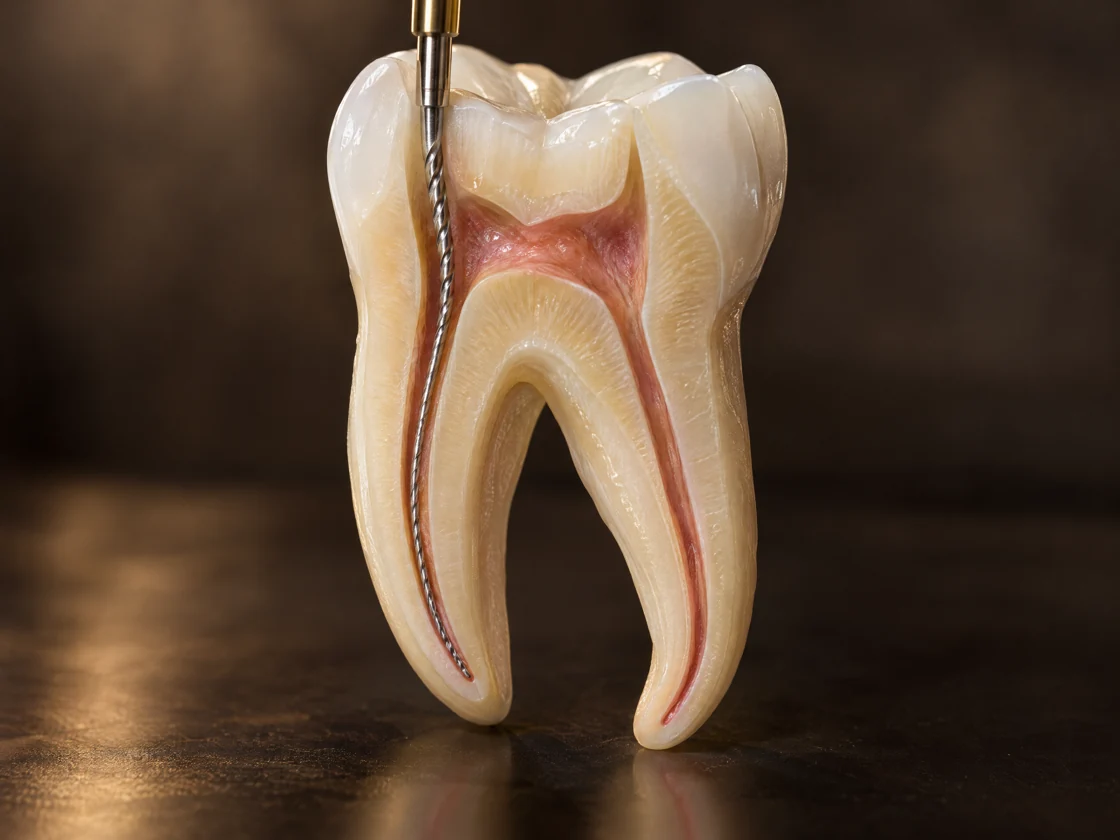
Beneath the enamel and dentine lies the dental pulp, containing nerves and blood vessels. Deep decay, cracks or an accident can damage this tissue. Inflammation or infection may extend to the area around the root tip.

During root canal treatment, diseased tissue is removed from the root canal system. The canals are shaped, rinsed and then filled. A secure seal and an appropriate restoration of the remaining tooth are part of the treatment plan.

Whether this approach is appropriate also depends on how much sound tooth structure remains and how well the tooth is supported in the jaw. A root filling alone does not automatically restore the strength of a severely damaged tooth.

AI-generated teaching model of a molar in cross-section, showing two root canals and a fine instrument in a curved canalAI-generated
A look inside the tooth: this simplified teaching model shows two root canals. Their number, course and branches can differ from tooth to tooth. This is not a patient case.

Your concerns in focus

What concerns you about root canal treatment?

The examination, the inside of the tooth and the subsequent restoration all need to be considered together.

I would like to understand the findings

Assessing the whole tooth

The examination considers your symptoms, the tooth's responses and any necessary X-rays. Fillings, possible cracks and the gums also inform the assessment of whether the tooth can be preserved.

About the examination
I would like to understand the process

Working inside the root canal system

Treatment removes diseased tissue from the root canals. The canals are shaped, rinsed and then filled.

About the treatment process
I would like to know what happens afterwards

Restoring the outside too

After the root filling, the tooth needs a secure seal and an appropriate restoration. The choice of filling or ceramic restoration depends on the remaining tooth structure and the forces it bears.

About the subsequent restoration

A guide for your conversation, not a diagnosis or treatment recommendation. Your selection is not stored or transmitted.

Understanding the findings

When treatment
inside the tooth may be needed

Symptoms can be a sign

Prolonged reactions to heat or cold, spontaneous pain, tenderness when biting or swelling may call for an examination. Some changes are discovered without pain. Symptoms alone do not establish which treatment is needed.

An examination provides clarity

We discuss how the problem has developed, examine the tooth and its responses, and consider any necessary X-rays. Existing fillings, cracks and the gums are also assessed. Together, these findings allow us to assess whether the tooth can be preserved.

Sometimes the pulp can be preserved

In certain circumstances, procedures to preserve living pulp tissue may be an option. Deep decay therefore does not necessarily lead to full root canal treatment. The options depend on the condition of the tissue.

Limitations are part of the decision

With an unfavourable fracture, too little remaining tooth structure or very limited support, extraction may be more appropriate. We discuss the work involved, the risks and the subsequent options for Restorative dentistry.

If you have acute symptoms

If you have severe pain, swelling or fever, please call promptly for a dental assessment. Outside our opening hours, contact the emergency dental service. Difficulty breathing or swallowing, or severe swelling that is increasing rapidly, requires immediate medical help — call 112 in an emergency.

How we work inside the tooth

Four aids.
One careful treatment.

We combine rotary nickel-titanium instruments and electronic length measurement with a standard irrigation protocol and magnification using dental loupes. Each step has its own purpose.

Flexible nickel-titanium instruments

Their purposeThese fine, flexible instruments are mechanically driven. They help shape even curved canals and create space for irrigation and root filling.

Their limitationsSevere curves and narrow sections remain challenging. These instruments can also break; careful selection and handling are essential.

Electronic length measurement

Their purposeA measuring device helps determine the endpoint for canal preparation: how far should cleaning and later filling extend?

Their limitationsThe measurement is assessed alongside the findings and any necessary X-rays. It replaces neither diagnostic imaging nor examination of the whole tooth.

Root canal irrigation

Their purposeDisinfecting irrigants complement mechanical cleaning. They help flush out tissue remnants and reduce microbes in the root canal system. We use a standard irrigation protocol for this.

Their limitationsNo method reliably makes a branching root canal system completely free of microbes. Irrigation, preparation and a secure seal must work together.

Magnification with dental loupes

Their purposeDental loupes magnify the working area. This helps with identifying small structures and the entrances to the root canals.

Their limitationsNarrow or curved canals still cannot be seen in their entirety. For complex findings, we discuss whether further specialist treatment would be appropriate.

The examination determines which steps your tooth needs. No single device or instrument determines the success of treatment.

The process

Step by step
through treatment

One

Assessment & planning

We assess whether the tooth can be preserved, explain the alternatives and discuss the likely steps and costs.

Two

Anaesthesia & access

The tooth is numbed with local anaesthetic and isolated from saliva for treatment. An access opening allows the root canals to be treated.

Three

Length & preparation

The working lengths are determined. Suitable instruments prepare the canals; disinfecting irrigants form part of the cleaning process.

Four

Progress & temporary restoration

Whether a medicated dressing and a further appointment are needed depends on the findings. The tooth is temporarily sealed between appointments.

Five

Root filling & seal

The prepared root canal system is filled and the tooth is sealed. The subsequent permanent restoration is planned according to the remaining tooth structure.

Six

Reviews

We assess symptoms, function and healing. This may include follow-up X-rays. Appointments are tailored to your findings.

Would you like to discuss planned root canal treatment? Discuss root canal treatment

Planning beyond treatment

The tooth also needs
a seal on the outside.

The appropriate restoration after root canal treatment depends on the size of the defect, the remaining tooth walls and the forces on the tooth. Options may include a filling or a protective restoration made of ceramic. Not every root-treated tooth automatically needs the same type of crown.

If a laboratory-made restoration is required, we work with an external dental laboratory. Shape, material and costs are planned to suit the findings.

While you have a temporary restoration, please follow the agreed advice on chewing and care. If the seal is lost or the tooth becomes significantly more painful, contact us for a review.

A treated tooth may discolour later. Before any cosmetic colour correction we assess its condition, seal and healing.

If symptoms persist

Root canal treatment can fail, or inflammation can return. The cause is then investigated. Depending on the situation, repeat root canal treatment, root-end surgery or extraction may be considered.

Which alternative is reasonable depends on the findings and prognosis. Persistent symptoms should therefore be assessed again.

Costs & health insurance

What is covered?

German statutory health insurance covers treatment that is adequate, appropriate and economical within the medically necessary scope. For root canal treatment, this requires assessment of the tooth's condition, whether preserving it is justified and the prospects of success.

It must be possible to prepare and fill the canals to, or close to, the root tip. For molars, an additional condition applies: treatment is generally covered if it can preserve a complete row of teeth, prevent a shortened dental arch on one side or preserve functional dental restorations.

Anatomical features affect the work involved. Severely curved or very narrow canals may make preparation more difficult and require additional time and treatment. The steps that are possible and appropriate depend on the findings.

If a medically reasonable attempt to save a tooth does not meet statutory insurance criteria, privately agreed treatment may be an option. This is distinct from individual private additions that are separately permitted alongside statutory treatment. We discuss the specific reason, alternatives and possible private costs in advance. You receive a cost estimate; private services are agreed in writing before treatment begins. The subsequent restoration of the tooth is also considered.

If you have private or supplementary insurance, clarify possible reimbursement using the treatment plan before treatment begins.

Useful information for your decision

Preserving a tooth: what is involved

Treatment does not end with the root filling.

Assessing whether the tooth can be preserved

Before root canal treatment, we assess whether preserving the tooth is a reasonable option. Its condition, the treatment involved and possible alternatives all inform the decision.

Treating the canals carefully

Diseased tissue is removed, and the canals are cleaned and filled. Their shape and any existing infection affect the work involved and the number of appointments.

Talking openly about symptoms

Anaesthesia and the approach are agreed with you; sensitivity may still occur. Tell us if you are in pain, and have persistent symptoms after the appointment checked.

Planning the final restoration

The crown of the tooth also needs an appropriate seal. Whether a filling or another restoration is suitable depends on the remaining structure and the forces on the tooth.

Discussing costs and progress

Statutory cover and possible private additions are clarified in advance. Follow-up reviews are part of care, as successful healing cannot be established from the absence of symptoms alone.

Frequently asked questions

Before and after root canal treatment

Does root canal treatment hurt?

Local anaesthetic is used to make treatment possible. Acute inflammation may require further adjustments. Sensitivity or discomfort after the appointment is possible. Please tell us if you feel pain; we cannot promise that treatment will always be pain-free.

How many appointments will I need?

This depends on factors such as the number and shape of the canals, any infection and previous treatment. Treatment may be spread across several appointments. A fixed number cannot reasonably be given before an examination.

Can antibiotics replace root canal treatment?

Antibiotics do not reliably remove the cause within a diseased root canal system. They therefore do not replace the necessary dental treatment. Whether they are needed in addition depends on the clinical situation, for example if an infection is spreading.

Is removing the tooth the simpler choice?

Extraction is permanent. It is also necessary to consider whether and how the gap will subsequently be restored. We compare possible tooth preservation with the alternatives, rather than looking only at the number of treatment appointments.

Why are reviews needed after treatment?

The absence of symptoms alone does not reveal the full course of healing. Reviews help assess the tooth and the tissues around the root tips and coordinate further restoration.

Can a root-treated tooth develop problems again?

Yes. For example, a new loss of seal or hard-to-reach areas of the root canal system may play a role. Retreatment is possible in some cases; the decision requires careful investigation of the cause.

What if I am anxious about dental treatment?

Please feel free to tell us about your concerns before your appointment. We explain the steps and agree on signals for breaks. You can find information about our approach on the page for patients with dental anxiety.

Tooth preservation in Cologne

Make an informed decision
about the next step.

We examine your tooth and discuss the options for its further care.

Discuss root canal treatment

For acute symptoms, please call: 0221 669 401 80 · Contact & directions