First, understand the tooth colour.
Surface deposits may already be removable with professional teeth cleaning. Whether further whitening would be appropriate depends on the cause of discolouration and the examination.
Causes of discolouration
Teeth whitening · Cologne
Before whitening, we establish the cause of discolouration, examine your teeth and discuss what change might be possible.
The examination comes before the gel
Coffee, tea or tobacco can leave traces on tooth surfaces. But teeth also change colour for other reasons. We therefore first ask how long the discolouration has been present and whether it affects individual teeth or the whole dental arch.
Surface deposits may already be removable with professional teeth cleaning . Whitening aims to lighten the colour of natural teeth further. Whether it is appropriate for your findings can only be assessed after a check-up.

Your concerns in focus
The cause of discolouration and existing restorations determine what needs to be clarified first.
What would you like to know? Choose a concern. The drawing and explanation will reflect your selection.
Surface deposits may already be removable with professional teeth cleaning. Whether further whitening would be appropriate depends on the cause of discolouration and the examination.
Causes of discolourationFillings, crowns and veneers do not become lighter with whitening. Possible colour differences and the work involved in later adjustment are therefore discussed in advance.
Include existing restorations in the planA change in colour after an accident or root canal treatment needs a separate examination. Internal whitening may be an option for a root-treated tooth; the findings determine the next steps.
More about a single dark toothA guide for the conversation, not a diagnosis or treatment recommendation. Your selection is not stored or transmitted.
The starting point determines the options
Whitening may be an option when the teeth and gums are healthy. The result depends on factors including the starting shade and the type of discolouration. We cannot promise a particular shade or number of shade changes.
Existing fillings and ceramics do not become lighter with whitening. Colour differences may therefore become more noticeable. We discuss in advance whether later adjustment would be necessary and appropriate at all and what additional work it could involve.
A change in colour after an accident or Root canal treatment needs a separate examination. Internal whitening might offer another approach for a root-treated tooth. Whether this is an option or other measures should be discussed depends on the findings.
For particularly sensitive teeth, decay, leaking restorations or gum problems, we must first establish whether and when whitening would be appropriate. A product containing an ingredient to which you have a known allergy is not suitable. Cosmetic teeth whitening is not recommended during pregnancy or breastfeeding.
The process at our practice
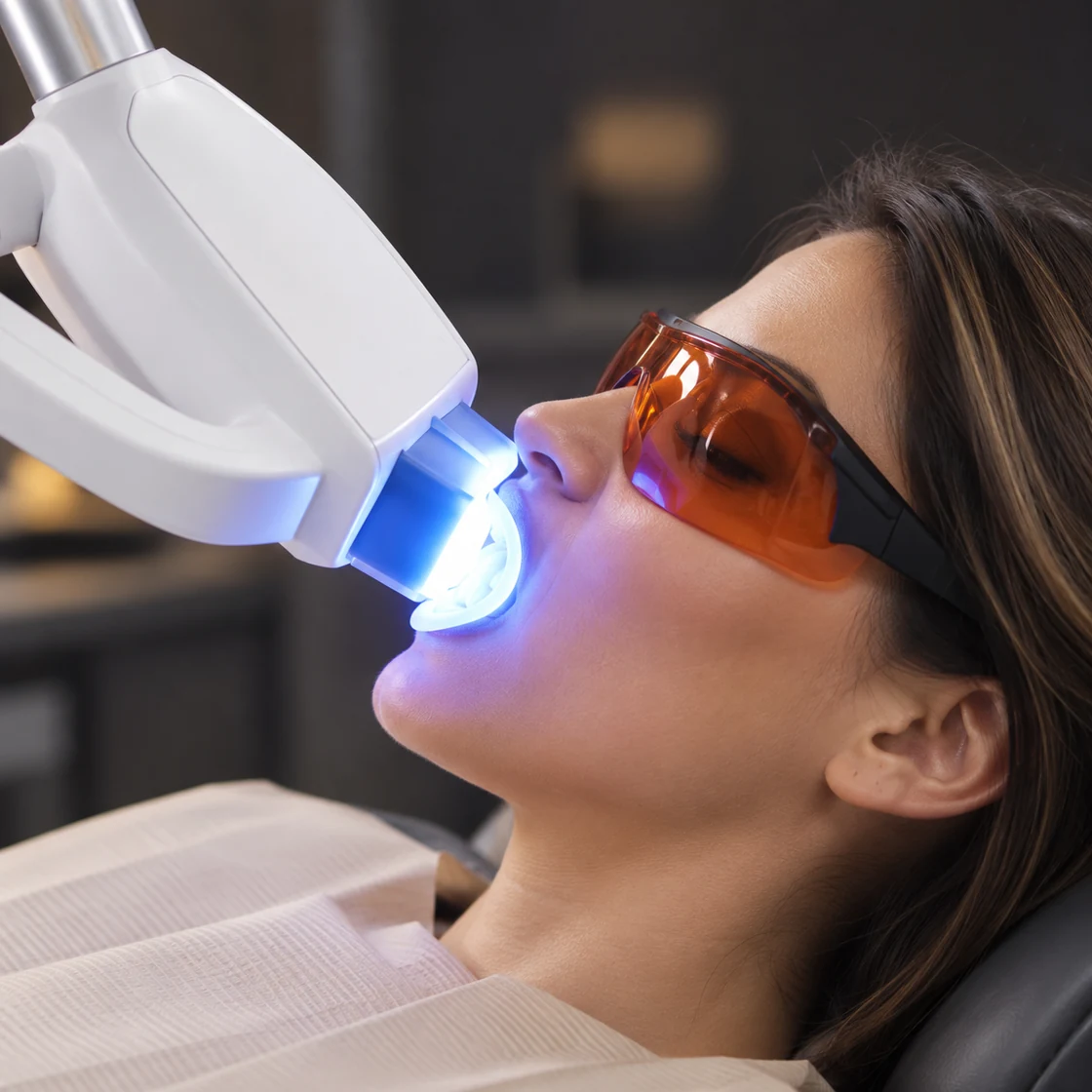
With the fläsh method used in our practice, a whitening gel is applied and activated with a whitening lamp. We tailor the application to the findings and the instructions for the product used.
We examine teeth, gums and existing restorations. The starting shade is recorded. We then discuss expectations, limitations and the preparation required.
Deposits that interfere with whitening are removed beforehand. We clarify in advance whether professional teeth cleaning is needed and when it should take place. The gums are protected during the application.
The gel is applied under controlled conditions and used with the lamp. The number and length of cycles depend on the product and your situation. Please tell us immediately if you experience discomfort.
After the application, we check the teeth and gums and record the shade. You receive advice for the next few hours and learn whether a further check is appropriate.
Information about the system: fläsh patient information (PDF).
The first few hours
The fläsh patient information recommends drinking water for the first four hours after treatment and avoiding staining influences such as coffee, tea, red wine or tobacco. The instructions discussed for your specific procedure remain the guide.
Continue your dental care and ask us about suitable care if you experience sensitivity. Do not combine additional whitening products on your own initiative.
Take sensitivity seriously
Teeth can become sensitive during or after whitening. This is often temporary, but you do not simply have to tolerate pain. If pain is severe, the application is paused and the situation assessed.
If discomfort persists or increases after your appointment, please contact the practice. Whether a later top-up would be appropriate is decided after another check-up — not just according to how much time has passed.
Costs
Cosmetic teeth whitening is an elective private service. We agree the dental services and their fees under the German fee schedule for dentists (GOZ) in writing beforehand in an individual treatment and cost plan.
The amount depends on factors including preparation and the extent of treatment. Any possible later colour adjustment of existing fillings or ceramics must also be planned separately. Reimbursement is not guaranteed; purely cosmetic measures are usually self-funded.
Information to help you decide
What should be clarified before whitening.
Surface staining and natural tooth colour are different things. Cleaning can remove deposits; the examination shows whether additional whitening is appropriate.
Decay, leaking restorations or gum problems should be assessed before whitening. Known sensitivities and allergies to ingredients also matter for planning.
Fillings, crowns and veneers do not become lighter. Possible colour differences and the work involved in later adjustment should be discussed together in advance.
Teeth may become sensitive during or after whitening. Mention any discomfort so that the approach and follow-up care can be adapted.
A particular shade or duration cannot be promised. Discuss your desired result, the limitations and your individual private costs.
Frequently asked questions
This varies individually. Diet, tobacco, oral care and the starting point influence how the colour develops. We do not promise a fixed duration. Possible repeat treatment is discussed after examination and consideration of the options.
Whitening with the procedure described here takes place in the dental chair. We clarify with you beforehand whether the examination, necessary preliminary treatment and desired whitening will require one or several appointments.
Discolouration inside the tooth, for example from certain medicines such as tetracyclines, requires a separate assessment. Its response to whitening cannot reliably be expected to match that of ordinary external discolouration. We therefore cannot make a general promise about what change would be realistic.
Products differ in factors including active ingredient, concentration and application. At the practice, examination, protective measures and supervision are part of the process. Even before using a whitening product yourself, the causes and requirements should be assessed by a dentist.
Whitening changes tooth colour, but not shape or position. If you would like to change those as well, we discuss the options in aesthetic dentistry. Veneers are a separate form of restoration with different requirements and implications.
Consultation in Cologne
We examine your teeth and discuss the options for whitening — with time for your questions.
Book a whitening consultationOr call us on 0221 669 401 80.