Dental sleep medicine · Cologne
Mandibular advancement devices in Cologne.Understand your nights.
Plan the next step.
A custom-made mandibular advancement device can treat snoring and certain forms of obstructive sleep apnoea. Before making a device, we need to understand what is actually disturbing your sleep.
When snoring becomes a concern
One sound.
Different causes.
Perhaps your partner has mentioned your snoring. Perhaps you wake up feeling unrefreshed. Both are good reasons to look more closely.
Snoring occurs when soft tissues in the upper airway vibrate. It can occur on its own. In obstructive sleep apnoea, by contrast, the airway repeatedly narrows or closes enough to disrupt breathing during sleep.
Loudness alone does not distinguish these situations. Medical assessment and an appropriate referral or request therefore come before making a device. Suitability for a device is then also assessed by a dentist.
Explained using a model
Two splints. One adjusted jaw position.
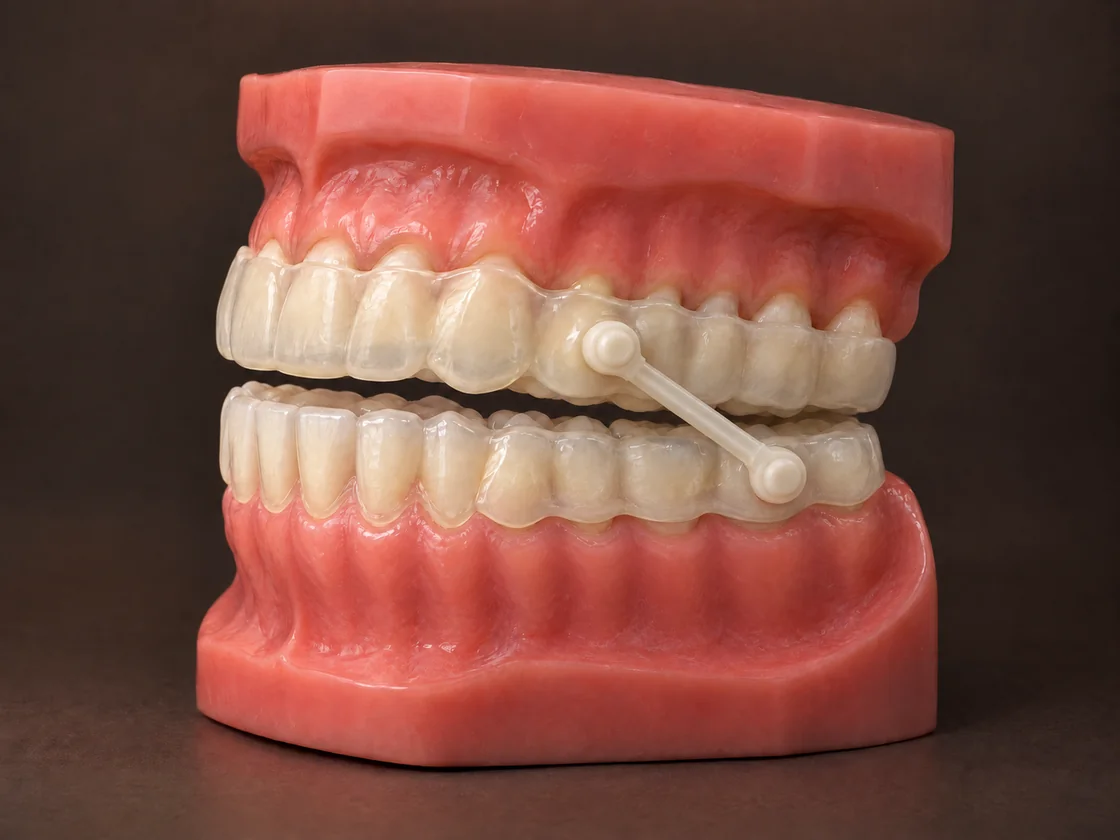
The model shows the principle of a mandibular advancement device. The three explanations cover its function, assessment and follow-up.
 AI-generated
Holding the lower jaw forward during sleep
One splint fits over the upper teeth and one over the lower teeth. In the model, they are joined by a plastic connector at the side. The splints hold the lower jaw slightly further forward during sleep. This can create more space in the throat; the position is adjusted individually.
Understand how the device worksFirst establish what is disturbing sleep
Snoring alone does not show whether pauses in breathing occur. Medical assessment and a referral or request come before making a device. The dental examination assesses teeth, their supporting structures and the jaw joints.
Learn about the assessment processCheck fit and effectiveness
Follow-up visits check the device’s fit, the teeth and the bite. For sleep apnoea, medical checks also assess how night-time breathing responds to treatment. Quieter snoring alone is not enough.
What follow-up includesIllustrative teaching model, not a patient case. The illustration does not replace a dental examination.
What the device is intended to do
The lower jaw is held
in a forward position.
A mandibular advancement device, or MAD, consists of two custom-made parts for the upper and lower jaws. Connectors hold the lower jaw slightly further forward during sleep. This can create more space in the throat and make the airway less likely to narrow.
The device is made to fit your dental arches and jaw position and can be adjusted. The appropriate design depends on the medical findings, retention on the teeth and how well your jaw joints tolerate it.
How far the lower jaw is advanced is adjusted individually and reviewed over time. This does not allow a fixed success rate to be predicted for an individual. In sleep apnoea, quieter snoring is also not enough: the effect on breathing must be checked medically.
From assessment to follow-up
Two disciplines.
One coordinated treatment pathway.
Medical assessment
A GP, ENT or sleep medicine practice can begin the assessment. A respiratory sleep study usually measures breathing and oxygen saturation, among other things, at home. Based on your symptoms and findings, the medical team decides whether additional polysomnography in a sleep laboratory is needed.
To make a device, we need the medical referral or request and the relevant findings. An overnight stay in a sleep laboratory is not automatically necessary for everyone who snores.
Dental assessment
We examine the teeth, gums, existing dental restorations, jaw joints and lower jaw movement. The device needs sufficient retention. Inflammation, loose teeth or certain joint symptoms may mean that immediate fitting is not appropriate.
Making & adjusting the device
After recording your dental arches and jaw position, the device is made individually. At fitting, we check its fit and starting position. We explain how to wear, clean and handle it. Adjustments follow the agreed plan.
Check effectiveness
We check the fit, teeth and bite. For sleep apnoea, the medical team also assesses the effect on night-time breathing. If it is insufficient, the setting or treatment must be reassessed together.
Using the device needs follow-up
The morning is
part of treatment too.
Initially, pressure on the teeth, increased saliva, dry mouth or discomfort in the muscles and jaw joints may occur. Tooth position and the bite can also change in the long term. Dental check-ups are therefore part of device treatment.
Report pain, a change in how your teeth meet or a damaged device. Do not adjust or alter the device yourself beyond the instructions discussed with you.
Care suited to the material
Clean your teeth and device daily according to the instructions for your model. Bring the device to check-ups. The fit should also be checked after new fillings, crowns or other changes in the mouth.
Material, loading and care affect how long the device lasts. There is no fixed replacement interval for every device; wear and function are assessed at appointments.
Costs & insurance
Snoring and sleep apnoea
are assessed differently.
A device for simple snoring is usually privately funded. Before it is made, you receive an individual cost plan according to the German fee schedule for dentists (GOZ).
For adults with obstructive sleep apnoea requiring treatment, a MAD may be covered by German statutory health insurance under G-BA requirements if positive airway pressure treatment cannot be carried out successfully. Suitably qualified statutory health insurance doctors establish the indication and request treatment; dental suitability is also assessed. The diagnosis alone does not mean every device is automatically covered.
We clarify in advance which care and billing arrangements are possible in your case. People with private or supplementary insurance should have their insurer review the cost plan before starting. Whether and how much is reimbursed depends on the policy and findings.
Information to help you decide
Before the device: understand your sleep
Snoring and sleep apnoea need different assessments.
Have breathing assessed medically
Observed pauses in breathing or marked daytime sleepiness should be discussed with a doctor. Before a device is fitted, it must be established whether a sleep-related breathing disorder is present and which treatment is appropriate.
Check teeth and joints
The device needs suitable retention. Before fitting, the teeth, gums, dental restorations and jaw joints are examined and any preliminary treatment is discussed together.
Monitor effectiveness
Less snoring alone does not prove that sleep apnoea is adequately treated. The effect on night-time breathing must also be checked medically after fitting.
Discuss changes
Pressure, joint symptoms or bite changes are possible. Dental follow-up therefore accompanies use and helps identify necessary adjustments in good time.
Understand the costs
A device for simple snoring is usually privately funded. For sleep apnoea, possible statutory health insurance cover depends on additional medical requirements.
Frequently asked questions
Before your first night with the device.
Can a dentist help with snoring?
A dentally fitted device may be an option. First, however, it must be established whether this is simple snoring or a sleep-related breathing disorder. We discuss the dental requirements and the necessary medical assessment pathway.
Do I need a prescription, and do I have to go to a sleep laboratory?
Before making a MAD, we need the medical referral or request and the findings. Statutory health insurance provision for sleep apnoea also requires the relevant medical qualifications and treatment criteria. Depending on the findings, the necessary examination may take place at home or in a sleep laboratory. A prescription alone does not replace the assessment.
Does the device replace my CPAP mask?
That can only be decided based on your sleep apnoea and previous treatment. CPAP is an established standard treatment. Do not stop it yourself because a device is planned; any change belongs in the medical treatment plan.
Is a grinding splint the same thing?
No. A bite splint to address the effects of teeth grinding has a different purpose. A MAD deliberately holds the lower jaw in an adjusted position. Existing splints and symptoms should be assessed together.
Is an over-the-counter anti-snoring device enough?
A ready-made device replaces neither diagnosis nor assessment of the teeth and jaw joints. The care described here involves making and monitoring a custom-made, adjustable device. Your findings determine the appropriate approach.
Do I have to keep wearing the device indefinitely?
Its effect depends on wearing it during sleep. How treatment continues in the long term depends on symptoms, follow-up findings and tolerance. Regular checks remain appropriate even if you notice an improvement.
Your appointment in Cologne
Bring what has
already been assessed.
Existing sleep medicine findings, your medical referral or request, details of previous treatment and any existing device help us start in the right place. If medical assessment has not yet taken place, please mention this before booking.
We assess the dental requirements and discuss what the next step could be.
Discuss a mandibular advancement device
Call us on 0221 669 401 80 · Contact & directions