
Dentistry · Cologne
Dental implants in Cologne.
Artificial tooth roots can support crowns, bridges or dentures. Together, we assess whether implant treatment suits your oral health and expectations.
Before deciding
We look at
more than the gap.
An implant is anchored in the jawbone. The visible restoration is attached to it. Both parts need to be planned together from the outset.
We examine the remaining teeth, gums, bite and available bone. Medical conditions and medication are also part of the medical history. Necessary X-rays complement the assessment; a surface scan alone does not show the bone.
Any periodontitis requiring treatment must be addressed in preparatory care. Smoking and poorly controlled blood glucose can increase the risk of complications.
Alternatives are part of the discussion too
Where neighbouring teeth are healthy, an implant may avoid preparing them for a conventional bridge. However, a bridge or removable denture may also be appropriate, for example if surgery is not wanted or is unsuitable.
We discuss the options, the work involved and aftercare. Whether a gap needs restoring at all is assessed on the basis of function and the overall situation.
Limited bone means additional planning
Reduced bone volume may require bone augmentation. Whether this is possible and appropriate depends on the findings. Such a step may lengthen treatment and brings its own risks and costs.
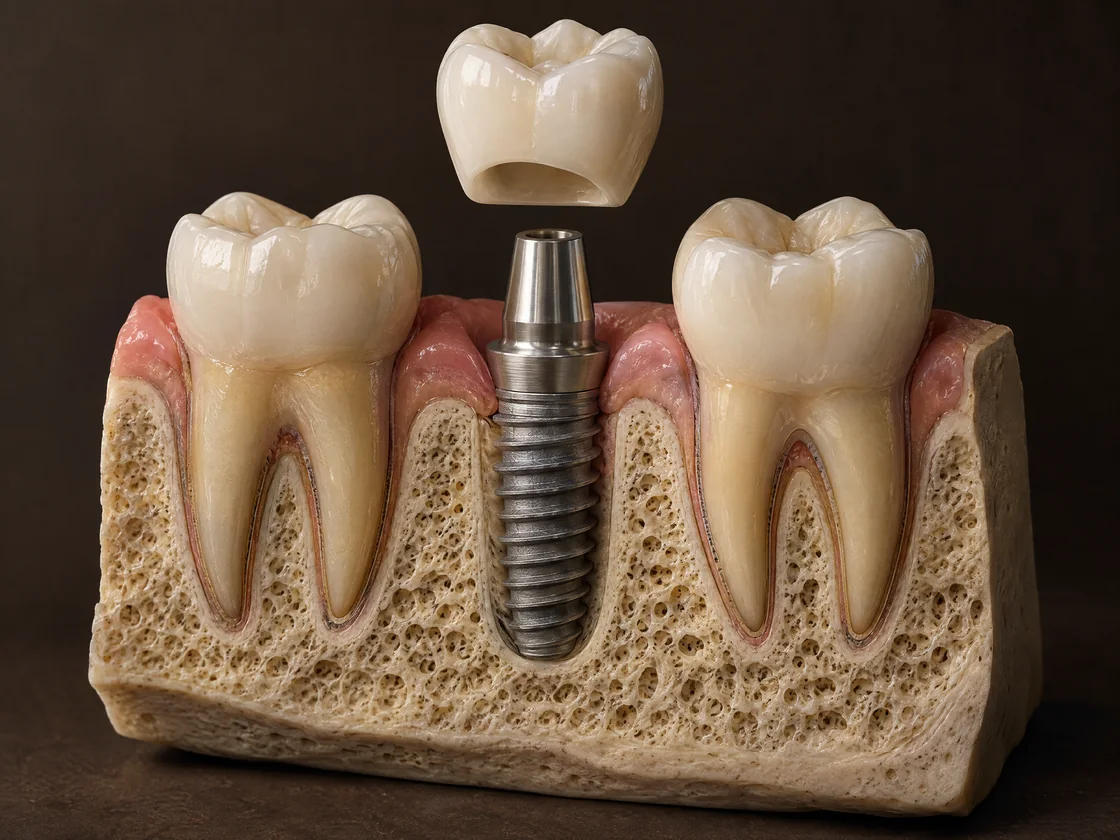
Explained with a model
Artificial root. Visible restoration.
An implant and the crown attached to it are different parts. The cross-section through the teaching model shows how they fit together.
 AI-generated
Anchored in the bone
The implant functions as an artificial tooth root. Examination includes assessing how much suitable bone is available and which neighbouring structures need consideration.
Learn about the requirementsPlanning the abutment and crown together
In this example, a connecting abutment supports a single crown. Implant position and the later restoration are planned together; the specific design depends on the initial situation.
Understand the treatment pathwayKeeping the tissues healthy
The gums and surrounding tissues around implants can become inflamed. Careful cleaning and agreed follow-up appointments therefore remain important after placement.
What aftercare involvesAn illustrative teaching model, not a patient case. The illustration does not replace a dental examination.
Material choice
Titanium or ceramic?
For general context: choosing the material of the artificial root is a separate decision from choosing the material of the crown attached to it. A ceramic crown can, for example, be supported by a titanium implant. The following differences can help guide a discussion about possible treatment.
Titanium implants
Titanium has long been established in implant dentistry. Various systems and abutments are available for different situations. However, the material alone does not determine treatment success.
Ceramic implants
Zirconia ceramic implants may be an alternative. The scientific evidence differs according to the system and design. Long-term assessment is more limited than for established titanium implants, particularly for two-piece systems.
Before detailed planning, we clarify which restoration may suit your findings and which treatment steps can take place in our practice. Known allergies and previous reactions to materials are discussed individually. A blanket promise of complete compatibility would be inappropriate for any material.
Your treatment pathway
Plan. Allow healing.
Restore and provide continuing care.
The overall treatment duration depends on factors including preparatory treatment, available bone and healing. You receive a schedule tailored to your situation.
Assessment & planning
We clarify the requirements, discuss alternatives and prepare the treatment and cost plan. The later restoration and its cleaning are also considered.
Surgery & healing
The implant is placed surgically. During healing, a stable connection with the bone is intended to develop. Wound review appointments and guidance on loading depend on the procedure.
Restoration & reviews
After sufficient healing, the planned crown, bridge or denture is fitted. Fit, bite and cleaning access are checked and reviewed over time.
Immediate restoration is a separate decision
Placing an implant immediately after extraction and immediately loading it with a dental restoration are different procedures. Both require suitable conditions. A firm promise of “new teeth in one day” cannot be made before diagnostic assessment.
Understanding the risks
What can happen?
Pain, swelling or bruising may occur after surgery. Possible complications include infection, impaired healing and failure to establish stable integration. Depending on the location, neighbouring structures such as nerves or the maxillary sinus may be affected.
Inflammation around an implant can also develop later. Peri-implantitis affects the surrounding tissues with bone loss and can lead to implant loss. Technical problems with the abutment or restoration are also possible.
Long-term care
Care remains part
of treatment.
Implants do not develop decay, but their junctions and the spaces around them need careful cleaning. We show you suitable aids and tailor professional follow-up care to your risk.
Reviews assess the tissues and the restoration. Bleeding, swelling, pain or looseness should be investigated. An implant is not a restoration that can go without further care after placement.
Regular professional cleaning complements your care at home. We cannot guarantee that an implant will last a lifetime.
Planning costs
Consider the whole treatment.
Implant treatment includes diagnostic assessment, surgical services, the implant and its planned restoration. Bone augmentation or other preparatory treatment may also be needed. We therefore explain the expected overall costs based on your plan.
For patients with German statutory health insurance, implant services are generally billed privately. The diagnosis-related fixed subsidy may apply to the restoration on the implant. Full statutory cover is only possible for narrowly defined, particularly severe exceptional indications: conventional prosthetic treatment must be impossible and implant treatment must form part of an overall medical treatment plan. This is assessed separately before treatment begins.
Private services are charged under the GOZ. Reimbursement from private and supplementary insurers depends on the policy. Have the treatment and cost plan and possible reimbursement checked before treatment begins.
Useful information for your decision
Understand the whole pathway before an implant
The artificial root is one part of the restoration.
Check the requirements
Bone, gums and existing teeth are assessed together. Medical conditions, medication and smoking need to be discussed because they may affect treatment.
Compare alternatives
An implant requires surgery. A bridge or removable restoration may also be an option; the decision depends on the findings and your expectations.
Allow for healing
Preparatory treatment and available bone affect the timeline. Immediate restoration requires specific conditions and cannot be promised before an examination.
Understand risks and aftercare
Healing and lasting stability are not guaranteed. An implant also needs daily cleaning at junctions and between teeth. Reviews and professional aftercare depend on your risk and are part of planning from the start.
Consider the overall cost
The restoration attached to the implant, and possibly preparatory treatment, add to the implant itself. Clarify every component and possible reimbursement before treatment begins.
Further questions
What does this mean for me?
Is there an age limit for implants?
In young people, jaw growth must be complete; this cannot be established simply by reaching the age of 18. In older people, health, ability to tolerate treatment and access to reliable care matter more than age alone.
Can I eat normally while the implant heals?
Loading must suit the implant's stability and healing. After surgery, you receive specific advice on eating and care. A temporary restoration fitted immediately is not automatically ready for unrestricted use.
Does every missing tooth need its own implant?
No. Depending on the situation, implants can also support a bridge or denture. Their number and position are planned for the entire restoration. A fixed number of implants per jaw would not be appropriate without an examination.
Consultation in Cologne
Assess what is possible.
Decide together.
We discuss your dental situation, alternatives and the treatment involved. Feel free to bring existing records and your medication list.
Book an implant consultation