
Dental insights · Everyday tips
Replacing and storing your toothbrush: what matters day to day
A toothbrush is part of the daily routine. But when was yours last replaced, and where does it stay between uses? A crowded holder, a closed travel case or visibly splayed bristles can easily go unnoticed. These six tips help you review your routine without turning toothbrush care into a complicated project.
Published on
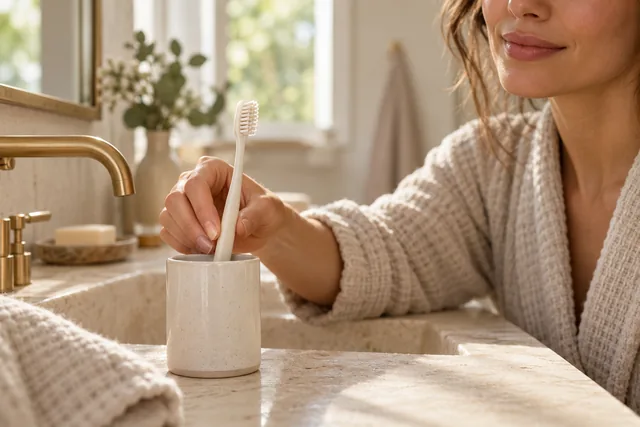 AI-generated
01 Replacement: check the date and the bristles
Germany's Information Centre for Caries Prevention recommends replacing manual toothbrushes and electric brush heads at least every three months. The American Dental Association gives a guideline of about three to four months. Both emphasise that worn or frayed bristles call for earlier replacement.
Make a note of the date when you unpack a brush, or set a reminder. Still check the brush head regularly. If the bristles splay unusually quickly, excessive pressure may be a factor. You can raise this at your next check-up.
Information Centre for Caries Prevention: replacing a toothbrush or brush head · American Dental Association: toothbrushes and toothbrush care
02 Rinse thoroughly after brushing
After each use, rinse your toothbrush with tap water to remove toothpaste and debris. This refers to the brush itself. Follow the relevant instructions when cleaning an electric toothbrush handle, charging station or travel case. A quick look at the joins helps you spot dried residue during cleaning.
03 Let it air-dry upright
Store the brush with its head pointing upwards and let it air-dry. Keeping a damp brush in a closed container encourages microbial growth. A travel case is therefore not an ideal permanent storage place for wet bristles. Take the brush out again when you arrive and give it space to dry.
04 Keep brushes separate and do not share
Each person should use their own toothbrush. Arrange brushes so their heads do not touch. Different colours or clear markings can help prevent mix-ups. Include cups and holders in regular cleaning and let them dry afterwards. Choose storage that gives the brushes enough room and allows you to reach all the surfaces easily.
American Dental Association: toothbrushes and toothbrush care · GOV.UK: storage in supervised toothbrushing schemes
05 Avoid kitchen experiments with disinfection
A toothbrush is not germ-free during use. Finding bacteria on it does not automatically mean it will cause illness. The ADA notes the lack of evidence of related health harm and the limited data on disinfection. It advises against microwaves and dishwashers because heat can damage the brush. If you have specific medical hygiene instructions, follow the advice given by your clinician.
American Dental Association: toothbrushes and toothbrush care
06 Check children's toothbrushes as well
Small brushes need regular bristle checks too. For babies and toddlers, the NHS recommends an age-appropriate small head with soft bristles and replacement every three months, or sooner if the bristles are damaged. Take a quick look while brushing together. A shared replacement date may make organisation easier, but the condition of each individual brush still matters.
A question for your next check-up
Does your brush often become misshapen after only a short time, or are you unsure how to use it? A photo of the brush head or its exact model name can help the conversation. At a check-up, you can discuss which brush and technique suit your situation. Regular replacement is one part of oral care; it does not replace thorough brushing and cleaning between the teeth.
Read on: Cleaning between teeth: floss or interdental brushes?
Sources and further information
General oral-care information, not individual treatment advice. Sources accessed and editorially cross-checked on 23 October 2026. The UK storage guidance concerns supervised toothbrushing in settings; only the general principles of separate, dry and easily accessible storage are used here.