Dental insights · Prevention
Cleaning between teeth: floss or interdental brushes?
When floss is useful, when interdental brushes fit and why the right size matters more than the brand.
Editorial review:
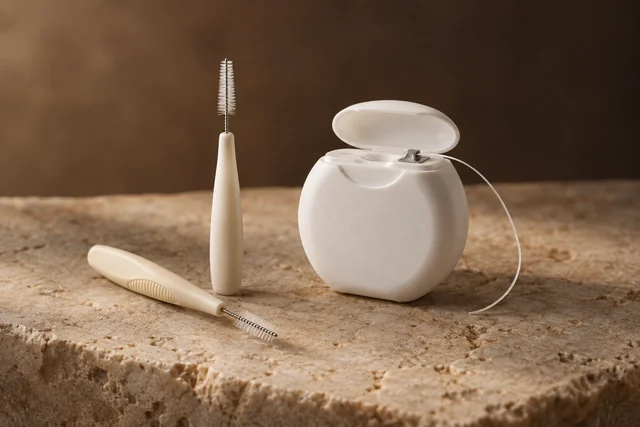 AI-generated
A toothbrush is part of daily care. But between neighbouring teeth, surfaces remain that it cannot reach adequately on its own. Bacterial plaque can be present there even when teeth feel smooth after brushing. The spaces between teeth therefore need their own cleaning. Whether floss or a brush is suitable depends mainly on the available space. German Dental Association: Dental floss
01 Tight contacts: where floss can help
If teeth are close together and an interdental brush cannot be inserted without a risk of injury, floss is one option. It should be guided along the side surfaces of the teeth. A quick pass that only dislodges food is not the same as cleaning those surfaces.
Carefully guide the floss through the contact, curve it against one tooth and move it up and down. Then clean the facing surface of the other tooth. The floss should not snap down onto the gum. If handling floss is difficult, you can also ask to be shown how to use a floss holder. LZK and KZV Hessen: Dental care and oral hygiene, pages 8–9
02 More space: a brush of the right size
For accessible, larger spaces, the European Federation of Periodontology recommends interdental brushes, provided they can be inserted without injury. They can remove plaque from the side surfaces of teeth. Fit is decisive; forcing a brush through a narrow space is not more thorough cleaning. Ask the dental practice to show you suitable sizes and how to use them. EFP: Recommendations for cleaning between teeth
When choosing, this means you do not have to use exactly one aid throughout your mouth. Ask whether the same option suits the front and back. Feel free to bring the pack you already have at home. This lets you discuss specifically what you can continue using and where a different approach might be useful.
03 What the studies actually say
Research on floss is less clear-cut than some advertising might suggest. The German Dental Association describes the evidence as limited but considers floss and interdental brushes useful additions. This means neither “floss is useless” nor a promise to prevent every disease with it. Technique and suitable choice are part of the recommendation. German Dental Association: Assessing the evidence
04 A routine that fits your everyday life
The KZBV recommends cleaning between teeth daily in addition to brushing twice a day. Set aside a fixed, easily accessible place in the bathroom and choose a time when you are not rushed. A useful question at your appointment is: “Can you show me on my own teeth how to reach the difficult areas?” KZBV: Prevention and early detection
You can bring three observations to your next discussion: where is it difficult to reach? Where does the floss catch? Which aid feels comfortable to hold? These specific details are more helpful than searching for a product claimed to be best for everyone.
Your questions belong in the conversation.
We establish what is appropriate for you based on your situation and an examination.
Contact the practiceClinical sources
The linked sources explain the general principles. Individual symptoms and decisions require a personal examination.