Purpose?
Transfer surfaces for planning and manufacture.

Impression material records tooth and tissue surfaces as a negative mould. A model can then be made for planning or manufacture. Material choice depends on the task: an overview model has different requirements from accurately recording a crown margin.
For training & practice ↓
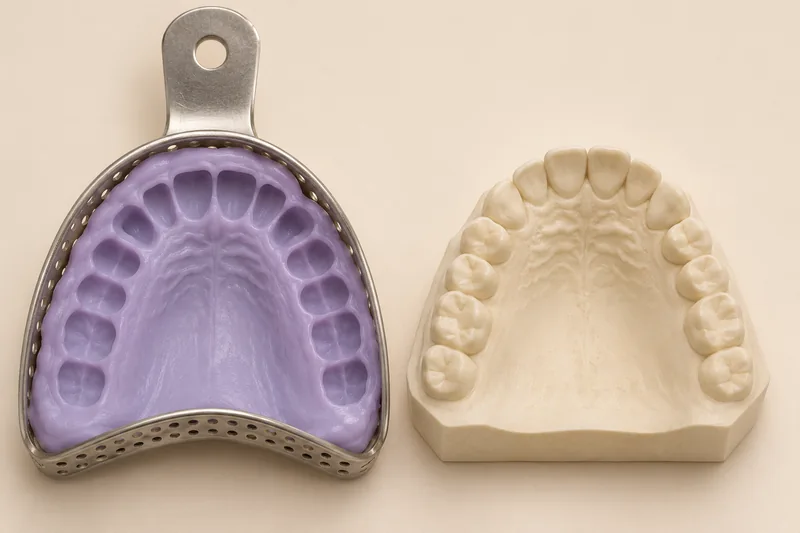
The material is held in a suitable tray against the required surfaces. It records contours, not the inside of teeth or bone.
Examples include alginates and elastomers such as silicones or polyethers. Their handling and dimensional stability differ.
Voids, distortion or incomplete margins can affect subsequent work. The impression may need repeating.
Transfer surfaces for planning and manufacture.
Depends on the task.
Gagging and known intolerances.
Three steps. No audio.
Each scene can also be selected manually.

Silent educational film with German on-screen text and simplified teaching images. Not a patient case or a promised treatment outcome. The full English explanation is available as text.
An impression is a negative mould. The resulting model reproduces the surfaces in a positive form.
Not universally. Scans and conventional impressions capture surfaces differently. Suitability depends on the task, access and tissue conditions.
Mention it beforehand. Positioning, tray choice and the approach can be discussed. A scan is not equally suitable for every task.
To capture the necessary structures adequately. Repeating it can be a quality-control step and does not automatically require altering the tooth.
Editorially suggested question to discuss with Dr Niusha Barahmand Pour:
What information does my restoration require from an impression or scan?
Unsure why an impression is planned? Its purpose and possible methods can be explained beforehand.
Discuss treatment stepsAppointment selection at DoctolibAn impression is a negative mould. The resulting model reproduces the surfaces in a positive form.
Editorial research: . General information, not an individual diagnosis or treatment recommendation. Teaching illustrations are simplified and do not depict a patient case.