Urgency?
Assessment on the day of injury.

An alveolar process fracture affects a segment of tooth-bearing bone. Several teeth may move with that segment. Assessment is urgent and should take place on the day of injury.
For training & practice ↓
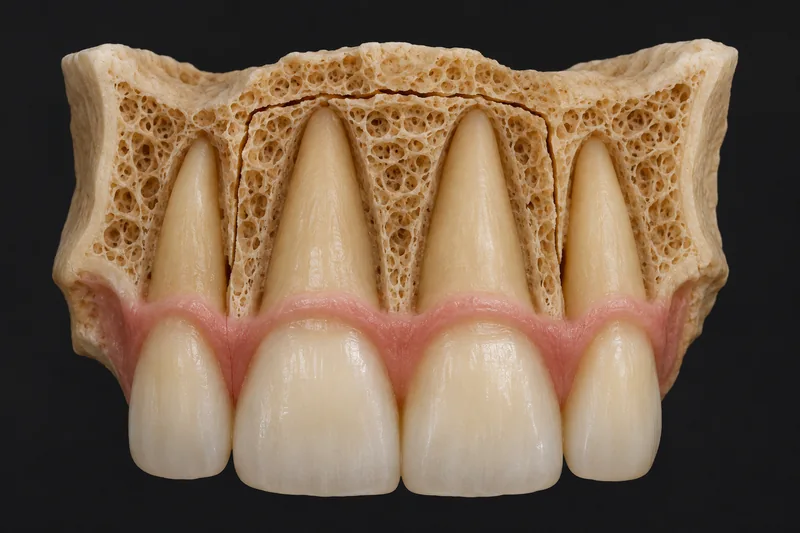
The fracture involves bone around the sockets, rather than only one tooth root.
Examination and appropriate imaging assess displacement and associated injuries.
Clinicians may reposition and stabilise the segment. Injured teeth need follow-up.
The fracture involves bone around the sockets, rather than only one tooth root.
Examination and appropriate imaging assess displacement and associated injuries.
Clinicians may reposition and stabilise the segment. Injured teeth need follow-up.
Assessment on the day of injury.
Do not reposition the segment yourself.
Stabilisation and reviews as indicated.
Three steps. No audio.
Each scene can also be selected manually.

Silent educational film with German on-screen text and simplified teaching images. Not a patient case or a promised treatment outcome. The full English explanation is available as text.
A root fracture affects the tooth; an alveolar fracture affects tooth-bearing bone. Both can coexist.
Do not manipulate the segment. Seek immediate dental or maxillofacial assessment.
Not necessarily. Each tooth and the surrounding bone require assessment.
Breathing difficulty, unconsciousness or serious head/facial injury takes priority as a medical emergency.
Editorially suggested question to discuss with Dr Niusha Barahmand Pour:
Which injured teeth need follow-up?
Contact an available dental practice or hospital immediately after an injury with an altered bite; use emergency dental services outside opening hours.
Call the practice · 0221 669 401 80Telephone contactA root fracture affects the tooth; an alveolar fracture affects tooth-bearing bone. Both can coexist.
Editorial research: . General information, not an individual diagnosis or treatment recommendation. Teaching illustrations are simplified and do not depict a patient case.