Purpose?
Plan contacts outside the mouth.

An articulator is a dental laboratory device that holds upper and lower models in relation to each other. It can approximate certain jaw movements. This helps assess contacts and available space outside the mouth; it does not replace a functional examination of the person.
For training & practice ↓
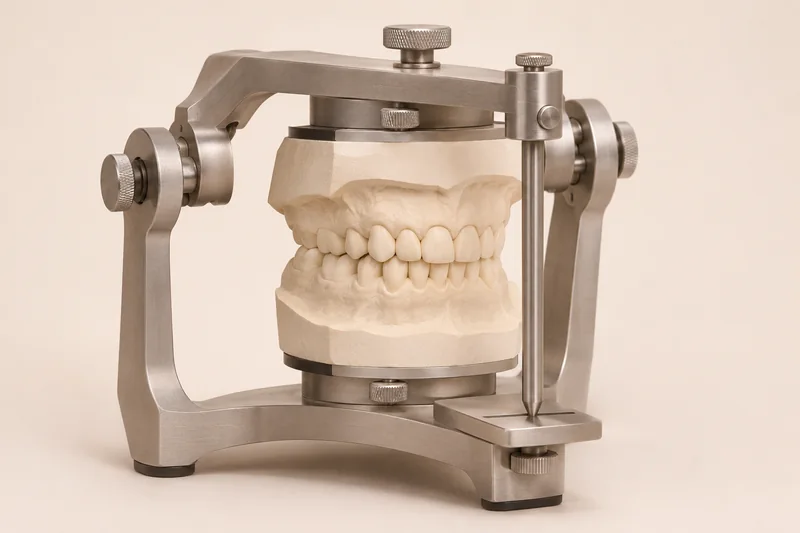
The recorded jaw relationship determines model mounting. Transfer errors can affect contacts seen on the models.
Depending on the device and settings, opening and other movements are approximated. Not all articulators reproduce the same movements.
A contact planned on a model needs clinical checking. Muscles, tissues and individual circumstances are represented only incompletely in the device.
Plan contacts outside the mouth.
Models and appropriate relationship records.
Clinical checking of the restoration.
Three steps. No audio.
Each scene can also be selected manually.

Silent educational film with German on-screen text and simplified teaching images. Not a patient case or a promised treatment outcome. The full English explanation is available as text.
A bite record captures a relationship between the jaws. An articulator uses such information to relate the models.
No. It is a mechanical approximation. Biological movement and symptoms cannot be fully reproduced.
Yes. Software can model these relationships and movements. Input quality and modelling assumptions still determine their usefulness.
No. Planning requirements depend on the type and extent of the restoration. More settings alone do not prove a better result.
Editorially suggested question to discuss with Dr Niusha Barahmand Pour:
Which contacts are planned for my restoration and then checked in my mouth?
Does a restoration's bite feel unfamiliar? Actual contacts should be checked in the mouth.
Discuss bite contactsAppointment selection at DoctolibA bite record captures a relationship between the jaws. An articulator uses such information to relate the models.
Editorial research: . General information, not an individual diagnosis or treatment recommendation. Teaching illustrations are simplified and do not depict a patient case.