Purpose?
Documentation and clear discussion.

Dental photographs record visible teeth, gums and sometimes the face. Comparable images can help explain findings or discuss a plan. A photograph does not replace an examination and is not automatically a prediction of a treatment result.
For training & practice ↓
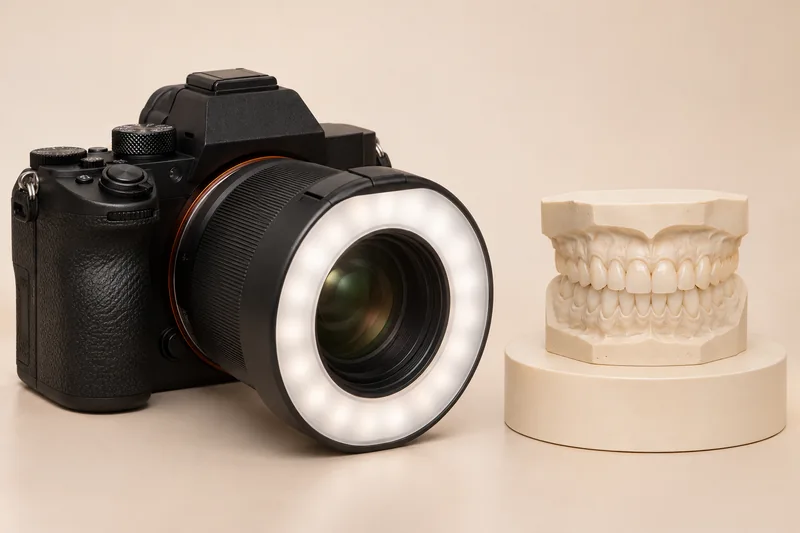
A photograph captures colour, shape and visible surfaces. Lighting, angle and moisture influence their appearance.
Similar views and lighting help comparison. Different photographic conditions can exaggerate apparent changes.
Clinical records and publication are different uses. The purpose and protection of images should be clear before they are taken.
Documentation and clear discussion.
Touch findings and hidden structures.
Purpose, storage and further use.
Three steps. No audio.
Each scene can also be selected manually.

Silent educational film with German on-screen text and simplified teaching images. Not a patient case or a promised treatment outcome. The full English explanation is available as text.
A clinical photograph records one moment. A digital simulation is a planning aid, not a promised result.
No. An ordinary photograph is two-dimensional. An intraoral scan records three-dimensional surface data for particular planning and manufacturing tasks.
No. Hidden areas and the inside of a tooth cannot be assessed reliably this way. An appropriate examination is needed.
No. Recording treatment does not automatically authorize publication. The purpose and permission for further use must be addressed separately.
Editorially suggested question to discuss with Dr Niusha Barahmand Pour:
What can my photographs show, and what needs an additional examination?
Unsure what a planning photograph shows? Its visible details can be discussed together.
Discuss the planAppointment selection at DoctolibA clinical photograph records one moment. A digital simulation is a planning aid, not a promised result.
Editorial research: . General information, not an individual diagnosis or treatment recommendation. Teaching illustrations are simplified and do not depict a patient case.