Who may benefit?
People with particular hard-to-reach areas.

A single-tuft toothbrush has a very small bundle of bristles. It can target individual surfaces that are difficult to reach, such as behind the last tooth or beside fixed appliances. It supplements other oral care rather than replacing systematic cleaning of all teeth.
For training & practice ↓
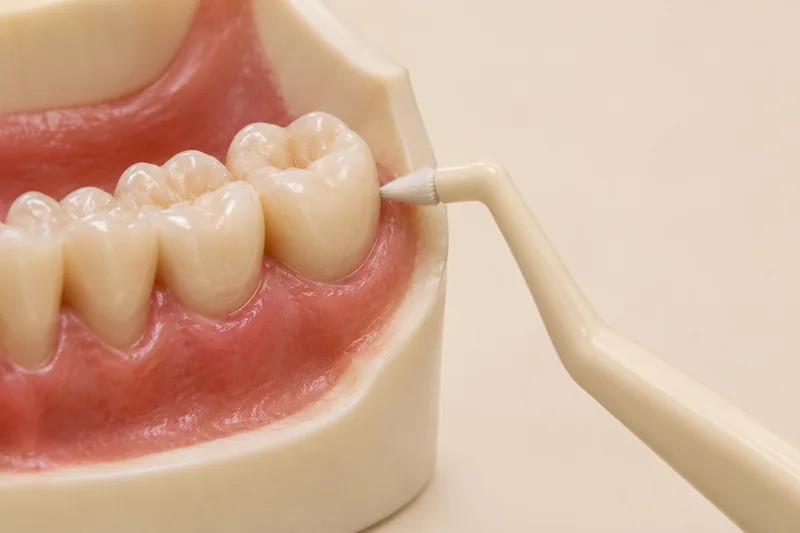
A small head may help where a larger one cannot sit well. The relevant surface can be demonstrated in your own mouth.
Guide the bristles along the tooth surface. Heavy pressure or poking the gums does not improve cleaning.
The single-tuft brush complements ordinary brushing and suitable interdental cleaning. Not everyone needs every cleaning aid.
People with particular hard-to-reach areas.
With demonstrated technique and light pressure.
Cleaning the other teeth and between teeth.
Three steps. No audio.
Each scene can also be selected manually.

Silent educational film with German on-screen text and simplified teaching images. Not a patient case or a promised treatment outcome. The full English explanation is available as text.
Single-tuft and interdental brushes have different tasks. Force does not make a narrow space suitable for a brush.
No. A single-tuft brush approaches a surface from the outside. An interdental brush is shaped to pass through a suitably sized space between teeth.
It may help at difficult areas. The appropriate brush and technique depend on the appliance and the person's cleaning access.
Do not respond by pressing harder. Recurrent bleeding, pain or poor access should be checked and the technique adapted.
Editorially suggested question to discuss with Dr Niusha Barahmand Pour:
Which areas am I not reaching well with my current brush?
Is one area repeatedly missed during brushing? Suitable aids can be selected personally.
Discuss oral careAppointment selection at DoctolibSingle-tuft and interdental brushes have different tasks. Force does not make a narrow space suitable for a brush.
Editorial research: . General information, not an individual diagnosis or treatment recommendation. Teaching illustrations are simplified and do not depict a patient case.