Purpose?
Assessment of the root division.

A furcation probe is a curved examination instrument for the root division of multi-rooted teeth. It assesses whether and how far the space between roots can be entered from the gingival margin. The Nabers probe is a familiar example.
For training & practice ↓
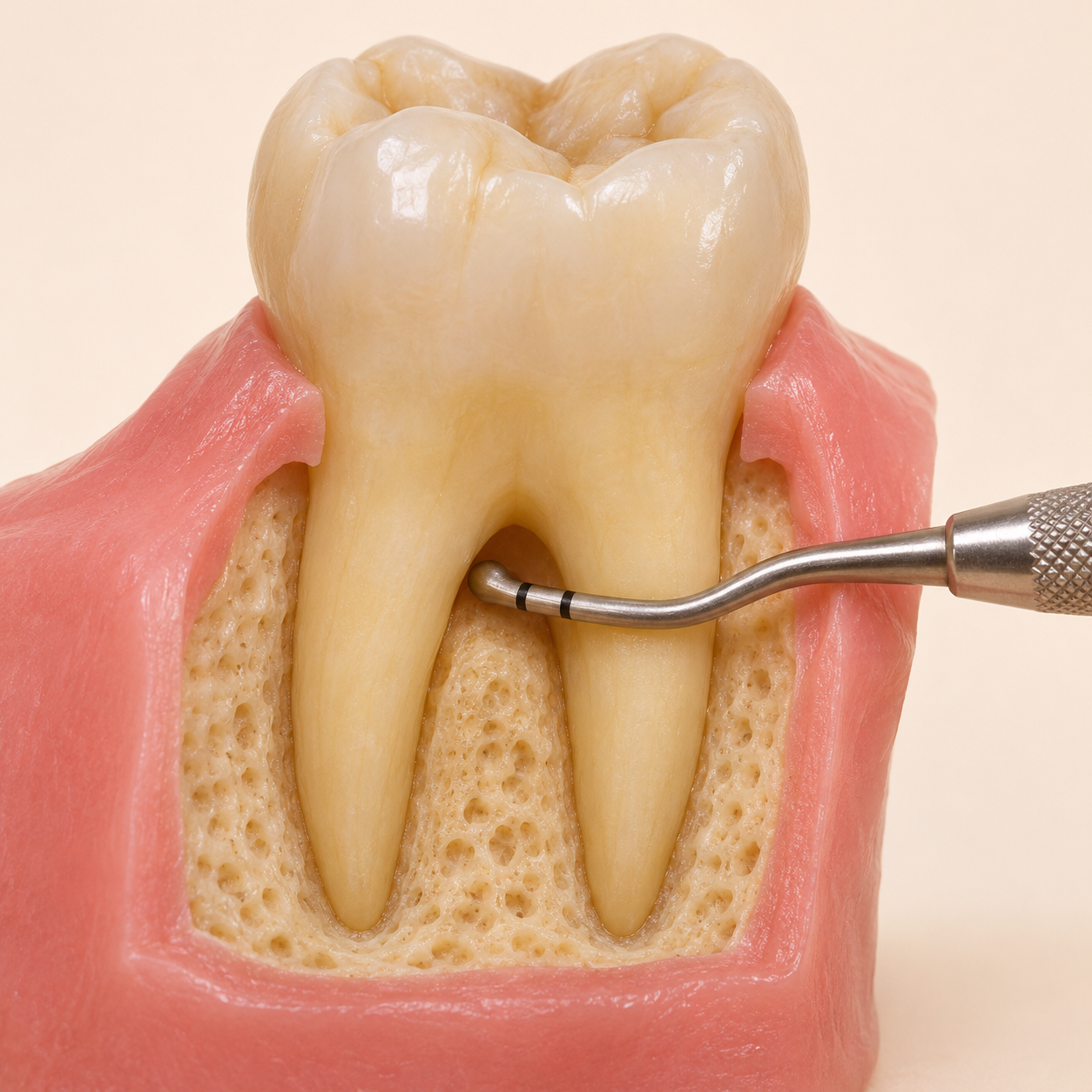
Many back teeth have more than one root. Their division is called the furcation. A curved probe can follow access to this region better than a straight measuring probe.
The examination records the sideways extent of an accessible defect. This differs from vertical pocket depth measured along an individual root.
Narrow root spaces and difficult entrances can make probing challenging. Measurements, other clinical findings and justified imaging are interpreted together.
Assessment of the root division.
No.
No; it is one part of the findings.
Three steps. No audio.
Each scene can also be selected manually.

Silent educational film with German on-screen text and simplified teaching images. Not a patient case or a promised treatment outcome. The full English explanation is available as text.
Pocket depth is measured alongside a tooth. Furcation involvement concerns the region between several roots. Both may be important for the same tooth.
Its main role is examination and measurement. It is not intended for home cleaning.
No. The decision depends on the overall findings, maintainability, cleaning and treatment options.
No. Superimposition can obscure the root division. Imaging supplements clinical examination.
You can bring this question to your appointment:
How extensive is the finding between the roots, and what does it mean for retaining and cleaning this tooth?
Discuss your individual findings and whether a referral is appropriate.
Discuss your findingsAppointment selection at DoctolibPocket depth is measured alongside a tooth. Furcation involvement concerns the region between several roots. Both may be important for the same tooth.
Editorial research: . General information, not an individual diagnosis or treatment recommendation. Teaching illustrations are simplified and do not depict a patient case.