What is assessed?
Breath odour and, where appropriate, selected gases.

Breath odour assessment establishes whether exhaled air has an unusual smell and how strong it is. It may combine a structured assessment by an examiner with instruments that measure selected gases. Findings are interpreted alongside symptoms and the oral examination; a single reading does not explain the cause.
For training & practice ↓
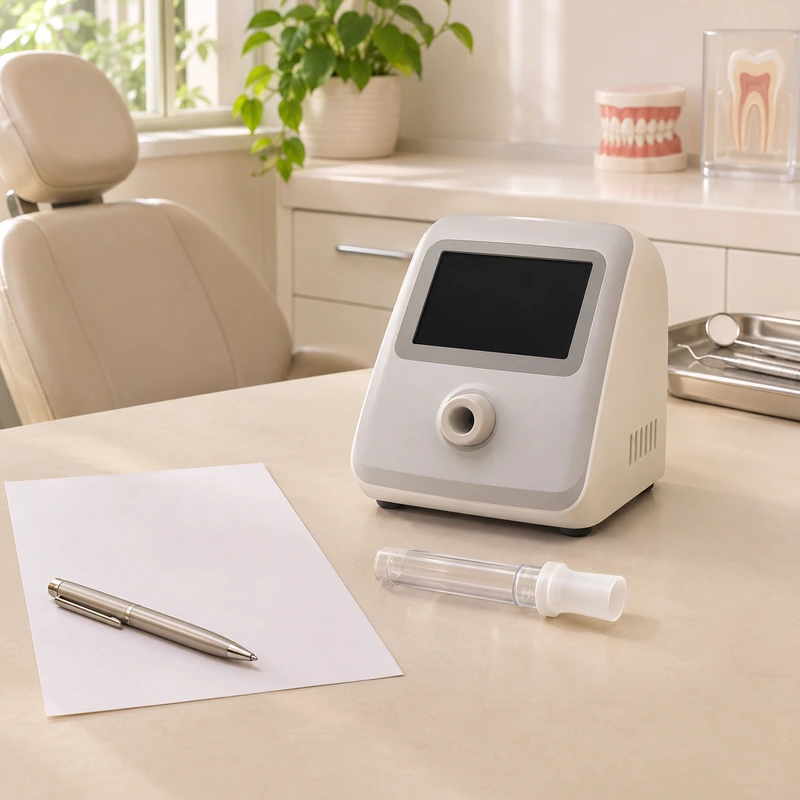
An organoleptic examination rates breath odour using a defined approach. Your own perception of your breath is not a reliable substitute for this assessment.
Some instruments detect selected volatile sulphur compounds. They do not necessarily detect every substance that smells; the method and examination conditions matter.
The tongue, gums, teeth and saliva are assessed as well. Together, these findings guide treatment of a cause or further medical investigation when appropriate.
Breath odour and, where appropriate, selected gases.
No. It does not replace structured assessment.
Investigation and planning directed at the cause.
Three steps. No audio.
Each scene can also be selected manually.

Silent educational film with German on-screen text and simplified teaching images. Not a patient case or a promised treatment outcome. The full English explanation is available as text.
Breath assessment concerns smell or selected gases. Saliva tests assess other properties, such as flow or buffering capacity, and do not replace odour assessment.
No. Devices differ in the gases they detect. A result is considered alongside professional odour assessment, symptoms and the clinical examination.
Ask the examining service for its specific instructions. Food, smoking and products that mask odours may affect testing conditions. Do not stop prescribed medicines yourself.
Not on its own. Many causes are within the mouth. History and examination determine whether further medical investigation is appropriate.
You can bring this question to your appointment:
Which method was used, and what does its result mean alongside my oral examination?
An individual examination can clarify the findings and suitable next steps.
Arrange an assessmentAppointment selection at DoctolibBreath assessment concerns smell or selected gases. Saliva tests assess other properties, such as flow or buffering capacity, and do not replace odour assessment.
Editorial research: . General information, not an individual diagnosis or treatment recommendation. Teaching illustrations are simplified and do not depict a patient case.
If you turn this on, this website stores which guides you open, separately from advertising preferences. The markers expire after a fixed 30-day period from activation. The list is not sent to us by this feature. You can turn it off here and delete the markers.
Other people using the same browser profile can also see the markers. German and English versions share one marker. Expired entries are removed the next time you open a page with this feature; deleting browser data may remove them earlier. “Viewed” means opened, not read or completed.