Purpose?
Support healing and augmentation.

Bone substitutes support healing in a bony defect. They have different origins and are not automatically the patient’s own bone. Selection depends on the defect and intended restoration.
For training & practice ↓
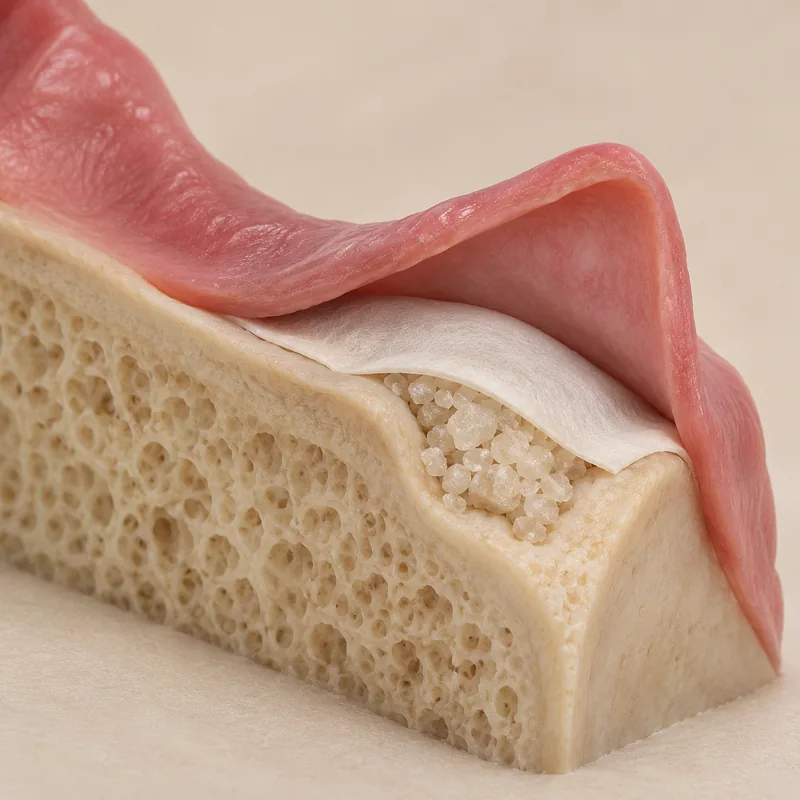
Materials can be human-derived, animal-derived or synthetic. The patient’s own bone is a separate category.
Many act as a scaffold for bone formation. Breakdown and remodelling vary with the material.
Origin, benefits, risks and other options belong in the consent discussion. Personal concerns can be raised before treatment.
Support healing and augmentation.
Varies.
Material, risks and options.
Three steps. No audio.
Each scene can also be selected manually.

Silent educational film with German on-screen text and simplified teaching images. Not a patient case or a promised treatment outcome. The full English explanation is available below.
Materials can be human-derived, animal-derived or synthetic. The patient’s own bone is a separate category.
Many act as a scaffold for bone formation. Breakdown and remodelling vary with the material.
Origin, benefits, risks and other options belong in the consent discussion. Personal concerns can be raised before treatment.
Supporting material is not the same as newly formed, vascularised bone.
No. Synthetic is one possible origin.
Not necessarily. Residual material can remain depending on the product and course.
No universal superiority follows from its category. Selection should fit the situation.
Editorially suggested question to discuss with Dr Niusha Barahmand Pour:
Which material is proposed and why does it fit the findings?
Knowing the proposed material helps support an informed decision.
Discuss graft materialsAppointment selection at DoctolibSupporting material is not the same as newly formed, vascularised bone.
Editorial research: . General information, not an individual diagnosis or treatment recommendation. Teaching illustrations are simplified and do not depict a patient case.