Principle?
Protected healing space.

Guided bone regeneration, or GBR, uses a barrier to protect an area intended for bone healing. It helps maintain space and separate faster-growing soft tissue. Bone or substitute material is often used as well.
For training & practice ↓
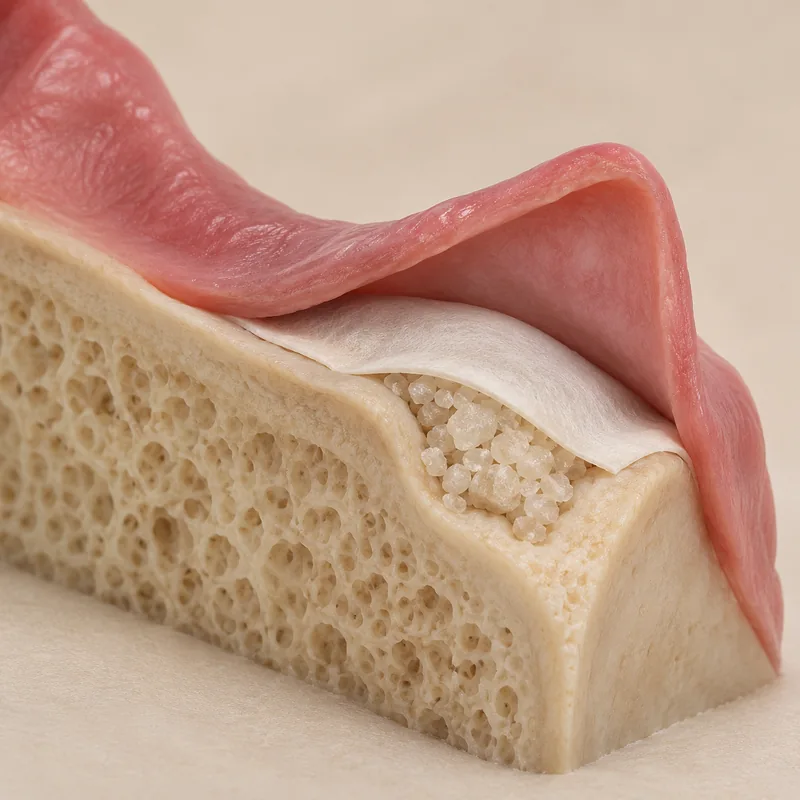
The defect and intended restoration are assessed first.
A membrane or other barrier covers the site. Material and stabilisation depend on the defect.
The wound requires follow-up. Exposure, infection or insufficient augmentation may change the plan.
Protected healing space.
Chosen for the defect.
Check wound and augmentation.
Three steps. No audio.
Each scene can also be selected manually.

Silent educational film with German on-screen text and simplified teaching images. Not a patient case or a promised treatment outcome. The full English explanation is available below.
The defect and intended restoration are assessed first.
A membrane or other barrier covers the site. Material and stabilisation depend on the defect.
The wound requires follow-up. Exposure, infection or insufficient augmentation may change the plan.
GBR concerns bone regeneration. GTR refers to guided regeneration of periodontal tissues.
No. Resorbable and non-resorbable types exist. The latter may require planned removal.
No. The defect and healing process influence the result.
No. Sinus augmentation concerns the sinus-floor region; GBR describes a barrier principle.
Editorially suggested question to discuss with Dr Niusha Barahmand Pour:
Why is a barrier proposed here and what follow-up will it need?
An augmentation plan should explain risks and possible further steps.
Discuss augmentation planningAppointment selection at DoctolibGBR concerns bone regeneration. GTR refers to guided regeneration of periodontal tissues.
Editorial research: . General information, not an individual diagnosis or treatment recommendation. Teaching illustrations are simplified and do not depict a patient case.