When?
Selected teeth close to the nerve.

A coronectomy removes the crown of a lower wisdom tooth while deliberately retaining its roots. For selected teeth close to the lower-jaw nerve, this may reduce nerve-injury risk. It is not suitable for every tooth.
For training & practice ↓
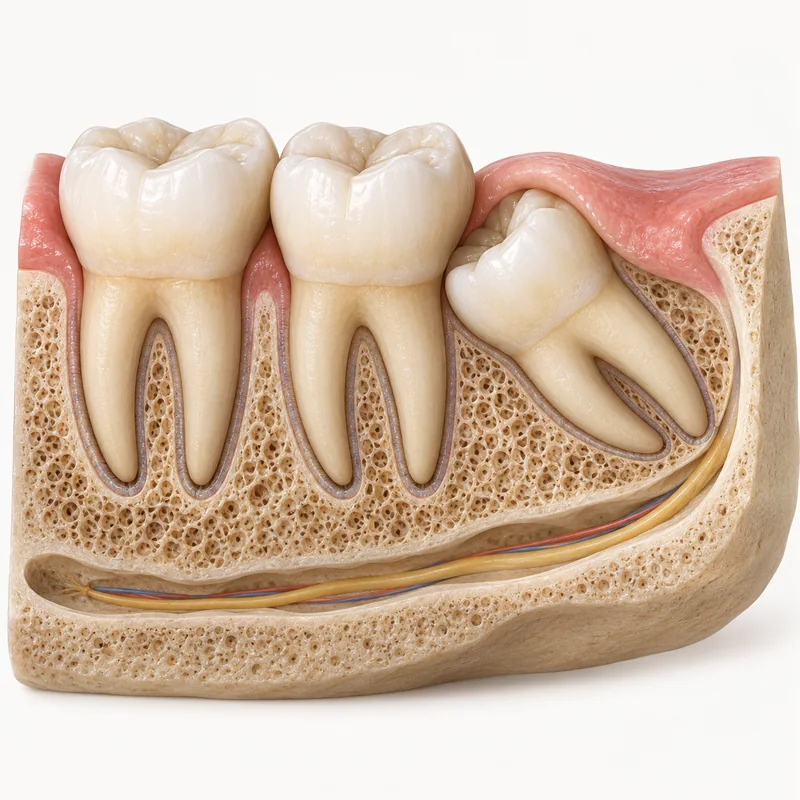
Imaging and examination show the relation of roots to the mandibular canal.
Roots are intentionally retained when suitable.
Roots may migrate or cause later problems; further treatment is sometimes needed.
Imaging and examination show the relation of roots to the mandibular canal.
Roots are intentionally retained when suitable.
Roots may migrate or cause later problems; further treatment is sometimes needed.
Selected teeth close to the nerve.
No.
Planned reviews.
Three steps. No audio.
Each scene can also be selected manually.

Silent educational film with German on-screen text and simplified teaching images. Not a patient case or a promised treatment outcome. The full English explanation is available as text.
Coronectomy is surgery, not fitting a dental crown.
No. It is a planned procedure requiring consent and follow-up.
No. Risk may be reduced in suitable cases, not eliminated.
These findings may make the procedure unsuitable and require individual surgical assessment.
Editorially suggested question to discuss with Dr Niusha Barahmand Pour:
How close are the roots to the nerve, and what are the options?
Discuss your wisdom-tooth findings and whether surgical referral is appropriate.
Discuss a wisdom toothAppointment selection at DoctolibCoronectomy is surgery, not fitting a dental crown.
Editorial research: . General information, not an individual diagnosis or treatment recommendation. Teaching illustrations are simplified and do not depict a patient case.