Should I pull a white piece from the socket?
Do not remove packing yourself. Ask which material was used.

Local haemostatic materials help control bleeding at the wound. After an extraction a clinician may place an absorbable collagen sponge or oxidised cellulose in the socket. Pressure and, where appropriate, sutures complement these measures.
For training & practice ↓
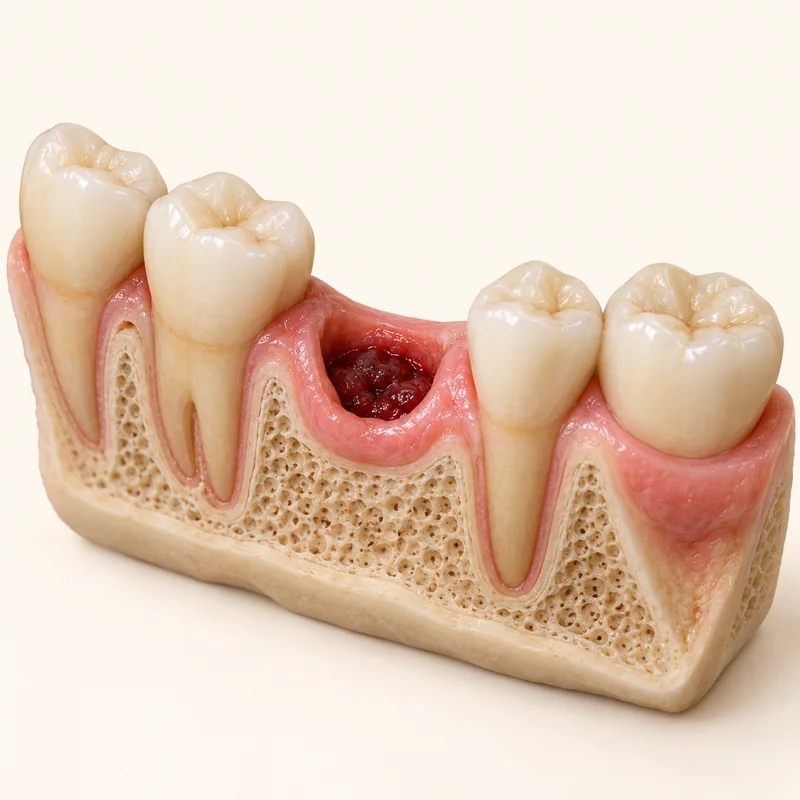
A blood clot normally forms in the socket after extraction. The dental team checks that bleeding is controlled before discharge.
A suitable dressing can support formation of a clot locally. The material and any additional measures depend on the wound and individual bleeding risk.
Bite gauze sits over the wound. If bleeding restarts, steady pressure as instructed by the dental team may help. This pad is separate from the packing placed inside.
Do not remove packing yourself. Ask which material was used.
Saliva can be lightly bloodstained after extraction. Continuing active flow needs different assessment.
Do not change medication on your own.
Three steps. No audio.
Each scene can also be selected manually.

Silent film with English on-screen text and simplified teaching images.
This applies pressure externally. A local haemostatic material can be placed inside the socket.
Some are absorbable. For other materials or dressings, the team will advise on review or removal.
Contact a dentist or urgent service immediately if active bleeding persists after advised pressure or the mouth fills quickly with blood.
Include antiplatelet medicines and the time of the last dose. The treating team coordinates any individual adjustments.
Ask which material was placed and which number to call if bleeding returns.
What should stay in the socket and when should the bite gauze be removed?
Call the treating dentist or emergency dental service for ongoing bleeding.
Call the practice · 0221 669 401 80Telephone contactBleeding still needs checking before discharge even if a haemostatic material has been used.
Editorial research: . General information, not an individual diagnosis or treatment recommendation. Teaching illustrations are simplified and do not depict a patient case.
If you turn this on, this website stores which guides you open, separately from advertising preferences. The markers expire after a fixed 30-day period from activation. The list is not sent to us by this feature. You can turn it off here and delete the markers.
Other people using the same browser profile can also see the markers. German and English versions share one marker. Expired entries are removed the next time you open a page with this feature; deleting browser data may remove them earlier. “Viewed” means opened, not read or completed.