Where?
Between the mouth and maxillary sinus.

An oro-antral communication is an opening between the mouth and the maxillary sinus. It can occur after removal of an upper back tooth whose roots lay close to the sinus floor. Prompt dental or surgical assessment determines whether treatment or closure is needed.
For training & practice ↓
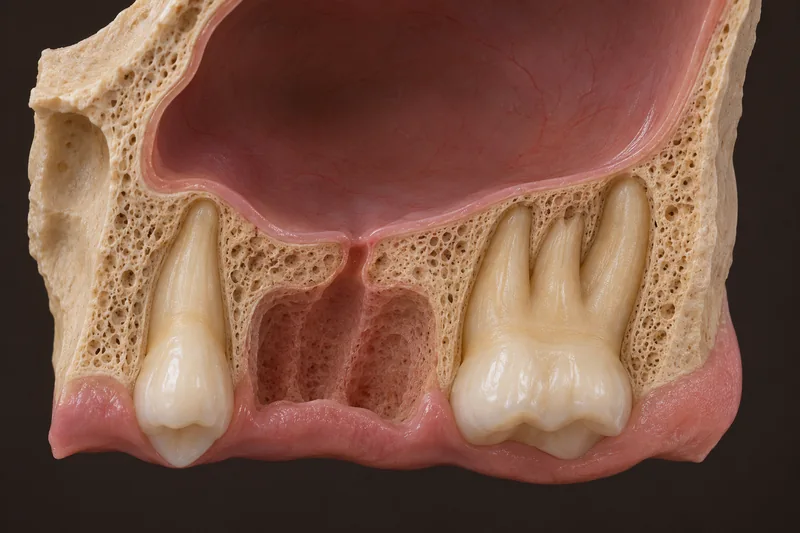
Upper back teeth and the maxillary sinus often lie close together. Tissue normally separates the mouth from the air-filled sinus.
A procedure may leave an opening. Fluid passing towards the nose or air moving through the wound can be noticed.
Contact the treating practice directly if suspected. Do not test it by forceful nose blowing; pressure precautions and aftercare depend on the findings.
Between the mouth and maxillary sinus.
Do not test by nose blowing.
Contact the treating practice the same day.
Three steps. No audio.
Each scene can also be selected manually.

Silent educational film with German on-screen text and simplified teaching images. Not a patient case or a promised treatment outcome. The full English explanation is available below.
Upper back teeth and the maxillary sinus often lie close together. Tissue normally separates the mouth from the air-filled sinus.
A procedure may leave an opening. Fluid passing towards the nose or air moving through the wound can be noticed.
Contact the treating practice directly if suspected. Do not test it by forceful nose blowing; pressure precautions and aftercare depend on the findings.
A communication is an anatomical opening. Sinusitis is inflammation of the sinus. They may coexist but require separate assessment.
No. Size, timing, tissue condition and inflammation influence management; some openings require closure.
No. Self-testing can strain the wound. A clinician should assess it.
A persistent, lined connection may be called an oro-antral fistula. A fresh opening and an established fistula are not identical.
Editorially suggested question to discuss with Dr Niusha Barahmand Pour:
Is there a communication with the sinus, and what wound care is needed now?
For a new concern following treatment, call the treating practice first. If it is unavailable, contact the dental emergency service.
Call the practice · 0221 669 401 80Telephone contactA communication is an anatomical opening. Sinusitis is inflammation of the sinus. They may coexist but require separate assessment.
Editorial research: . General information, not an individual diagnosis or treatment recommendation. Teaching illustrations are simplified and do not depict a patient case.