
What is noticeable?
Cracks, redness or crusting at the mouth corners, sometimes painful.

Angular cheilitis causes painful cracks at one or both mouth corners. Moisture, irritation and other factors often interact. Fungi or bacteria may contribute, but are not always the sole cause.
For dental trainees & teams
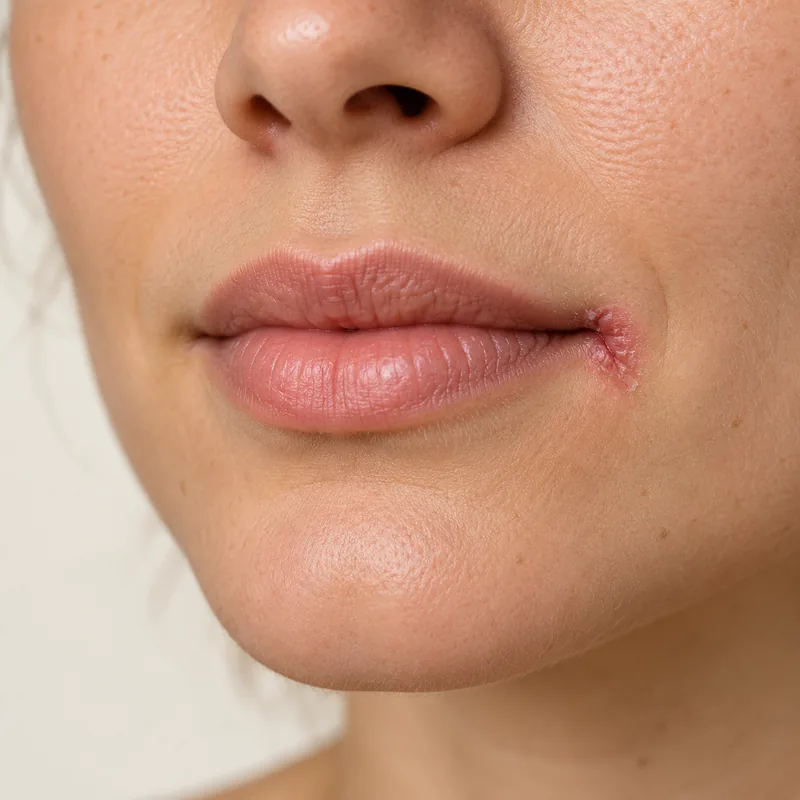
Saliva and repeated licking can soften and irritate the skin at the corners. Redness, small cracks or crusts may develop.
Denture fit, skin conditions or certain deficiencies may play a part. A cracked corner alone does not prove vitamin deficiency.
Recurring or persistent cracks warrant examination. Care, denture adjustment or targeted medicines depend on the findings.
Cracks, redness or crusting at the mouth corners, sometimes painful.
Anyone with recurrent, persistent or spreading changes.
Skin, oral tissues, habits and, where relevant, denture fit or suspected deficiencies.
Three steps. Straight to the point.
Explanations are also shown on screen.

Silent film in German · English explanations in the three views above
A fissure is a crack. A blister is a different skin change; shape alone still does not provide a reliable self-diagnosis.
No. Irritation and other causes are possible; antifungal treatment is not automatically the answer.
No. Herpes is a different condition. Similar discomfort may require different treatment.
Not automatically. Investigate a deficiency when there is a reason to suspect one, rather than taking supplements indiscriminately.
A question to discuss with Dr. med. dent. Niusha Barahmand Pour:
What part could irritation, oral tissues and any dentures play?
Individual findings are the basis for discussing appropriate next steps.
Repeated cracking is a reason to look for contributing factors.
Have mouth corners assessedChoose an appointment on DoctolibBuild on the simple explanation with clinical terms, key distinctions and a knowledge question.
Angular cheilitis describes a finding, not automatically the organism causing it.
Editorial research: 23 October 2026. This explanation covers general principles and does not replace a personal examination. Suitable treatment is discussed following individual assessment.