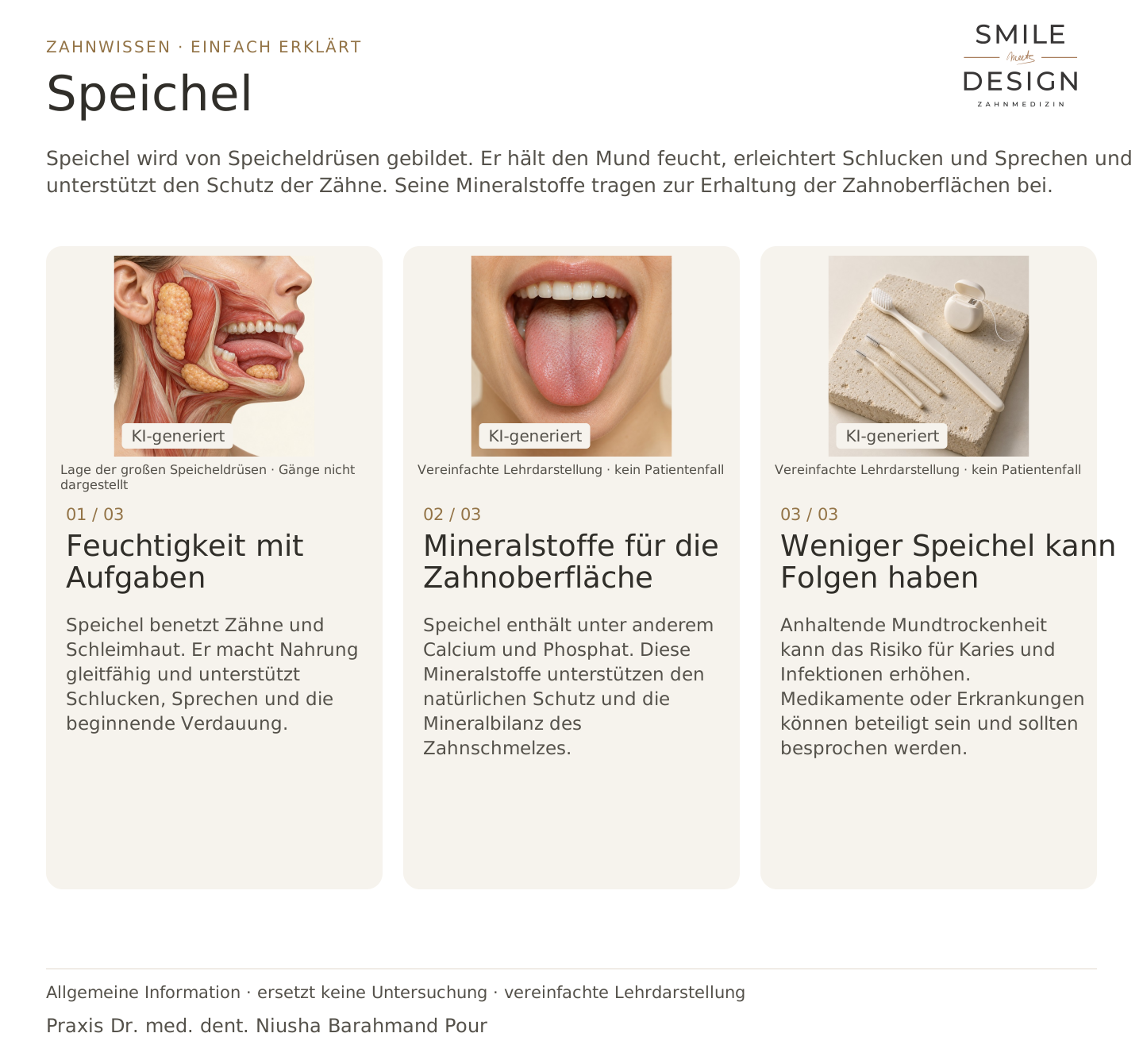
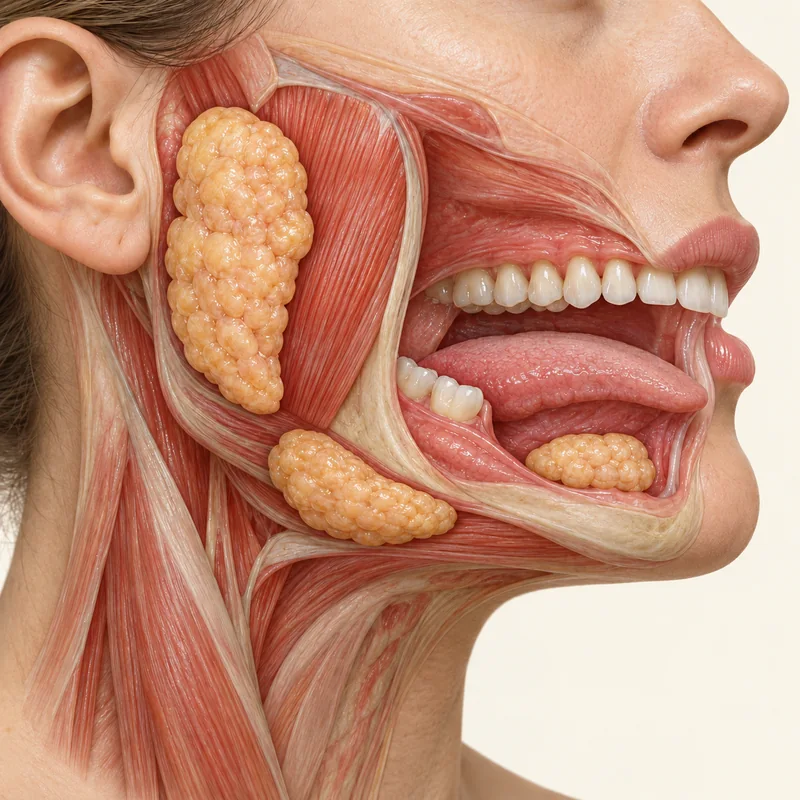
Where does saliva come from?
From major and minor salivary glands, which release it into the mouth.

Saliva is produced by salivary glands. It keeps the mouth moist, helps with swallowing and speaking, and supports tooth protection. Its minerals help maintain tooth surfaces.
For dental trainees & teams
Saliva coats teeth and the oral lining. It moistens food and supports swallowing, speaking and the first stages of digestion.
Saliva contains calcium and phosphate, among other substances. These minerals support the protection and mineral balance of enamel.
Persistent dry mouth can increase the risk of decay and infections. Medicines or health conditions may contribute and should be discussed.
From major and minor salivary glands, which release it into the mouth.
It supports moisture, swallowing and tooth protection through its minerals.
Persistent dryness should prompt a discussion of possible causes and suitable measures.
Three steps. Straight to the point.
Explanations are also shown on screen.

Silent film in German · English explanations in the three views above
Saliva is a protective body fluid. Dry mouth is a symptom whose cause can be investigated.
In several major and many minor salivary glands. It enters the mouth through ducts.
Persistent dryness should not simply be attributed to age. Medicines or health conditions often contribute.
Not on your own. Possible links and changes to treatment need medical or dental assessment.
A question to discuss with Dr. med. dent. Niusha Barahmand Pour:
Could my dry mouth affect my teeth or oral lining?
The individual starting point comes before selecting measures.
Persistent dry mouth is worth discussing to consider possible causes.
Discuss dry mouthChoose an appointment on DoctolibBuild on the simple explanation with clinical terms, key distinctions and a knowledge question.
Saliva is a protective fluid; persistent dry mouth is a symptom with possible underlying causes.
Editorial research: 23 October 2026. This explanation covers general principles and does not replace a personal examination. Suitable treatment is discussed following individual assessment.