What is a typical feature?
Brief, severe, recurring attacks of facial pain.

Trigeminal neuralgia typically causes short, severe, shooting attacks in areas supplied by the trigeminal nerve. Pain may be felt in the cheek, jaw or teeth. Examination is needed to distinguish it from a dental cause.
For training & practice ↓
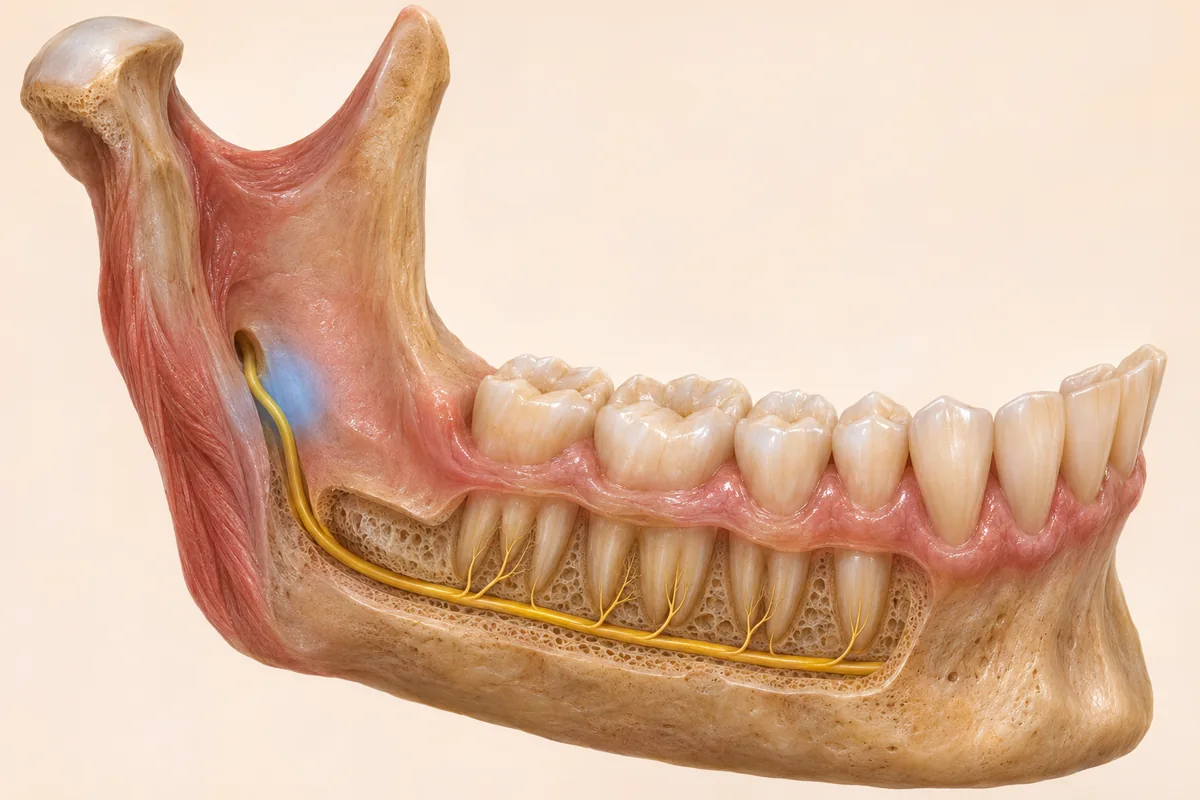
The trigeminal nerve carries sensation from much of the face. Its branches include those supplying the upper and lower jaws. Jaw pain alone therefore does not prove that a tooth is diseased.
In the typical form, attacks last from seconds to around two minutes. Touch, chewing or toothbrushing may trigger them. Persistent pain can also occur; the pattern alone does not establish the diagnosis.
A dental examination looks for findings that could explain the pain. Suspected neuralgia calls for medical or neurological assessment.
Brief, severe, recurring attacks of facial pain.
Dental causes, pain history and neurological causes when indicated.
Describe triggers, duration, frequency and the affected side.
Three steps. No audio.
Each scene can also be selected manually.

Silent educational film with German on-screen text and simplified teaching images. Not a patient case or a promised treatment outcome. The full English explanation is available as text.
Inflammation within a tooth and trigeminal nerve pain are different causes. Pain location and intensity alone cannot reliably distinguish them.
Extracting a tooth does not treat established trigeminal neuralgia. Dental treatment needs a corresponding dental finding; unexplained facial pain should be assessed before an irreversible procedure.
No. The history, examination and other possible causes must be considered together. Other conditions can also cause facial pain.
Medical treatment may include specific medicines and, in selected cases, procedures. Choice and monitoring depend on the cause, benefit and adverse effects.
You can bring this question to your appointment:
Do my dental findings explain these attacks, or do I need neurological assessment?
Recurring jaw or dental pain deserves an individual assessment.
Discuss your findingsAppointment selection at DoctolibInflammation within a tooth and trigeminal nerve pain are different causes. Pain location and intensity alone cannot reliably distinguish them.
Editorial research: . General information, not an individual diagnosis or treatment recommendation. Teaching illustrations are simplified and do not depict a patient case.