What is the chart for?
Clear documentation of teeth and findings.

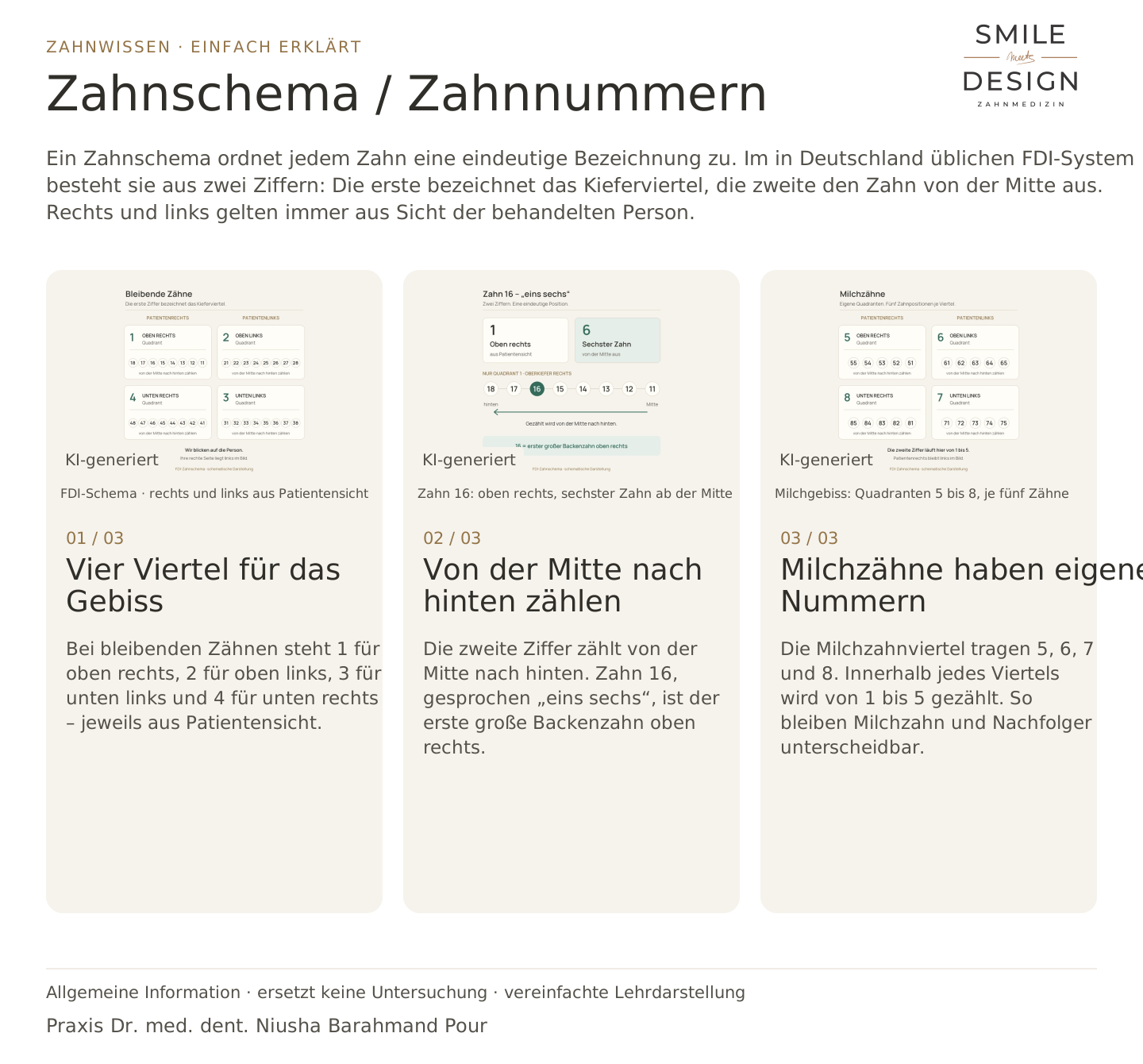
A dental chart gives each tooth an identifiable label. In the FDI system commonly used in Germany, there are two digits: the first identifies the quarter of the mouth and the second counts from the centre. Right and left always refer to the patient’s own sides.
For dental trainees & teams
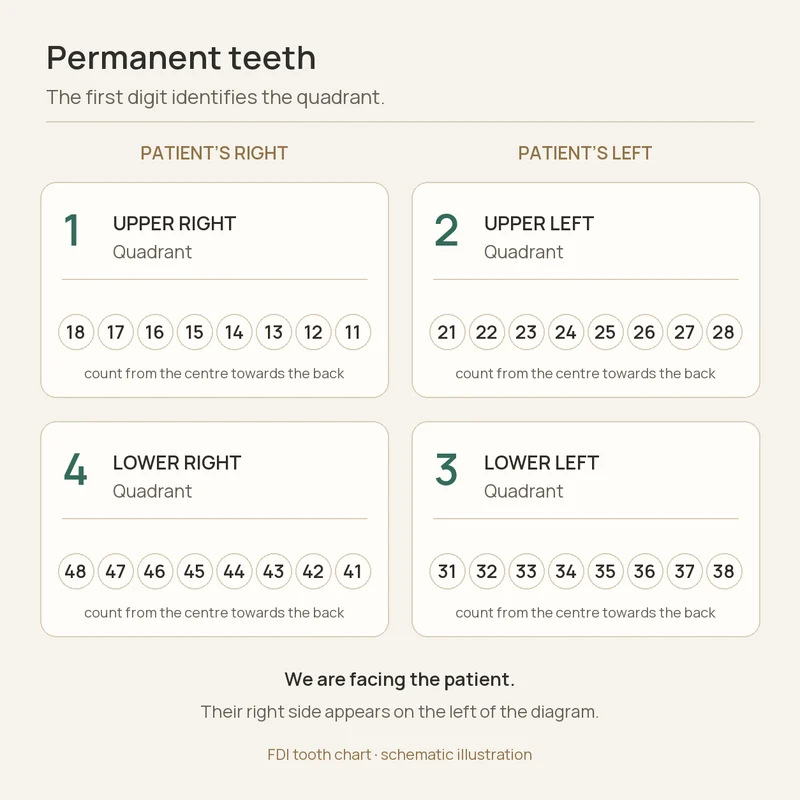
For permanent teeth, 1 means upper right, 2 upper left, 3 lower left and 4 lower right, always from the patient’s perspective.
The second digit counts from the centre backwards. Tooth 16, read “one six”, is the first permanent molar on the upper right.
The baby-tooth quadrants use 5, 6, 7 and 8. Each quarter counts from 1 to 5, keeping baby teeth and their successors distinct.
Clear documentation of teeth and findings.
First the quarter of the mouth, then the position from the centre.
Always the patient’s own sides.
Three steps. Straight to the point.
Explanations are also shown on screen.

Silent film in German · English explanations in the three views above
A tooth number identifies a location. A billing code identifies a charged service. Both may appear on an invoice and do not mean the same thing.
No. The FDI digits are interpreted separately: 1 means upper right and the second 1 means central incisor. It is read “one one”.
A chart is often displayed as if looking at a person facing you, so their right side appears on the left of the image. Patient-side labels are what matter.
FDI is widely used internationally but is not the only system. Records from other countries may use another notation. If uncertain, clarify both the tooth and the numbering system.
A question to discuss with Dr. med. dent. Niusha Barahmand Pour:
Can we match the tooth numbers on the chart to my examination findings together?
Symptoms, examination findings and personal wishes form the basis of individual treatment planning.
Matching tooth numbers to the mouth can make a report or treatment plan clearer.
Discuss questions about your findingsChoose an appointment on DoctolibBuild on the simple explanation with clinical terms, key distinctions and a knowledge question.
The first digit separates location and tooth set: permanent quadrants 1–4, primary quadrants 5–8. The second indicates position from the midline.
Editorial research: 23 October 2026. This explanation covers general principles and does not replace a personal examination. Suitable treatment is discussed following individual assessment.