Normal?
A finely textured tongue surface is generally normal.

Tongue papillae are small projections of the lining on the upper surface of the tongue. They give it its characteristic texture. Some contain taste buds; others mainly support touch and moving food.
For training & practice ↓
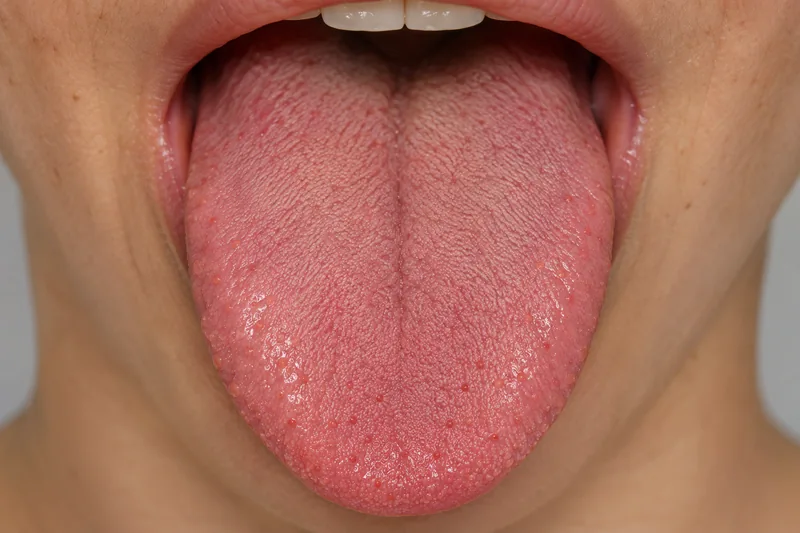
A tongue is normally not completely smooth. Numerous small papillae shape its surface. The illustration shows an example of this texture; it is not a benchmark for assessing your own tongue.
Filiform papillae have mechanical roles and contain no taste buds. Fungiform, foliate and circumvallate papillae may contain taste buds. These microscopic sensory organs are not the visible bumps and cannot be seen in the illustration.
Sweet only at the front and bitter only at the back: that rigid division is incorrect. Taste is perceived at different suitable sites. New painful or persistent changes still deserve examination.
A finely textured tongue surface is generally normal.
The surface, not individual taste buds.
For new painful or persistent changes.
Three steps. No audio.
Each scene can also be selected manually.

Silent educational film with German on-screen text and simplified teaching images. Not a patient case or a promised treatment outcome. The full English explanation is available as text.
Papillae are part of the lining. Surface coating is different; removing it should not injure the underlying tissue.
No. A papilla is a projection of the lining. Taste buds are small groups of sensory cells in the epithelium of certain papillae; filiform papillae contain none.
No. Even identifying papillae from images is challenging. A photograph is not a reliable individual taste test.
No. They are part of the tongue, not coating. New painful or persistent changes deserve examination rather than stronger scraping.
Editorially suggested question to discuss with Dr Niusha Barahmand Pour:
Is the noticeable area part of the normal surface texture, or a change that needs assessment?
A new area on the tongue is painful or remains changed? We can examine the oral lining and discuss the next steps.
Have a tongue change assessedAppointment selection at DoctolibVisible papillae, microscopic taste buds and taste qualities are three different levels. A coloured map with exclusive taste zones would be misleading.
Editorial research: . General information, not an individual diagnosis or treatment recommendation. Teaching illustrations are simplified and do not depict a patient case.