
Dental insights · New developments
AI in dental X-rays: what it can detect – and what it cannot
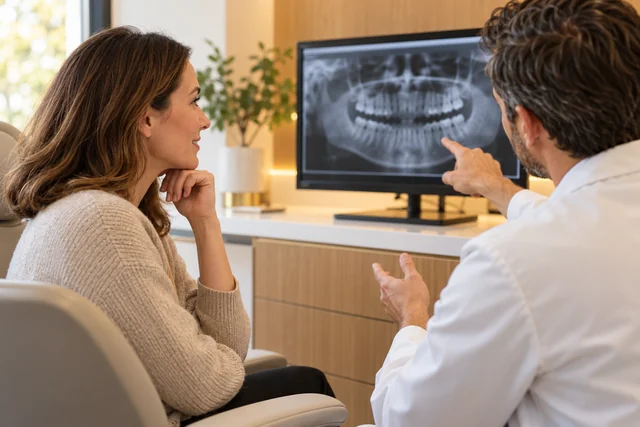
Coloured boxes or markers appear on an X-ray. Does that mean the software has already diagnosed a disease? Some AI programs help identify areas that may deserve attention on dental images. But what this means for treatment cannot be decided from the screen alone. These five points help distinguish the technology's capabilities from its limitations.
Published on
 AI-generated
01 The software draws attention to specific areas
Depending on the product, AI may flag possible decay or areas of concern around root tips. Some programs also support measurements of the bone around teeth. One product documented by the US Food and Drug Administration explicitly lists these tasks as support for interpreting two-dimensional X-rays.
This is an example with defined image types and patient groups, not a blanket clearance for all software. US clearance also does not replace European assessment. What matters is the specific task the program being used is intended to perform.
02 A marker may be right or wrong
AI can miss abnormalities. It can also highlight an area that turns out to be normal when assessed by a dental professional. The whole image therefore needs to be reviewed, not just the highlighted areas. An image without markers does not reliably rule out disease either.
03 Image findings and the examination belong together
A diagnosis also depends on symptoms, medical and dental history, and an examination of the mouth. This context helps establish what an abnormality means and whether action is needed. The image-assistance systems described here do not make treatment decisions independently.
For example, a highlighted area of early decay does not automatically mean drilling is needed. Depending on the findings, preventive measures may also be an option. Ask which observations support the recommendation and what alternatives are available.
If several areas are highlighted, you can ask for them to be explained one at a time. Ask which ones matter for the current recommendation. This keeps the discussion focused on what the findings mean for you.
ADA: evaluating AI image analysis · FDA: an example of a defined intended use
04 Intended use and evaluation matter
The German Dental Association recommends examining an AI product's purpose, scope, instructions for use, and the data used to train and test it, among other factors. A statement about one program cannot simply be applied to another. Dentists remain responsible when using these tools. A clear explanation is therefore more useful to you than the label 'with AI' alone.
05 It is also worth asking how image data is handled
X-rays can contain personal health information. When AI is used to analyse them, it also matters where data is processed, who has access, and whether any further use is planned. These points appear in the German Dental Association's checklist. Ask for a plain-language explanation if needed. A striking software result alone does not reveal how the associated data is protected.
Five questions when discussing an image
You do not need to be able to evaluate the software yourself. Before your appointment, choose the questions that matter most to you. These suggestions help relate the explanation to your findings and your decision:
- Was AI used to analyse my image, and for which task?
- What is visible on the original image, and what did the software highlight?
- How does this finding relate to my symptoms and examination?
- What supports the recommended treatment, and what alternatives are there?
- Where is my image data processed, and who has access?
Read on: Digital impressions: what an intraoral scan can do – and what it cannot
Sources and further information
General information about AI-assisted image interpretation, not an individual diagnosis or treatment recommendation. Sources accessed and editorially checked on 27 October 2026. The FDA document describes a specific product and its intended use at that time; it establishes neither German authorisation nor use of that software in our practice.
- German Dental Association: Artificial intelligence in dental practice, October 2025; sections on professional responsibility and the checklist
- American Dental Association: Technical Report No. 1109 – Evaluation of Dental Image Analysis Systems Using Augmented/Artificial Intelligence, January 2025; introduction and sections 6.1–6.3
- U.S. Food and Drug Administration: K230144, Denti.AI Detect, 6 October 2023; Indications for Use and section 5 of the 510(k) Summary