
Dental knowledge · Everyday tips
Mouthwash: when it can help — and what it cannot replace
Mouthwash can complement daily oral care, but it is not automatically necessary. What matters is its active ingredient and purpose: extra protection against decay, temporary support for gum care or simply a fresh taste. It replaces neither thorough brushing nor cleaning between the teeth. Repeated gum bleeding or persistent bad breath should not simply be covered up.
Published on
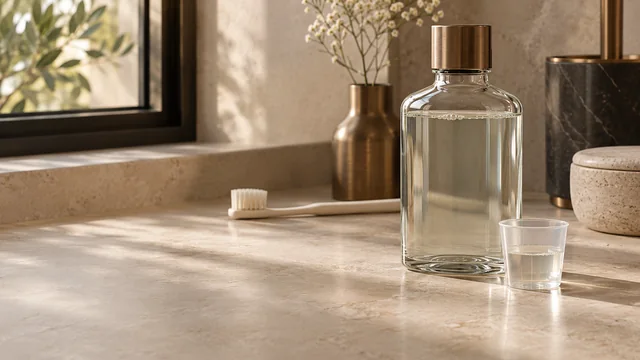 AI-generated
In this guide
What should the rinse do?
A fresh taste says little about clinical benefit. Cosmetic mouthwashes may temporarily mask odour. Fluoride rinses are intended to help prevent decay. Other ingredients aim to help control plaque or gum inflammation alongside mechanical cleaning. A strong sensation or a long ingredient list does not, by itself, make a product better.
Fluoride: additional protection when risk is higher
A fluoride rinse may be useful when decay risk is increased, for example with fixed braces. Exposed root surfaces in adults can also be a reason to consider one. The German guideline addresses fluoride rinses for permanent teeth; they do not replace fluoride toothpaste. Whether an additional rinse is appropriate can be discussed in light of the examination findings.
S3-Leitlinie Kariesprävention bei bleibenden Zähnen – grundlegende Empfehlungen, Version 2.0 (2025)
Chlorhexidine is not a daily default for everyone
Chlorhexidine, often shortened to CHX, can reduce plaque as an adjunct. This does not mean everyone should use it continuously or that it can treat gum disease on its own. Studies also report staining, altered taste and irritation of the lining of the mouth. Its effect on gum inflammation depends, among other factors, on the initial condition.
When it is recommended, the purpose, concentration and duration should be clear. Do not extend a prescribed course on your own. Some toothpaste ingredients can interfere with its action, so discuss timing with the dental team or pharmacist. If the lining of the mouth becomes sore, irritated or starts peeling, stop using chlorhexidine and contact your dental team, doctor or pharmacist.
Cochrane: Chlorhexidine mouthrinse to reduce gingivitis and plaque build-up (2017) · NHS: How and when to use chlorhexidine, reviewed 19 August 2024 · NHS: Side effects of chlorhexidine, reviewed 19 August 2024
Before or after brushing?
An additional fluoride rinse is often best used at a different time, such as after lunch. This avoids immediately washing away the fluoride left by toothpaste. After brushing, spit out the toothpaste rather than immediately rinsing with water. A particular medicinal rinse may have different instructions. Read the label instead of using several products in quick succession.
Alcohol-free products, children and dry mouth
Alcohol-free does not automatically mean suitable for everyone. With a dry mouth, however, an alcohol-free formulation is usually the more appropriate choice because alcohol can cause additional irritation. Persistent dry mouth needs assessment; medication can affect saliva flow too. Do not stop medication on your own.
Young children should not use mouthwash without specific dental advice. Being able to spit it out reliably is essential, and the age limit on the product also applies. Mouthwash is not a drink and should be stored out of young children’s reach.
American Dental Association: Mouthrinse (Mouthwash) · National Institute of Dental and Craniofacial Research: Dry Mouth
Four questions before buying
The most useful decision starts with your own oral-care routine, rather than the shop shelf. These four points can help structure a discussion at the practice:
- What is the specific aim? A fresh taste and protection against decay are not the same.
- Is daily cleaning already appropriate? A rinse should complement it.
- How should this product be used? Note the amount, timing and duration.
- When will the need be reviewed? For medicinal rinses in particular, agree on an end date or review point.
American Dental Association: Mouthrinse (Mouthwash) · NHS: How and when to use chlorhexidine, reviewed 19 August 2024
Assess the cause of symptoms
If your gums repeatedly bleed or bad breath persists despite oral care, an examination is more useful than another product change. At an appointment with SMILE meets DESIGN in Cologne, bring the names of your mouthwash and toothpaste. This makes it easier to discuss your existing routine and possible next steps.
American Dental Association: Mouthrinse (Mouthwash) · National Institute of Dental and Craniofacial Research: Dry Mouth
Common questions
Do I need mouthwash every day?
No. Whether it is useful depends on your needs and the active ingredient. Frequency and duration follow the specific product instructions or dental advice.
American Dental Association: Mouthrinse (Mouthwash) · NHS: How and when to use chlorhexidine, reviewed 19 August 2024
Can it replace floss or interdental brushes?
No. Liquid does not replace targeted mechanical cleaning between teeth. Ask which cleaning aid suits the spaces between your teeth.
Does burning mean the rinse is working particularly well?
No. Burning does not demonstrate effectiveness. If it persists or the lining of the mouth becomes irritated, its use should be reviewed.
Can CHX stain teeth?
No. Burning does not demonstrate effectiveness. Seek professional advice if burning persists. If the lining becomes sore, irritated or starts peeling while using chlorhexidine, stop using it and contact your dental team, doctor or pharmacist.
Cochrane: Chlorhexidine mouthrinse to reduce gingivitis and plaque build-up (2017)
Related reading
Sources and further reading
Research and editorial date: 7 November 2026. General information; individual findings and recommendations require an examination.
- American Dental Association: Mouthrinse (Mouthwash)
- S3-Leitlinie Kariesprävention bei bleibenden Zähnen – grundlegende Empfehlungen, Version 2.0 (2025)
- Cochrane: Chlorhexidine mouthrinse to reduce gingivitis and plaque build-up (2017)
- NHS: How to keep your teeth clean, reviewed 30 June 2025
- NHS: How and when to use chlorhexidine, reviewed 19 August 2024
- NHS: Side effects of chlorhexidine, reviewed 19 August 2024
- National Institute of Dental and Craniofacial Research: Dry Mouth