Is a photo enough?
No.

Ankyloglossia means that the lingual frenulum functionally restricts tongue movement. Appearance alone does not determine the diagnosis or treatment. In infants, feeding, growth and breastfeeding are assessed together; difficulties may have other causes.
For training & practice ↓
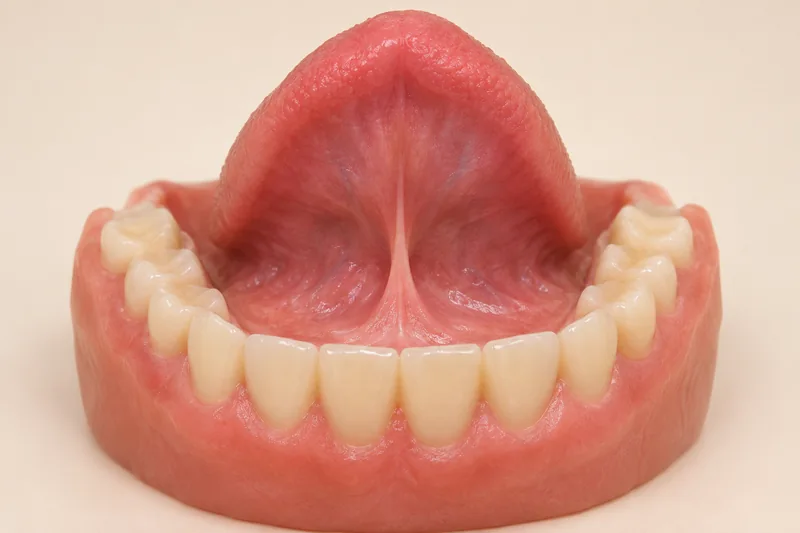
The lingual frenulum connects the underside of the tongue with the floor of the mouth. Its appearance varies without always causing dysfunction.
Assessment asks whether and how tongue movement is restricted during relevant activities. Feeding difficulty requires evaluation of the whole feeding situation.
Breastfeeding or feeding support can form part of care. A procedure is considered individually and is not automatically necessary.
No.
No.
Arrange prompt paediatric assessment and appropriate support.
Three steps. No audio.
Each scene can also be selected manually.

Silent educational film with German on-screen text and simplified teaching images. Not a patient case or a promised treatment outcome. The full English explanation is available below.
The lingual frenulum connects the underside of the tongue with the floor of the mouth. Its appearance varies without always causing dysfunction.
Assessment asks whether and how tongue movement is restricted during relevant activities. Feeding difficulty requires evaluation of the whole feeding situation.
Breastfeeding or feeding support can form part of care. A procedure is considered individually and is not automatically necessary.
A visible or short-looking frenulum is an anatomical observation. Diagnosis and possible treatment also require functional assessment.
No. Appearance without meaningful functional limitation is not sufficient by itself to justify a procedure.
That cannot be promised. A preventive procedure for merely hypothetical future problems is not routinely justified.
Seek prompt paediatric assessment and qualified feeding or lactation support where appropriate. Do not focus solely on the frenulum.
Editorially suggested question to discuss with Dr Niusha Barahmand Pour:
Which function is actually restricted, and what support is appropriate first?
Questions about tongue movement can be discussed. Feeding problems in infants need prompt paediatric attention.
Discuss tongue movementAppointment selection at DoctolibA visible or short-looking frenulum is an anatomical observation. Diagnosis and possible treatment also require functional assessment.
Editorial research: . General information, not an individual diagnosis or treatment recommendation. Teaching illustrations are simplified and do not depict a patient case.