Purpose?
Attach certain indirect restorations.

Resin luting composite is a resin-based material used to attach certain indirect restorations to prepared teeth. It contains a resin matrix and fillers, among other components. It is not household glue: the tooth, restorative material and bonding system must be compatible.
For training & practice ↓
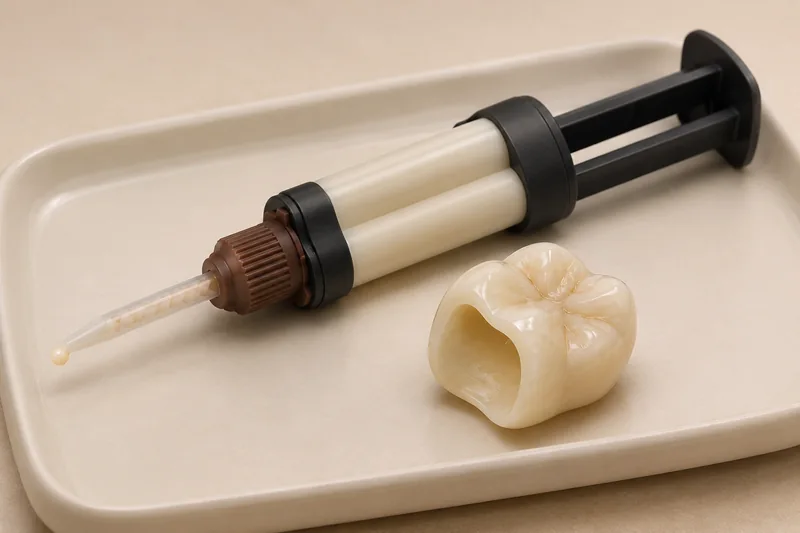
Fit and contacts are assessed before attachment. Luting material should not compensate for a fundamentally ill-fitting restoration.
The tooth and restoration each require appropriate surface preparation. The steps depend on the material and system.
Depending on the product, curing uses light, a chemical reaction or both. Excess material, margins and contacts require careful checking.
Attach certain indirect restorations.
The tooth, material and product system.
Have it examined rather than gluing it yourself.
Three steps. No audio.
Each scene can also be selected manually.

Silent educational film with German on-screen text and simplified teaching images. Not a patient case or a promised treatment outcome. The full English explanation is available as text.
Both are resin-based materials. Their formulation, flow and intended use may differ.
No. Material, thickness, light transmission and the manufacturer's instructions influence selection. A protocol cannot be transferred indiscriminately between materials.
With thin, translucent restorations, the underlying material can contribute to appearance. Colour and the overall situation are therefore considered beforehand.
Do not attach it using household glue. Keep the piece safely and arrange prompt assessment; the cause and suitability for rebonding need checking.
Editorially suggested question to discuss with Dr Niusha Barahmand Pour:
Which attachment method suits my restoration's material?
Is a restoration loose, or is bonding planned? The materials and procedure can be explained personally.
Have the restoration assessedAppointment selection at DoctolibBoth are resin-based materials. Their formulation, flow and intended use may differ.
Editorial research: . General information, not an individual diagnosis or treatment recommendation. Teaching illustrations are simplified and do not depict a patient case.