When will the result arrive?
This varies with the laboratory and tests; agree how results will be communicated.

A biopsy removes tissue for examination in a laboratory. In the mouth, it can help identify an unexplained change in the lining. A recommended biopsy does not automatically mean cancer. Its purpose is to clarify a suspected condition and guide the next steps.
For training & practice ↓
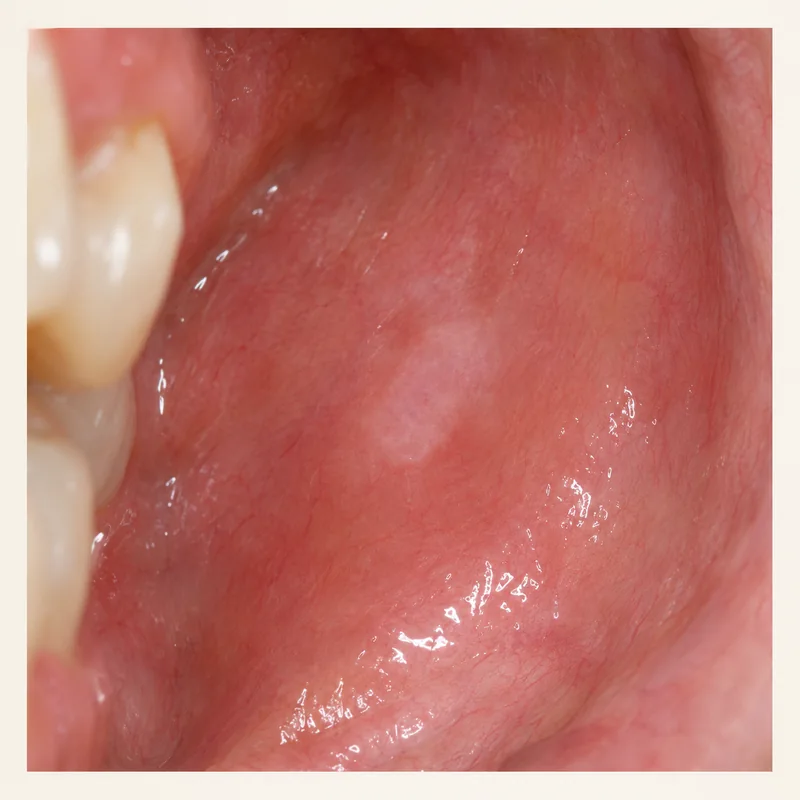
Before a biopsy, the clinician explains which change will be examined and what needs clarification. Appearance and symptoms alone do not always establish a diagnosis.
Depending on the finding, part of a change or an entire small change is removed. Local anaesthetic is often used; stitches may be needed.
The tissue is examined microscopically. Results are discussed alongside the clinical findings. Agree how you will receive the report and any further recommendations.
This varies with the laboratory and tests; agree how results will be communicated.
Follow the individual aftercare instructions.
Contact the treating team for persistent bleeding, increasing pain or swelling.
Three steps. No audio.
Each scene can also be selected manually.

Silent educational film with German on-screen text and simplified teaching images. Not a patient case or a promised treatment outcome. The full English explanation is available as text.
Biopsy describes tissue removal. Histology describes tissue examination. A suspected diagnosis is not yet a confirmed laboratory finding.
A biopsy can clarify different causes, including benign or inflammatory changes. The specific reason should be explained. Further interpretation depends on the examined tissue and clinical findings.
Local anaesthetic is often used. Pressure may still be felt, and the wound can be sore afterwards. The procedure, risks and aftercare are explained individually.
Not independently. Tell the treating clinician about medicines and relevant conditions. They decide whether preparation or any changes are needed.
You can bring this question to your appointment:
What question should the sample answer, and how will I receive the result?
An unexplained change in the oral lining can be examined and any further assessment discussed.
Arrange assessment of a changeAppointment selection at DoctolibTaking the sample, examining the tissue and reaching a final clinical interpretation are separate steps.
Editorial research: . General information, not an individual diagnosis or treatment recommendation. Teaching illustrations are simplified and do not depict a patient case.