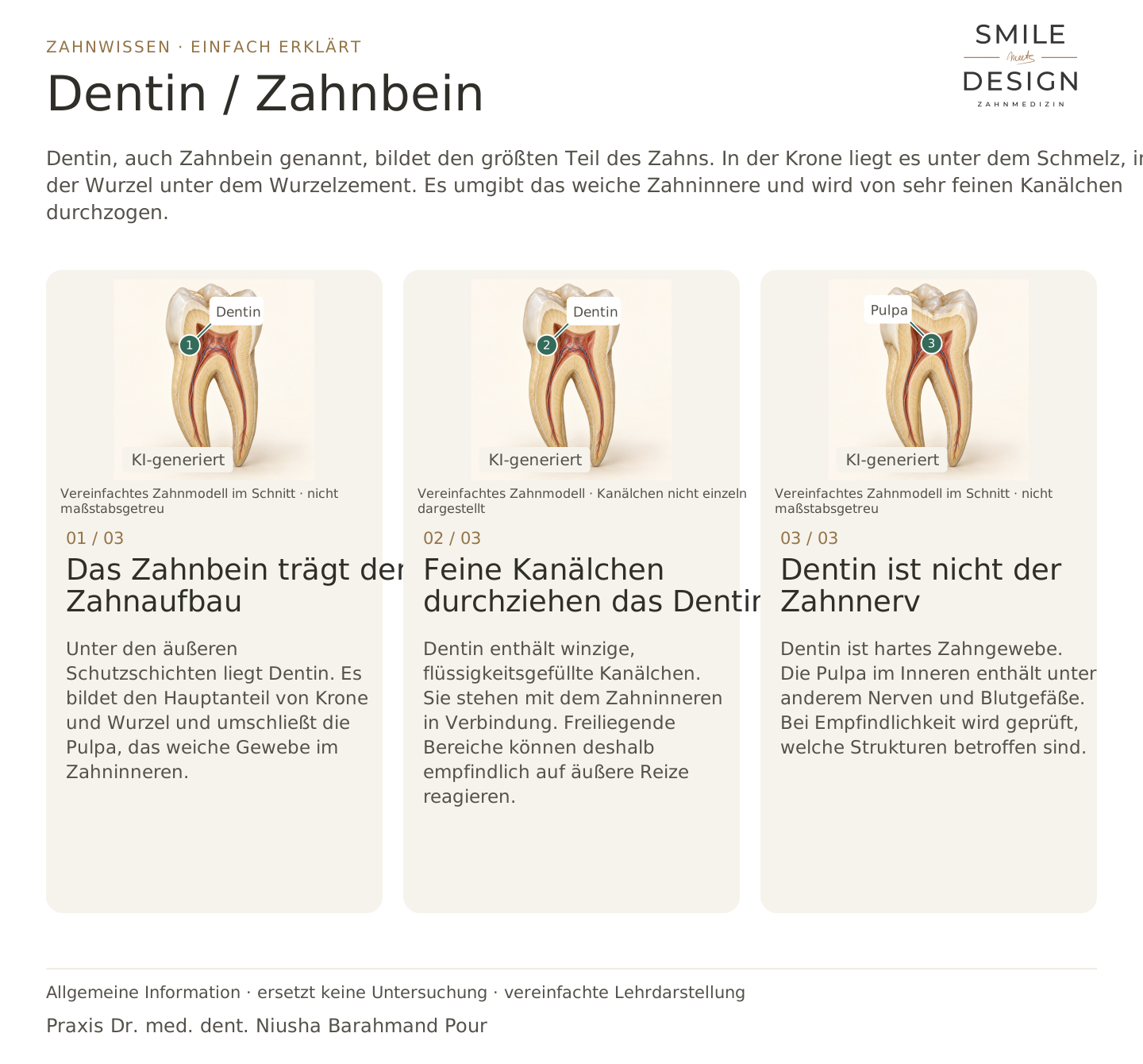
Where is dentine located?
It lies beneath the crown's enamel and beneath the root cementum. Dentine forms most of the crown and root and surrounds the tooth's soft interior.

Dentine forms most of the tooth. In the crown, it lies beneath enamel; in the root, beneath cementum. It surrounds the soft tissue inside the tooth and contains very fine tubules.
For dental trainees & teams
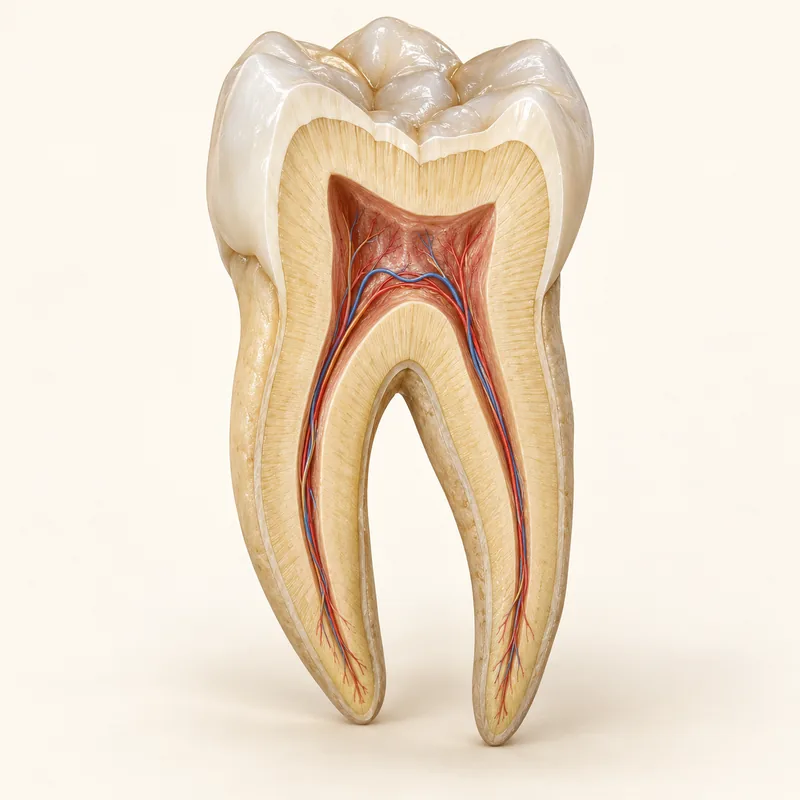
Dentine lies beneath the outer protective layers. It forms most of the crown and root and surrounds the pulp, the soft tissue inside the tooth.
Dentine contains tiny, fluid-filled tubules connected to the inside of the tooth. Exposed areas can therefore respond sensitively to external stimuli.
Dentine is hard tooth tissue. The pulp inside contains nerves and blood vessels, among other components. If there is sensitivity, an assessment establishes which structures are affected.
It lies beneath the crown's enamel and beneath the root cementum. Dentine forms most of the crown and root and surrounds the tooth's soft interior.
Dentine contains very fine, fluid-filled tubules connected to the inside of the tooth. When exposed, cold or touch can cause discomfort.
Dentine is hard, mineralised tissue. Nerves and blood vessels are instead found in the soft pulp inside the tooth.
Three steps. Straight to the point.
Explanations are also shown on screen.

Silent film in German · English explanations in the three views above
Dentine is the hard layer around the tooth's interior. Pulp is the soft tissue within, with its blood supply. The two are functionally connected.
No. Dentine also forms most of the root. There, it is covered externally by cementum.
No. It may be sensitive to cold, touch or other stimuli, but does not have to be. Symptoms alone do not reliably identify the cause.
No. Dentine is mineralised tooth tissue. Nerves and blood vessels are found in the soft tissue inside the tooth, the pulp.
A question to discuss with Dr. med. dent. Niusha Barahmand Pour:
Is dentine exposed at the sensitive site, and which other causes should be checked?
An examination and discussion of your personal concern come before treatment planning.
Questions about sensitive teeth can be assessed in a personal consultation.
Have your teeth examinedChoose an appointment on DoctolibBuild on the simple explanation with clinical terms, key distinctions and a knowledge question.
Dentine is mineralised tissue around the pulp. Its fine tubules are not the same as the much larger root canals.
Editorial research: 22 October 2026. This explanation covers general principles and does not replace a personal examination. Suitable treatment is discussed following individual assessment.