
What does the term “tooth nerve” really mean?
The term often refers to the pulp, although it contains more than nerves. Blood vessels and connective tissue are also part of this soft tissue.

The pulp is the soft tissue inside the tooth. It contains nerves, blood vessels and connective tissue and extends from the crown into the root canals. The term “tooth nerve” therefore describes only one part of this tissue.
For dental trainees & teams
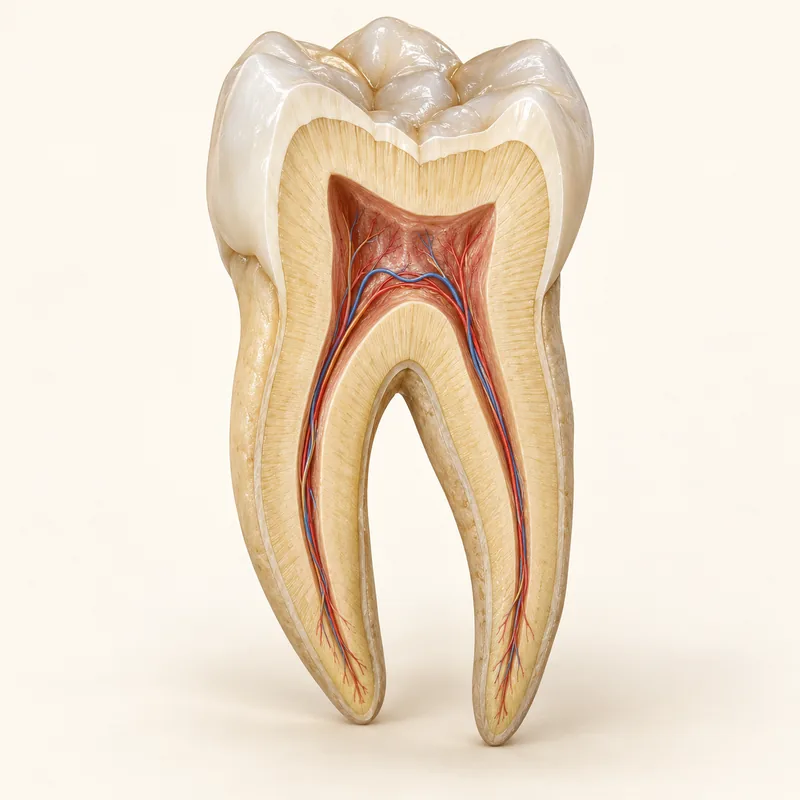
The pulp is protected inside the tooth. It includes nerves, blood vessels and connective tissue. “Tooth nerve” is a simplified everyday term for it.
Pulp tissue lies in the pulp chamber and extends into the root canals. Its roles include nourishment, sensation and tooth development.
Deep decay or injury can damage the pulp. The treatment needed depends on the findings. Not every response to cold means the pulp is seriously diseased.
The term often refers to the pulp, although it contains more than nerves. Blood vessels and connective tissue are also part of this soft tissue.
Its roles include nourishment, sensation and tooth development. The tissue extends from the pulp chamber into the root canals.
Deep decay or injury can affect the inside of the tooth. A response to cold alone does not prove that the pulp is seriously diseased.
Three steps. Straight to the point.
Explanations are also shown on screen.

Silent film in German · English explanations in the three views above
The pulp is the soft tissue inside. Dentine is the hard layer around it. These terms describe different tissues.
No. It is a combination of tissues containing nerves, blood vessels and connective tissue. Blood supply is just as important as sensation.
No. Toothache can have different causes. An examination and, if necessary, further tests establish whether and how the inside of the tooth needs treatment.
Yes. A mature tooth can survive without pulp tissue. It needs appropriate treatment, restoration and checks; keeping it cannot be guaranteed.
A question to discuss with Dr. med. dent. Niusha Barahmand Pour:
Which examinations help assess whether the inside of the tooth is affected?
Dr. Barahmand Pour has completed curriculum-based training in endodontics, the field concerned with treating the inside of the tooth.
A personal appointment can help assess questions about the inside of a tooth or any symptoms.
Discuss tooth symptomsChoose an appointment on DoctolibBuild on the simple explanation with clinical terms, key distinctions and a knowledge question.
“Tooth nerve” is a simplified everyday term. The pulp also contains blood vessels and connective tissue; dentine is the hard layer around this interior space.
Editorial research: 22 October 2026. This explanation covers general principles and does not replace a personal examination. Suitable treatment is discussed following individual assessment.