Who holds it?
An adult wears the sleeve on a finger.

A finger toothbrush fits over an adult’s finger. Some versions have soft silicone nubs. Once a tooth is visible, German infant oral-health guidance recommends cleaning it with a small, soft-bristled toothbrush designed for children.
For training & practice ↓
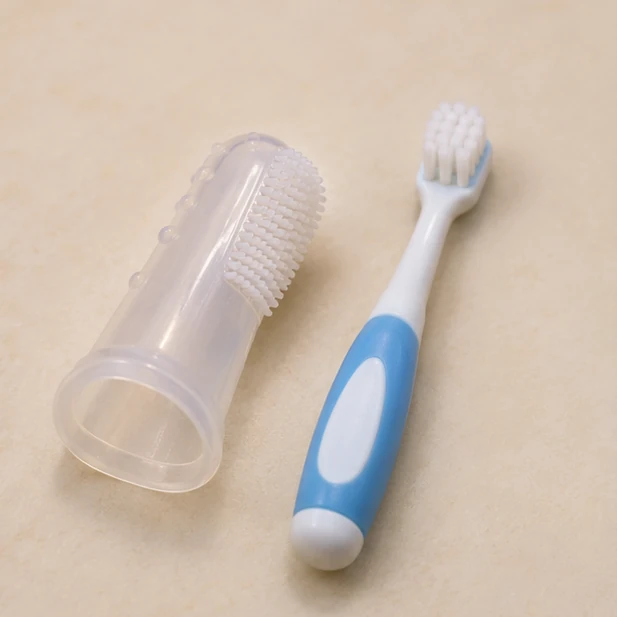
The finger brush on the left has short nubs. The conventional brush on the right has a small bristled head.
German infant oral-health guidance recommends a soft, age-appropriate toothbrush once the first teeth appear.
The bristles approach the teeth from the cheek side on this model. The inside surfaces need attention too.
An adult wears the sleeve on a finger.
As soon as the first tooth is visible.
They allow gentle cleaning of small tooth surfaces.
Three steps. No audio.
Each scene can also be selected manually.

Silent film with English on-screen text and simplified teaching images.
Silicone nubs on a sleeve and the bristles of a toothbrush contact teeth differently. German infant oral-health guidance recommends a soft children’s brush for the first teeth.
The bristles can reach the inside surface and the gumline. Chewing on a finger brush by itself does not systematically clean every side of a tooth.
Start when the first tooth appears. Introduce the brush gently. A brief, calm routine is easier to repeat than trying to brush against strong resistance.
Different designs cannot be treated as interchangeable. In a small study of 20 babies, a conventional children’s brush removed plaque more effectively than a gauze finger cleaner. The researchers did not test silicone finger brushes.
A question to ask
Could you show me how to reach the inside of the first tooth?
Bring questions about cleaning baby teeth to your child’s dental visit.
Choose an appointmentAppointment selection at DoctolibA gauze sleeve, a silicone finger brush and a bristled toothbrush contact a tooth differently. Check which products and age group a study compared.
Editorial research: . General information, not an individual diagnosis or treatment recommendation. Teaching illustrations are simplified and do not depict a patient case.
If you turn this on, this website stores which guides you open, separately from advertising preferences. The markers expire after a fixed 30-day period from activation. The list is not sent to us by this feature. You can turn it off here and delete the markers.
Other people using the same browser profile can also see the markers. German and English versions share one marker. Expired entries are removed the next time you open a page with this feature; deleting browser data may remove them earlier. “Viewed” means opened, not read or completed.