Do they usually hurt?
Typical Fordyce spots cause no symptoms.

Fordyce spots are visible sebaceous glands in areas without associated hair follicles, such as the lips or inner cheeks. They may look like small pale or yellowish dots and are a normal variation. A teaching image cannot establish whether a particular spot is one of them.
For training & practice ↓
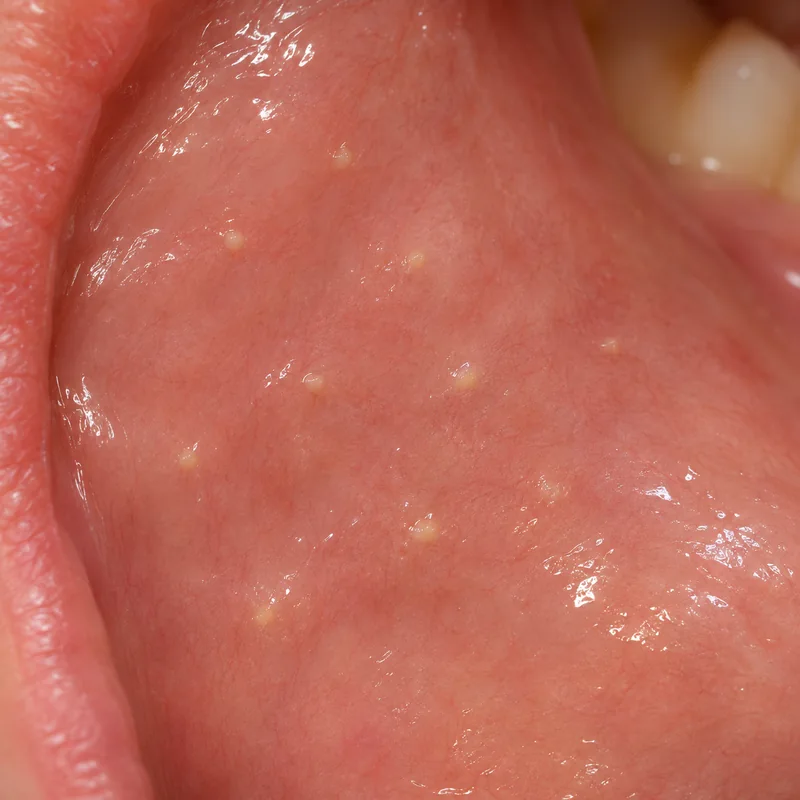
Typical spots are small, slightly raised and pale. They may occur alone or in groups. This example explains their location, not the diagnosis of a personal concern.
The simplified close-up shows a sebaceous gland without an associated hair. It is not a salivary gland. The name describes a tissue type, not an infection.
Confirmed Fordyce spots usually need no treatment. Squeezing or picking can irritate tissue. Uncertain or changing areas should be assessed professionally.
Typical Fordyce spots cause no symptoms.
Confirmed Fordyce spots are benign.
An examination rather than self-diagnosis by image comparison.
Three steps. No audio.
Each scene can also be selected manually.

Silent educational film with German on-screen text and simplified teaching images. Not a patient case or a promised treatment outcome. The full English explanation is available as text.
Fordyce spots are not blocked saliva. A mucocele belongs to a different group of findings.
No. Confirmed Fordyce spots are not contagious. This cannot be assumed for every pale dot or blister on the lips.
The visible dots are sebaceous glands, not something to squeeze. A dental or dermatological examination can establish what an uncertain finding is.
A confirmed, unremarkable finding normally needs no treatment. When uncertain, an examination is more useful than trying home remedies.
You can bring this question to your appointment:
Does this look like a normal variation, or is further assessment needed?
An uncertain change on the lips or oral lining can be assessed at an appointment.
Arrange an oral examinationAppointment selection at DoctolibTissue type and visible appearance are different concepts. Similar appearances do not establish the same diagnosis.
Editorial research: . General information, not an individual diagnosis or treatment recommendation. Teaching illustrations are simplified and do not depict a patient case.