What is its function?
Producing and releasing saliva.

Salivary glands produce saliva and release it into the mouth through ducts. There are three pairs of major glands and many minor glands in the oral lining. The gland is the organ; saliva is the fluid it produces.
For training & practice ↓
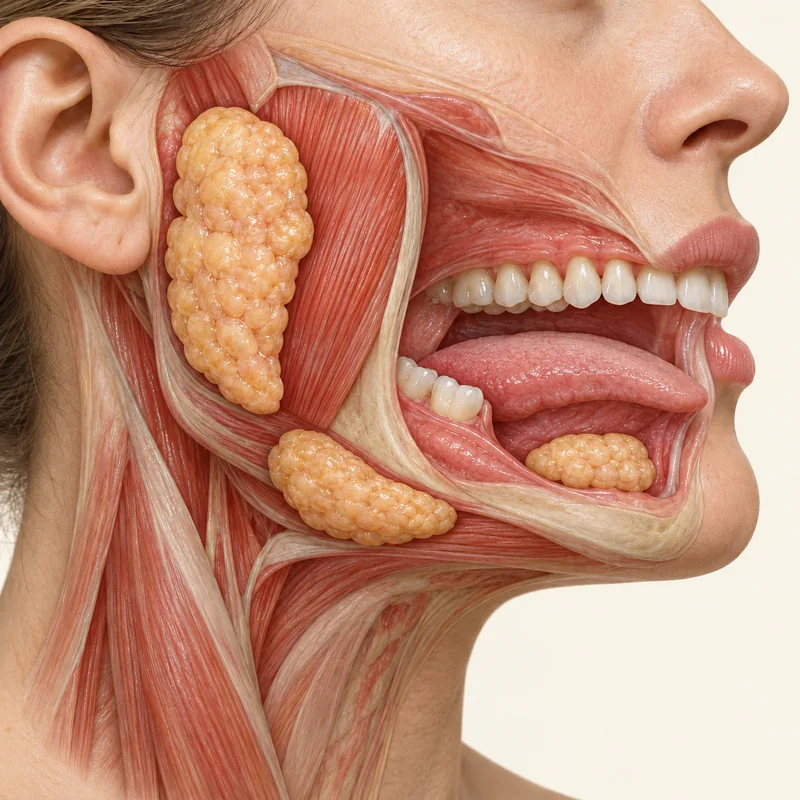
Parotid, submandibular and sublingual glands work with smaller glands. Different openings belong to different ducts.
Saliva helps speaking, swallowing and tooth protection. Persistently reduced saliva can contribute to discomfort and dental disease.
Dryness or swelling can relate to medicines, blocked drainage or disease. Do not stop prescribed medication without advice.
Producing and releasing saliva.
Describe symptoms, duration, medicines and relation to meals.
Assessment and treatment, sometimes with medical specialists.
Three steps. No audio.
Each scene can also be selected manually.

Silent educational film with German on-screen text and simplified teaching images. Not a patient case or a promised treatment outcome. The full English explanation is available below.
Parotid, submandibular and sublingual glands work with smaller glands. Different openings belong to different ducts.
Saliva helps speaking, swallowing and tooth protection. Persistently reduced saliva can contribute to discomfort and dental disease.
Dryness or swelling can relate to medicines, blocked drainage or disease. Do not stop prescribed medication without advice.
The gland produces fluid. Saliva then spreads over teeth and oral lining.
No. Salivary glands make saliva; lymph nodes belong to the immune system. A palpable lump needs assessment.
No. There are several possible causes; symptoms, medication and examination findings are considered together.
No. Drinking can moisten the mouth but does not address every cause. Persistent dryness needs discussion.
An editorially suggested question for a discussion with Dr med dent Niusha Barahmand Pour:
What might explain the change in salivary flow?
Dryness, pain or swelling? A telephone discussion can help arrange appropriate assessment.
Call the practice · 0221 669 401 80Telephone contactThe gland produces fluid. Saliva then spreads over teeth and oral lining.
Editorial research: . General information, not an individual diagnosis or treatment recommendation. Teaching illustrations are simplified and do not depict a patient case.