Where?
At the back end of an arch.

In a distal-extension situation, posterior teeth are missing with no natural tooth behind the gap. This may affect one or both sides. Planning needs to consider where a restoration can gain support and the role of the remaining teeth.
For training & practice ↓
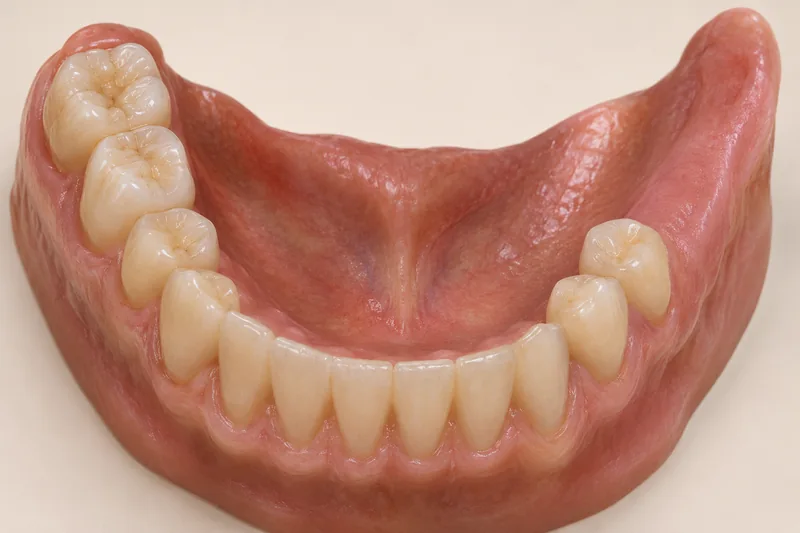
A space between two existing teeth has different boundaries from a toothless area at the end of an arch.
Depending on the restoration, teeth, mucosa and possibly implants may carry different shares of the load. These structures do not behave identically.
Remaining teeth, the ridge, opposing teeth, cleaning and personal preferences influence selection. Every missing posterior unit does not automatically need the same replacement.
At the back end of an arch.
Either is possible.
Support, function and cleaning access.
Three steps. No audio.
Each scene can also be selected manually.

Silent educational film with German on-screen text and simplified teaching images. Not a patient case or a promised treatment outcome. The full English explanation is available as text.
A bounded gap lies between existing teeth. A free-end gap has no natural tooth behind it.
Not automatically. There is no natural posterior abutment beyond the free end. Special bridge designs or other solutions require professional assessment.
No. Implants are a possible planning option, not part of the definition. Suitability and other restorative approaches are considered individually.
Have its fit, support and tissues checked. Do not bend clasps or grind the base yourself; oral changes may require adjustment.
Editorially suggested question to discuss with Dr Niusha Barahmand Pour:
How could my restoration be supported, and which options suit the remaining teeth?
Missing back teeth or a moving restoration? Assessment can clarify sensible next steps.
Discuss replacement optionsAppointment selection at DoctolibA bounded gap lies between existing teeth. A free-end gap has no natural tooth behind it.
Editorial research: . General information, not an individual diagnosis or treatment recommendation. Teaching illustrations are simplified and do not depict a patient case.