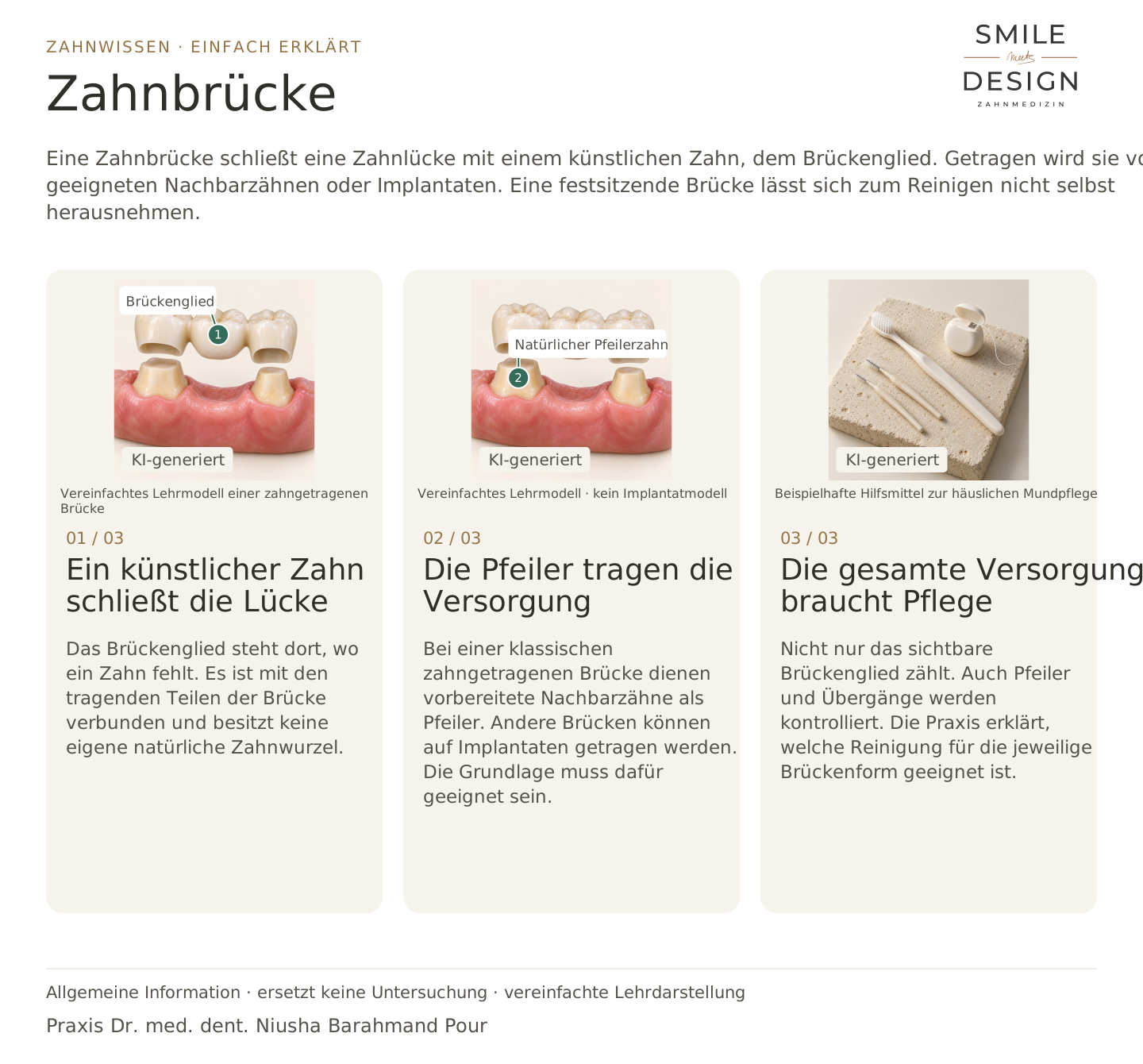
How is the gap bridged?
An artificial tooth, the pontic, is connected to supporting parts. In a tooth-supported bridge, suitable neighbouring teeth act as the abutments.

A dental bridge fills a gap with an artificial tooth, called a pontic. It is supported by suitable neighbouring teeth or implants. A fixed bridge cannot be removed by the patient for cleaning.
For dental trainees & teams
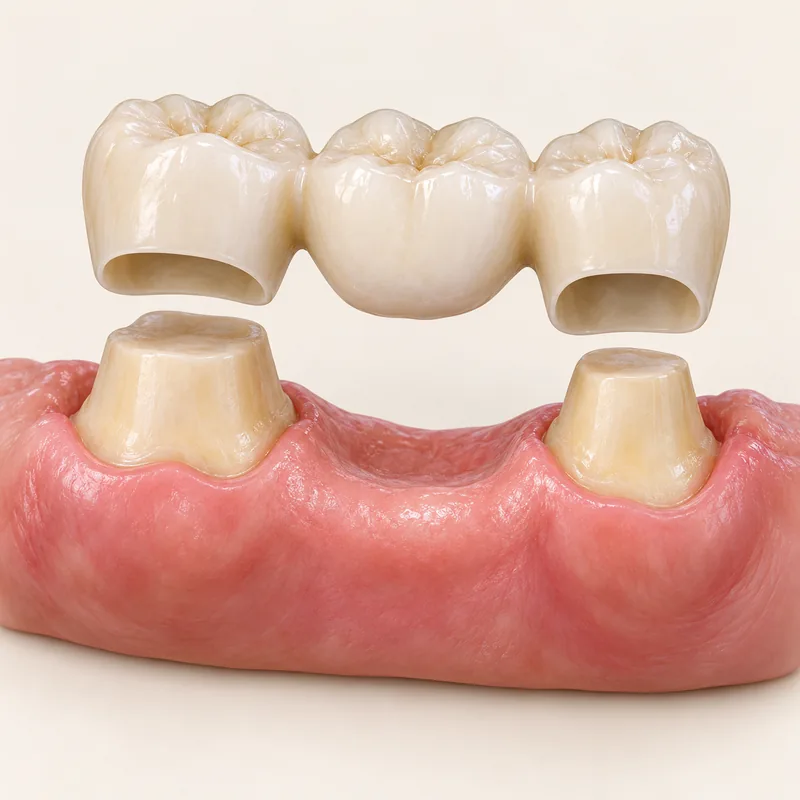
The pontic sits where a tooth is missing. It is connected to the supporting parts of the bridge and has no natural tooth root of its own.
In a conventional tooth-supported bridge, prepared neighbouring teeth act as supports, or abutments. Other bridges can be supported by implants. The supporting structures must be suitable.
Care extends beyond the visible pontic. The abutments and junctions are checked too. The practice explains which cleaning methods suit the particular bridge design.
An artificial tooth, the pontic, is connected to supporting parts. In a tooth-supported bridge, suitable neighbouring teeth act as the abutments.
The abutments, gap length and biting forces must suit the design. Under suitable conditions, a bridge can also replace several missing teeth.
With a conventional tooth-supported bridge, the abutments are prepared for crowns. The fixed restoration then needs check-ups and suitable cleaning around the abutments and junctions.
Three steps. Straight to the point.
Explanations are also shown on screen.

Silent film in German · English explanations in the three views above
The pontic replaces the missing tooth in the gap. The abutments support the bridge. In a tooth-supported bridge, these are natural teeth.
For a conventional tooth-supported bridge, the abutment teeth are usually prepared for crowns. Other designs have different requirements.
No. A bridge is the restoration that spans a gap. An implant sits in the jaw and can serve as a support for replacement teeth.
In principle, yes. The length of the gap, biting forces and available abutments limit which design is suitable.
A question to discuss with Dr. med. dent. Niusha Barahmand Pour:
Which teeth or implants could support a bridge across the gap, and how could I clean it afterwards?
Her planning considers the existing structures and their function together. Options are discussed on the basis of the examination.
If you have a missing tooth, we can discuss whether a bridge suits the conditions in your mouth.
Book a dental bridge consultationChoose an appointment on DoctolibBuild on the simple explanation with clinical terms, key distinctions and a knowledge question.
Tooth-supported and implant-supported describe the supports. Fixed means the patient cannot remove the restoration themselves.
Editorial research: 22 October 2026. This explanation covers general principles and does not replace a personal examination. Suitable treatment is discussed following individual assessment.