Which colour matters?
The course and any new symptoms matter more than one particular colour.

A bruise forms when blood leaks from small vessels into nearby tissue. After oral surgery this may discolour the cheek. The time course, swelling, pain and any active bleeding all matter.
For training & practice ↓
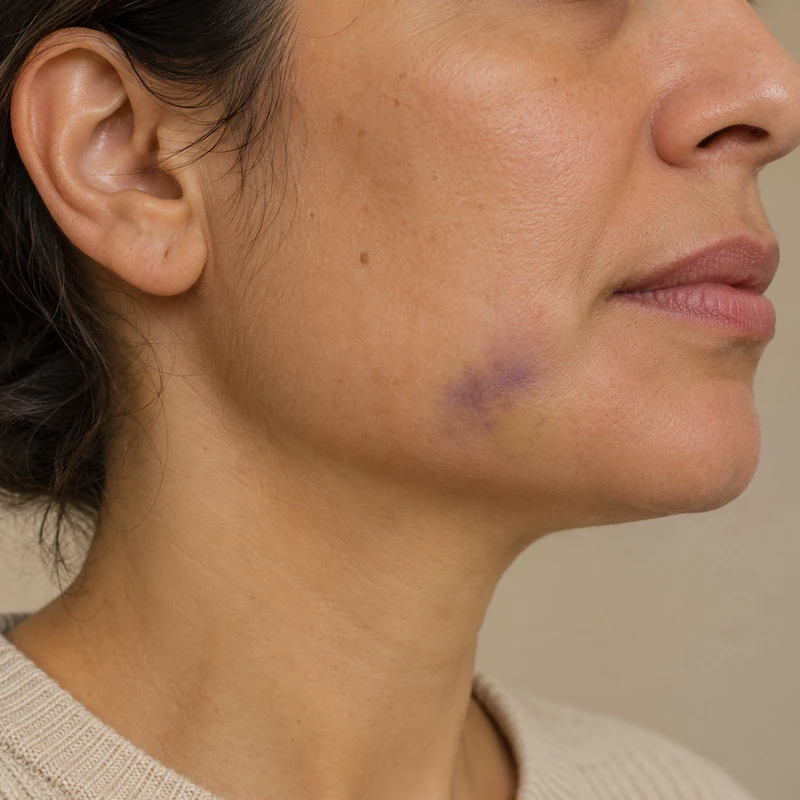
Bruising can appear after the procedure and change colour as it resolves. The blood lies beneath the surface.
A clot in an extraction socket is part of healing. Fresh blood repeatedly flowing from the wound is a different finding.
Contact the treating team if swelling or pain worsens after initially improving. Call 112 in Germany for rapidly increasing swelling with breathing difficulty.
The course and any new symptoms matter more than one particular colour.
A bruise can be present without active bleeding in the mouth.
Follow your prescription and contact your clinician about bleeding concerns.
Three steps. No audio.
Each scene can also be selected manually.

Silent film with English on-screen text and simplified teaching images.
A bruise is blood in tissue. With ongoing bleeding, fresh blood continues to leave the wound.
Contact your surgeon or an emergency dental service for persistent fresh bleeding despite the recommended pressure, fever or clear deterioration.
It can record colour and extent. Also describe swallowing, pain and the timing of changes.
Bruises usually fade gradually. Their size and the type of surgery influence recovery.
A question to bring along
Is this change consistent with my recovery?
Call the treating team if you have active postoperative bleeding.
Call the practice · 0221 669 401 80Telephone contactDescribe discolouration, swelling and blood flow separately. This helps the team judge urgency.
Editorial research: . General information, not an individual diagnosis or treatment recommendation. Teaching illustrations are simplified and do not depict a patient case.
If you turn this on, this website stores which guides you open, separately from advertising preferences. The markers expire after a fixed 30-day period from activation. The list is not sent to us by this feature. You can turn it off here and delete the markers.
Other people using the same browser profile can also see the markers. German and English versions share one marker. Expired entries are removed the next time you open a page with this feature; deleting browser data may remove them earlier. “Viewed” means opened, not read or completed.