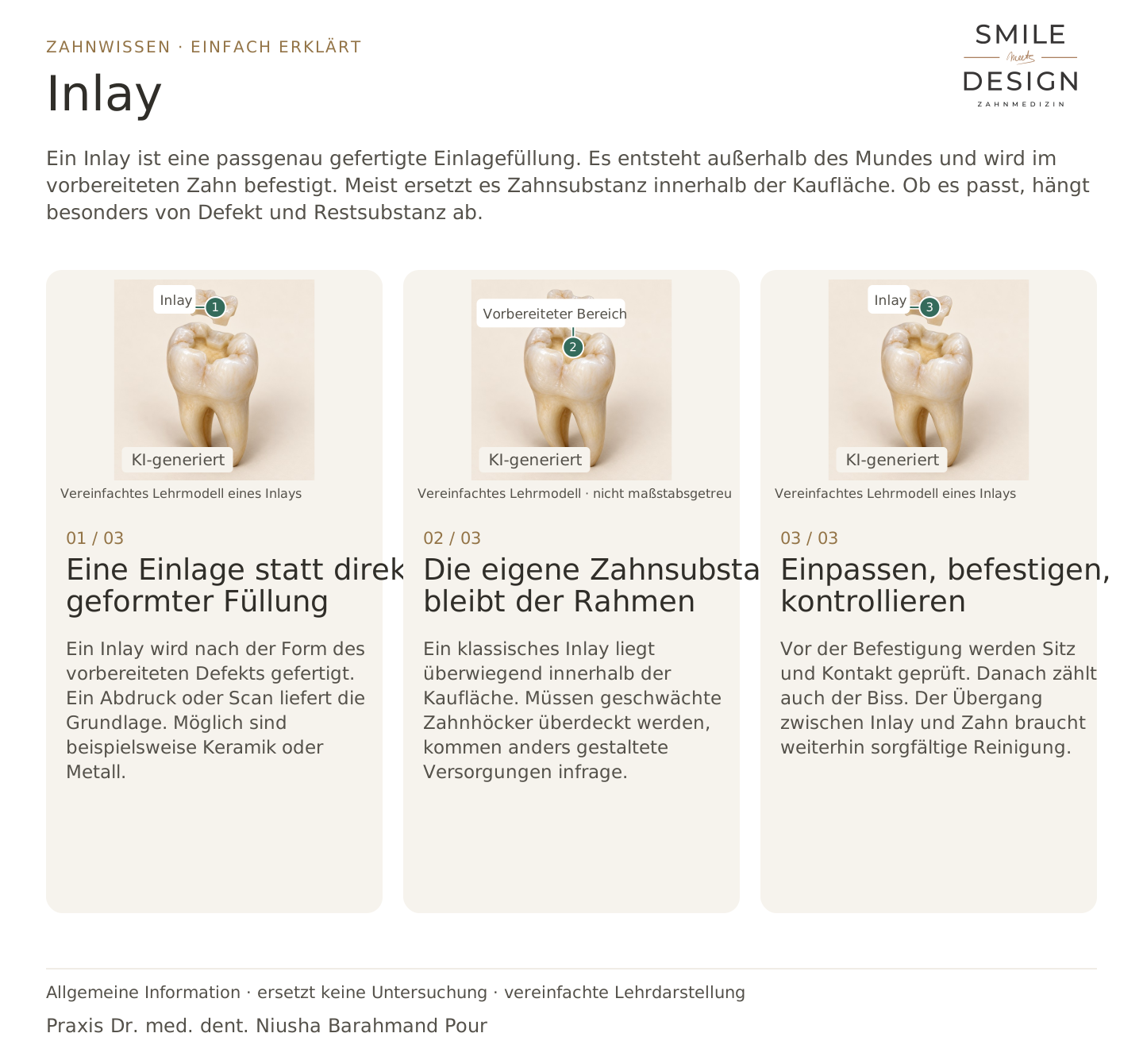
How does it differ from a direct filling?
An inlay is made outside the mouth to fit the prepared defect. The custom insert is then secured in the tooth.

An inlay is a custom-made filling produced outside the mouth and secured in a prepared tooth. It usually replaces tooth structure within the chewing surface. Its suitability depends particularly on the defect and the tooth structure that remains.
For dental trainees & teams
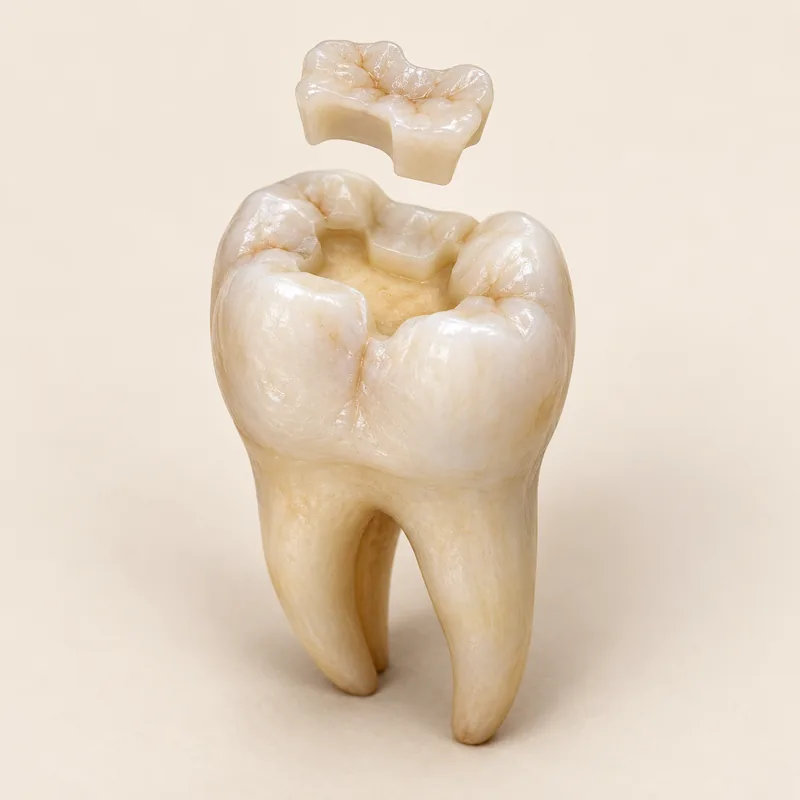
An inlay is made to fit the prepared defect. An impression or scan provides the information needed. Materials include ceramic and metal, for example.
A conventional inlay sits mainly within the chewing surface. If weakened tooth cusps need to be covered, a differently designed restoration may be considered.
The fit and contacts are checked before the inlay is secured. The bite is checked afterwards too. The junction between the inlay and tooth still needs careful cleaning.
An inlay is made outside the mouth to fit the prepared defect. The custom insert is then secured in the tooth.
A conventional inlay sits mainly within the chewing surface. Suitability depends particularly on the remaining tooth structure and the condition of the cusps.
An impression or scan guides fabrication. Fit, contacts and bite are checked before and after attachment; the junctions still need careful cleaning.
Three steps. Straight to the point.
Explanations are also shown on screen.

Silent film in German · English explanations in the three views above
These names describe restorations with different coverage. A conventional inlay sits mainly within the chewing surface; other restorations also cover tooth cusps. The precise design should be explained.
No. Inlays can also be made of metal alloys, for example. The material and method of attachment are chosen to suit the situation.
That depends on how it is made and the treatment process. A temporary restoration may be needed if the inlay is made externally; computer-assisted methods may follow a different schedule.
No. The choice depends on the individual tooth, the remaining tooth structure and the treatment options. The name alone does not tell you whether it is suitable.
A question to discuss with Dr. med. dent. Niusha Barahmand Pour:
Which walls and cusps of my tooth are still stable, and how much of it should the restoration cover?
Healthy structures and a functioning bite are foundations of Dr. Barahmand Pour's planning. A restoration is selected only after the requirements have been assessed.
If you have questions about an inlay, we can examine the tooth together and discuss the restoration options.
Book an inlay consultationChoose an appointment on DoctolibBuild on the simple explanation with clinical terms, key distinctions and a knowledge question.
Direct or indirect describes how a restoration is made. Composite or ceramic describes its material. These classifications answer different questions.
Editorial research: 22 October 2026. This explanation covers general principles and does not replace a personal examination. Suitable treatment is discussed following individual assessment.