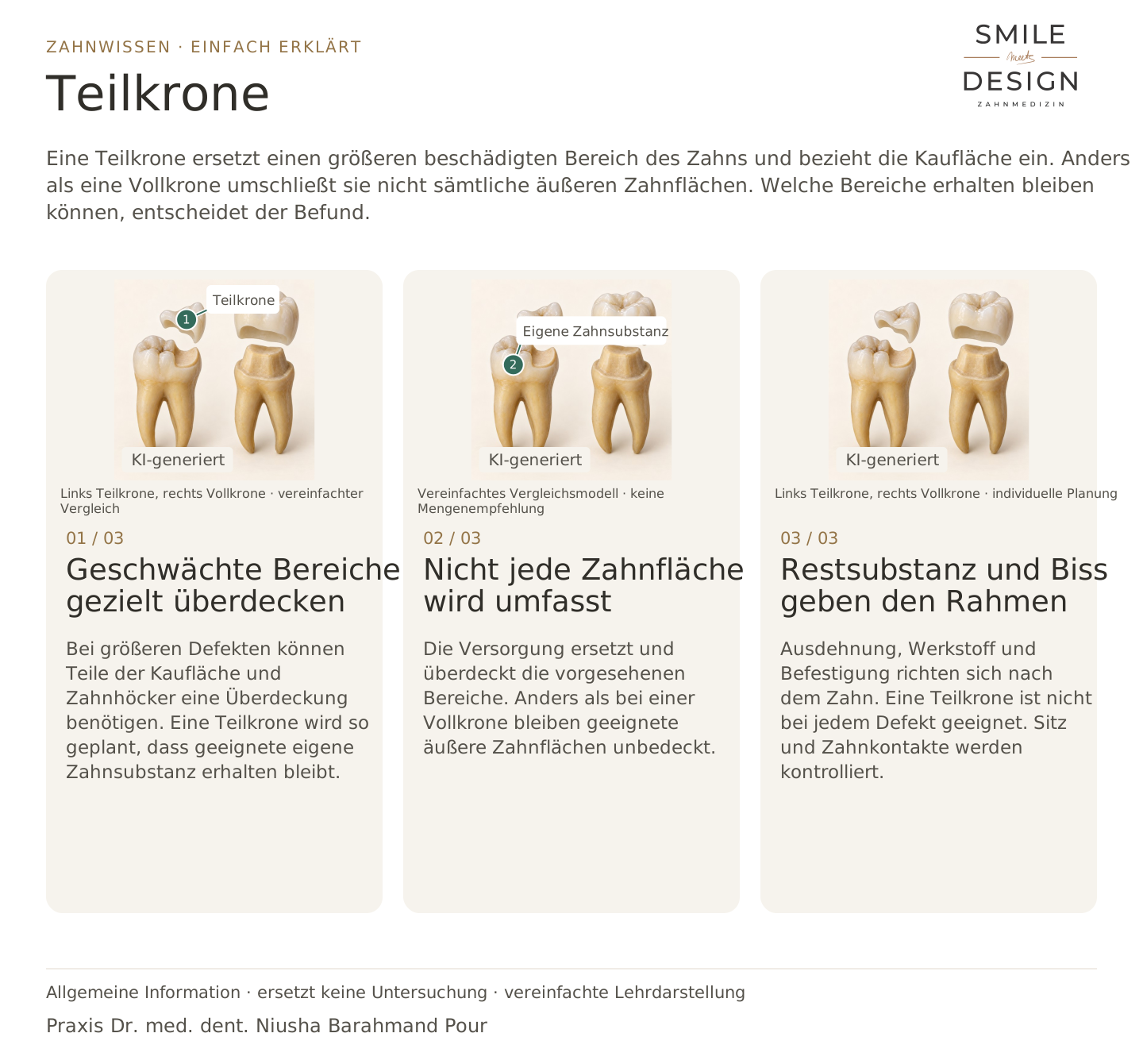
Which areas does a partial crown cover?
It includes damaged areas of the chewing surface and, where needed, tooth cusps. Suitable outer surfaces can remain uncovered.

A partial crown replaces a larger damaged part of a tooth and includes the chewing surface. Unlike a full crown, it does not surround all the tooth's outer surfaces. The examination determines which areas can be retained.
For dental trainees & teams
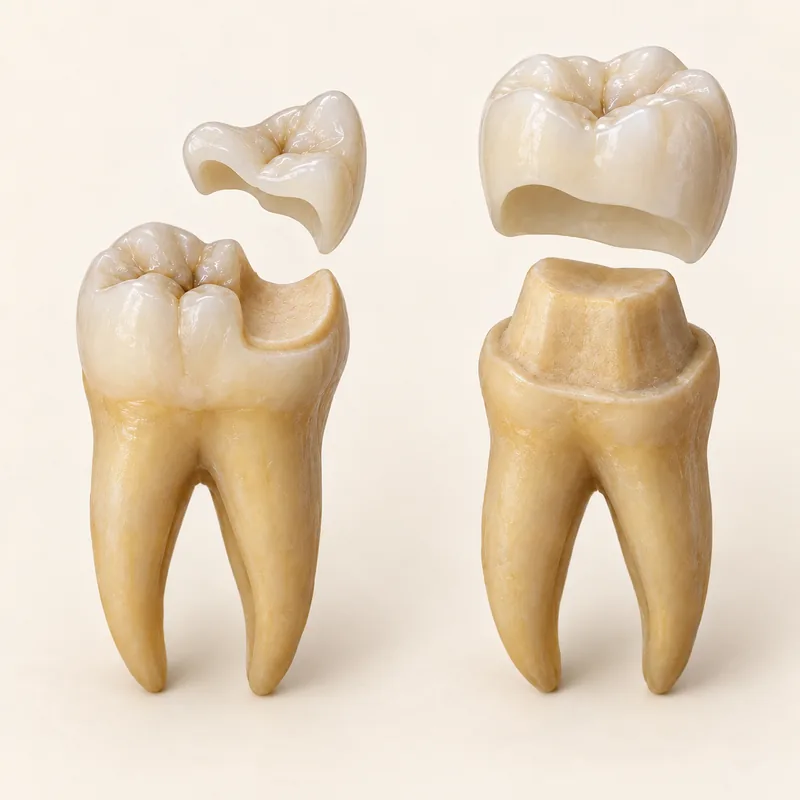
Larger defects may require parts of the chewing surface and tooth cusps to be covered. A partial crown is planned to preserve suitable natural tooth structure.
The restoration replaces and covers the selected areas. Unlike a full crown, it leaves suitable outer surfaces of the tooth uncovered.
Coverage, material and attachment are tailored to the tooth. A partial crown is not suitable for every defect. Its fit and contacts with other teeth are checked.
It includes damaged areas of the chewing surface and, where needed, tooth cusps. Suitable outer surfaces can remain uncovered.
A larger defect may leave parts of the tooth needing coverage. Remaining tooth structure and biting forces determine whether a partial crown is suitable.
Coverage, material and attachment are tailored to the tooth; fit and contacts are checked. The natural tooth beneath a partial crown still needs care.
Three steps. Straight to the point.
Explanations are also shown on screen.

Silent film in German · English explanations in the three views above
A partial crown leaves suitable outer tooth surfaces uncovered. A full crown surrounds the prepared natural crown. Neither replaces the tooth root.
The terms overlap but are not used in exactly the same way everywhere. What matters is which surfaces and cusps the particular restoration covers.
Not automatically. The restoration also depends on the remaining tooth structure and the forces it bears. One rule does not fit every tooth.
The natural tooth remains susceptible at the junctions and exposed surfaces. Thorough cleaning and check-ups therefore remain important.
A question to discuss with Dr. med. dent. Niusha Barahmand Pour:
Which surfaces of my tooth can be preserved, and where would protective coverage be useful?
Her approach combines tooth preservation with functional and aesthetic planning. The starting situation is assessed before deciding on a restoration.
An examination helps us assess how much tooth structure remains and which restoration may suit it.
Discuss a partial crownChoose an appointment on DoctolibBuild on the simple explanation with clinical terms, key distinctions and a knowledge question.
The size of the visible defect alone does not determine the restoration. The stability of the remaining walls and cusps, and the forces on them, also matter.
Editorial research: 22 October 2026. This explanation covers general principles and does not replace a personal examination. Suitable treatment is discussed following individual assessment.