What does it include?
A pontic and suitable attachment areas in the neighbouring teeth.

An inlay-retained bridge replaces a missing tooth and is anchored through inlays in adjacent teeth. These supporting teeth do not automatically need full crowns, but suitable preparations and sufficiently sound supporting tooth surfaces are still necessary. Clinical findings, available space and the loading of the complete structure are decisive.
For training & practice ↓
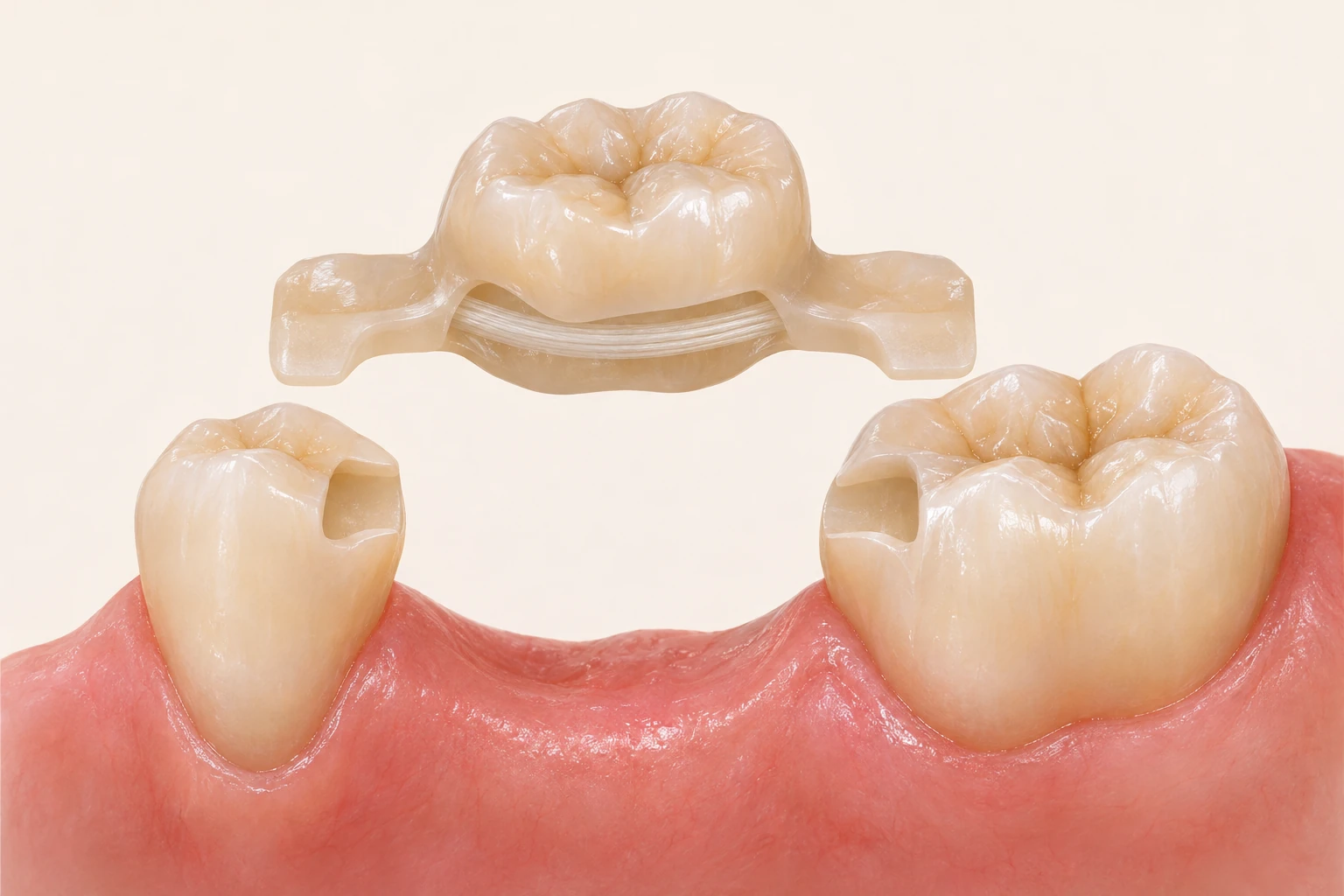
The bridge comprises a replacement for the missing tooth and attachment areas on either side. These fit into prepared regions of the neighbouring teeth. The inlays form part of the attachment; the pontic spans the actual gap.
Fillings, defects and remaining tooth tissue influence preparation. The restoration also needs enough space relative to neighbouring and opposing teeth. A smaller preparation is useful only if adequate attachment and loading can still be planned.
For adhesively bonded designs, prepared surfaces, bonding materials and the restoration must be compatible. The bite is considered during planning and checked after placement. Follow-up assesses attachment, margins and surfaces, among other features. An inlay-retained bridge is not suitable for every gap.
A pontic and suitable attachment areas in the neighbouring teeth.
Tooth tissue, existing fillings, available space, the bite and loading.
Attachment, margins, surfaces and contacts when biting, among other features.
Three steps. No audio.
Each scene can also be selected manually.

Silent educational film with German on-screen text and simplified teaching images. Not a patient case or a promised treatment outcome. The full English explanation is available as text.
An inlay fits within a tooth. An inlay-retained bridge uses such attachment areas to span a gap. Retention using full crowns has a different preparation design.
An inlay replaces missing tissue within one tooth. In an inlay-retained bridge, inlays in neighbouring teeth also support a pontic across a gap. Planning and loading therefore involve several connected parts.
No. The name describes how the restoration is retained, not just its material. The source used here describes glass-fibre-reinforced examples; it cannot establish a general material recommendation for all inlay-retained bridges.
That cannot be promised in general. Retention needs appropriately prepared areas. Existing fillings and defects may be incorporated into planning. Any required removal of tooth tissue should be discussed before a decision is made.
It may be an option to assess in selected situations involving a single gap. Supporting teeth, the bite, available space and loading must be suitable. These considerations are not a self-test and cannot determine individual suitability.
You can bring this question to your appointment:
How much tooth tissue would preparation involve, and what limitations would this restoration have with my bite?
An individual examination can clarify the findings and suitable next steps.
Arrange an assessmentAppointment selection at DoctolibThe name identifies the retention design. Material selection, bonding technique and clinical suitability require separate consideration. The cited case series illustrates examples, not general superiority.
Editorial research: . General information, not an individual diagnosis or treatment recommendation. Teaching illustrations are simplified and do not depict a patient case.