What is replaced?
A missing tooth can be replaced by a pontic within a glass-fibre-reinforced structure.

A glass-fibre bridge is a dental restoration in which glass fibres reinforce a resin composite. An artificial tooth spans a gap and is attached to neighbouring teeth through this structure. Suitability depends on factors such as the supporting teeth, available space and biting forces. “Glass fibre” describes the material principle; it does not automatically mean one particular attachment design or treatment without tooth preparation.
For training & practice ↓
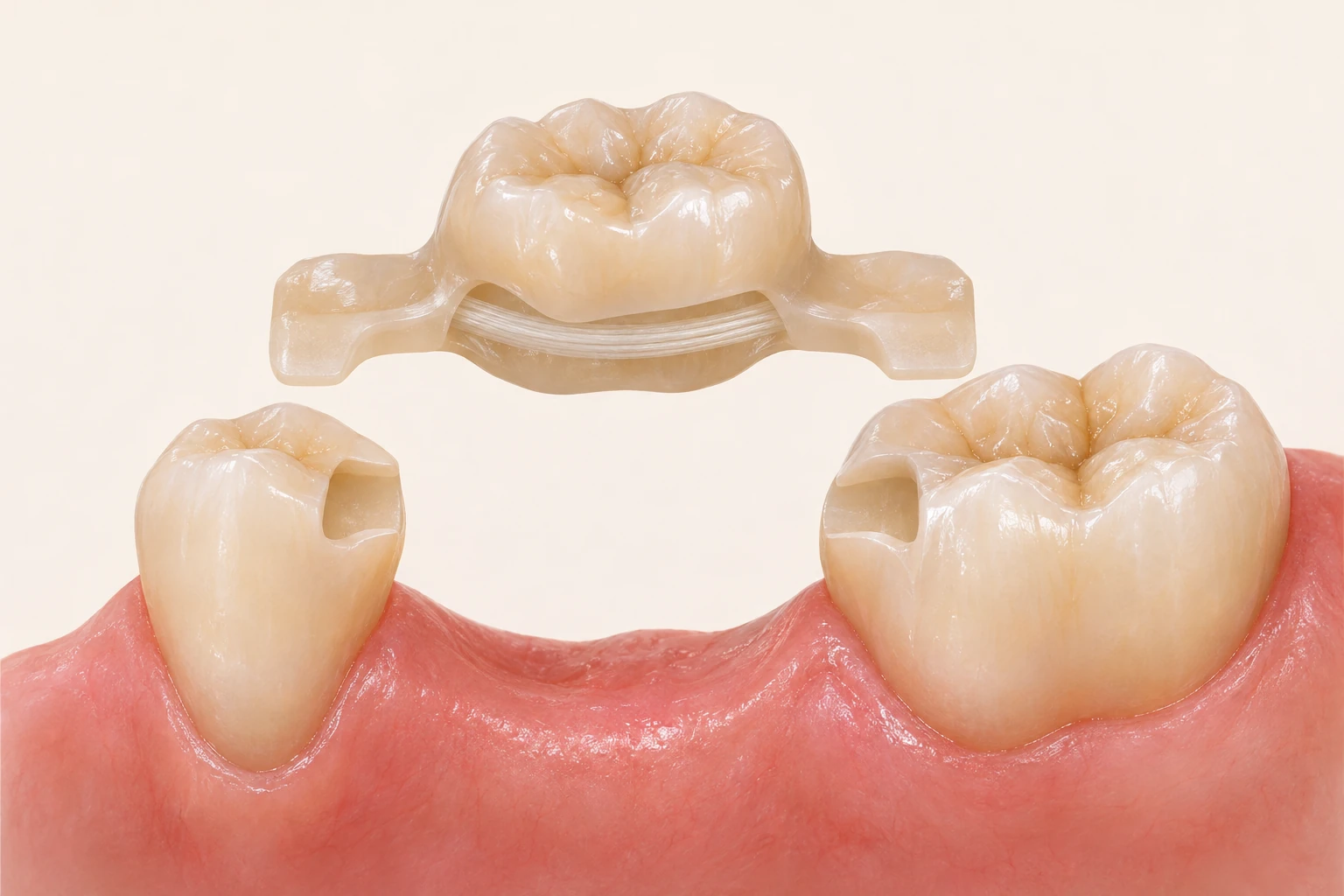
Glass fibres in a resin matrix reinforce the bridge framework. Tooth-coloured composite forms the visible replacement. Performance also depends on fibre position, the connections between materials and the design and construction of the restoration.
A pontic replaces the missing tooth. The bridge may, for example, connect to prepared inlay areas in the neighbouring teeth. Existing fillings and defects influence planning. A glass-fibre bridge therefore does not necessarily leave otherwise intact teeth unchanged.
The framework and covering need space, a suitable bite and cleaning access. High loads, including grinding, affect selection. Check-ups assess attachment, surfaces and neighbouring teeth. The material name alone does not establish a particular lifespan.
A missing tooth can be replaced by a pontic within a glass-fibre-reinforced structure.
Supporting teeth, available space, the bite, loading and the proposed attachment, among other factors.
Suitability, design, cleaning and follow-up are planned for the actual findings.
Three steps. No audio.
Each scene can also be selected manually.

Silent educational film with German on-screen text and simplified teaching images. Not a patient case or a promised treatment outcome. The full English explanation is available as text.
A glass-fibre bridge is named after its reinforcing material. An inlay-retained bridge is named after its attachment within the neighbouring teeth. Both descriptions can apply to the same restoration.
The terms describe different features. Glass fibre refers to reinforcement within the material; resin-bonded describes adhesive attachment. A glass-fibre-reinforced restoration can be adhesively bonded. Neither term alone fully describes the particular bridge design.
This depends on the attachment design and the condition of the teeth. Inlay-retained designs use prepared areas in adjacent teeth. Existing fillings or defects may influence these preparations. A general promise of treatment without drilling would therefore be inaccurate.
A reliable lifespan cannot be promised for an individual person. Design, bonding, loading and cleaning all matter. The publication used here describes only four selected cases with short follow-up; it does not establish a general long-term prognosis.
No. Whether it can preserve tooth tissue while adequately withstanding load needs assessment for the particular gap. The material name alone cannot determine which restoration is appropriate.
You can bring this question to your appointment:
How would this bridge be attached in my case, and what would that mean for the neighbouring teeth?
An individual examination can clarify the findings and suitable next steps.
Arrange an assessmentAppointment selection at DoctolibMaterial, attachment and clinical suitability are separate questions. A small case series illustrates possible uses but does not replace a comparative long-term study.
Editorial research: . General information, not an individual diagnosis or treatment recommendation. Teaching illustrations are simplified and do not depict a patient case.