What has chipped?
Restorative ceramic.

Ceramic chipping is loss of a fragment of restorative ceramic, for example from a crown or bridge. Its extent, position, loading and the remaining restoration determine management. A small chip does not automatically mean the whole crown or underlying tooth has fractured.
For training & practice ↓
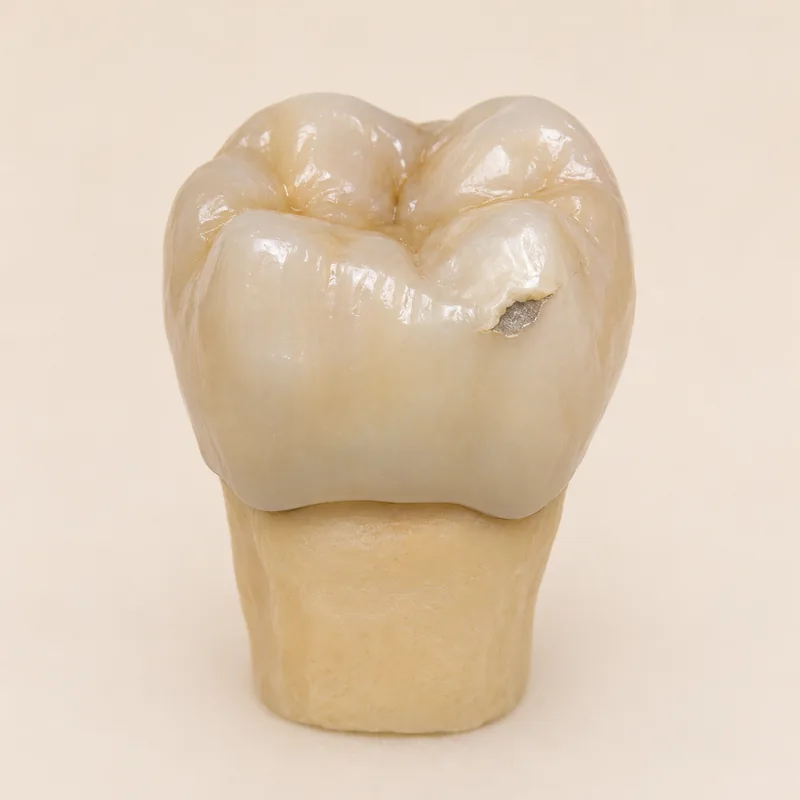
Assessment distinguishes missing ceramic, separation of a veneer layer and deeper structural damage.
Sharp edges, contacts, the bite and stability matter alongside appearance. A photograph cannot replace the complete assessment.
Monitoring, smoothing, repair or replacement may be considered. Repair is not suitable for every defect.
Restorative ceramic.
No; it depends on the findings.
No.
Three steps. No audio.
Each scene can also be selected manually.

Silent educational film with German on-screen text and simplified teaching images. Not a patient case or a promised treatment outcome. The full English explanation is available below.
Assessment distinguishes missing ceramic, separation of a veneer layer and deeper structural damage.
Sharp edges, contacts, the bite and stability matter alongside appearance. A photograph cannot replace the complete assessment.
Monitoring, smoothing, repair or replacement may be considered. Repair is not suitable for every defect.
Chipping here concerns ceramic. Fracture of tooth tissue or a supporting framework is a different finding and may need different management.
Not always. Suitable local defects may be smoothed or repaired when stability and the remaining restoration allow.
No. This can further damage the material, tooth or soft tissues. Have the edge assessed.
When it occurred, whether anything is sharp or loose and whether it hurts. Report loose parts or significant symptoms directly and promptly.
Editorially suggested question to discuss with Dr Niusha Barahmand Pour:
Is only the surface affected or also the supporting structure?
Describe the damaged area; call directly for a loose restoration or significant pain.
Have a ceramic defect assessedAppointment selection at DoctolibChipping here concerns ceramic. Fracture of tooth tissue or a supporting framework is a different finding and may need different management.
Editorial research: . General information, not an individual diagnosis or treatment recommendation. Teaching illustrations are simplified and do not depict a patient case.