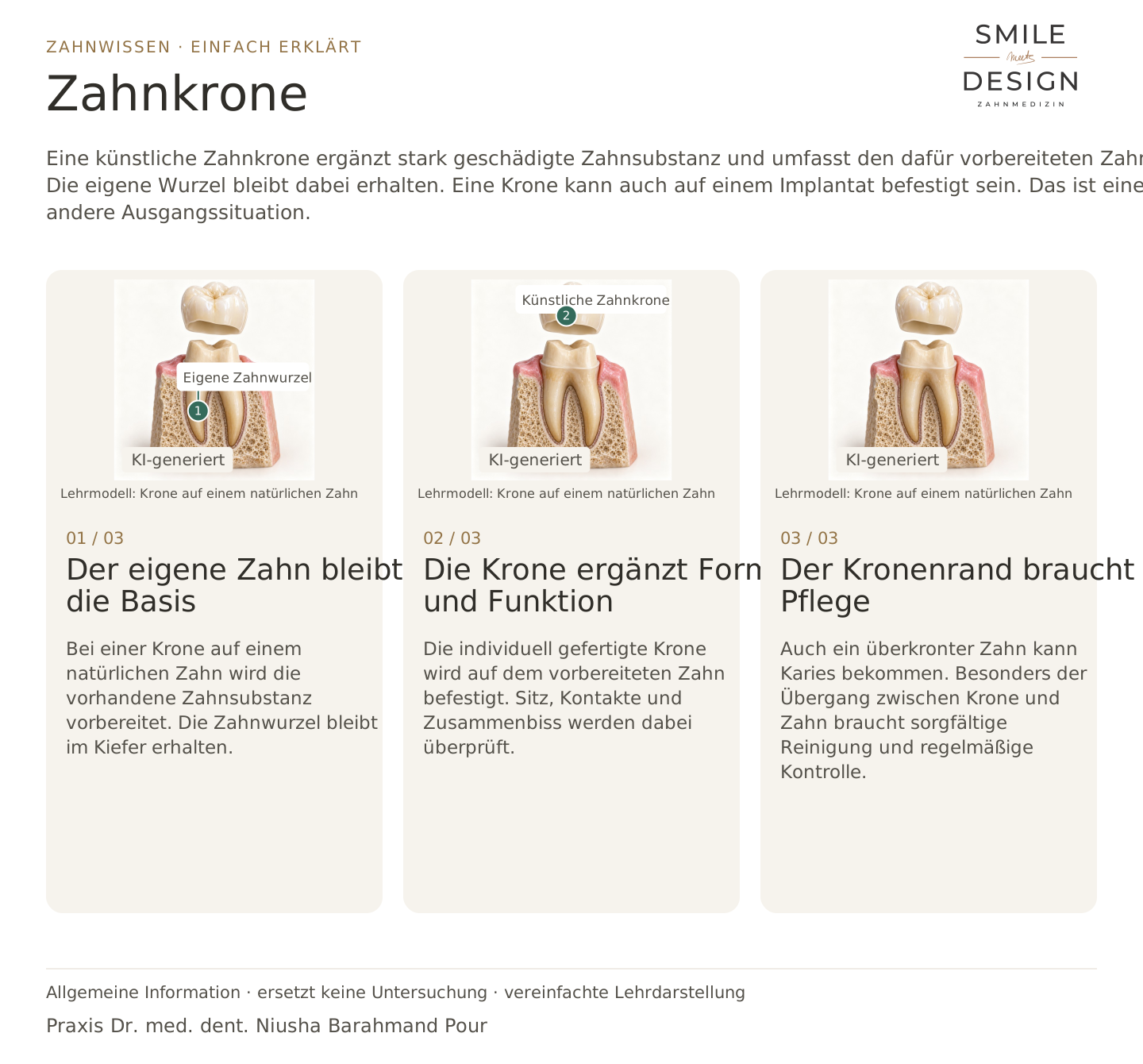
What does a crown restore?
On a natural tooth, an artificial crown covers the prepared outer tooth tissue. The natural root remains in the jaw; a crown on an implant has a different foundation.

An artificial dental crown restores severely damaged tooth tissue and covers the prepared tooth. Its natural root remains in place. A crown can also be attached to an implant, which is a different starting point.
For dental trainees & teams
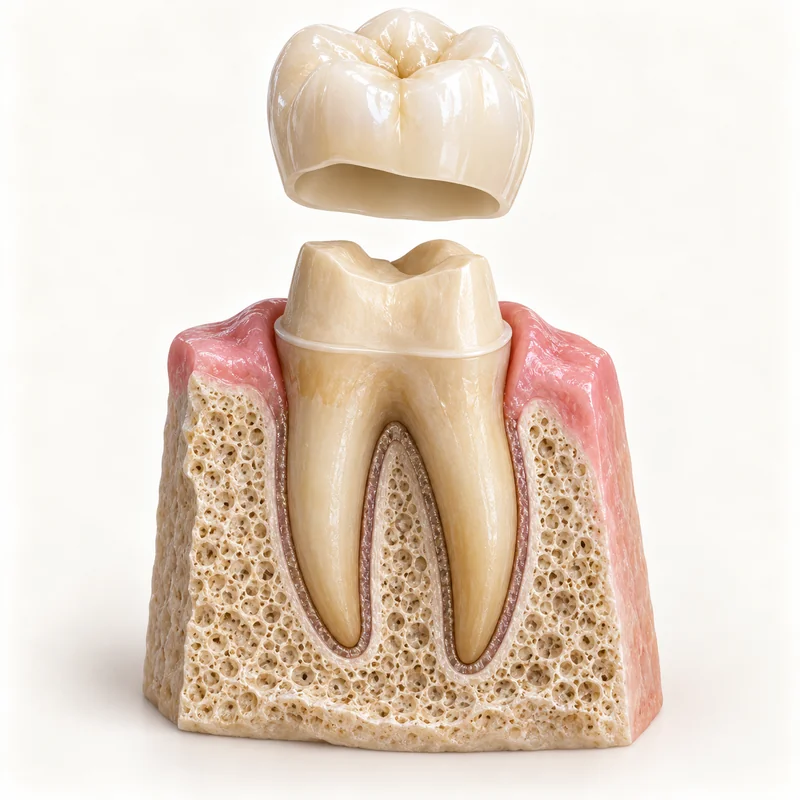
For a crown on a natural tooth, the existing tooth tissue is prepared. The tooth root remains in the jaw.
The individually made crown is attached to the prepared tooth. Its fit, contacts and bite are checked.
A crowned tooth can still develop decay. The junction between crown and tooth especially needs careful cleaning and regular checks.
On a natural tooth, an artificial crown covers the prepared outer tooth tissue. The natural root remains in the jaw; a crown on an implant has a different foundation.
More extensive damage to tooth tissue may be a reason for a crown. Suitability and material choice depend on factors including the remaining tooth and the forces it bears.
After planning and preparation, the individually made crown is attached and the bite is checked. Afterwards, the junctions with the tooth especially need cleaning and check-ups.
Three steps. Straight to the point.
Explanations are also shown on screen.

Silent film in German · English explanations in the three views above
A crown forms the visible restoration. An implant replaces the root in the jaw. An artificial crown can be supported by either a natural tooth or an implant.
No. A crown replaces damaged outer tooth tissue. Whether the inside of the tooth needs treatment is a separate question determined by the findings.
No. Options include ceramic and metal-containing crowns. The choice considers the tooth's condition, the forces it bears and personal preferences.
This is the enamel-covered part of your own tooth. An artificial crown is a restoration made as part of dental treatment.
A question to discuss with Dr. med. dent. Niusha Barahmand Pour:
How can the remaining tooth tissue, bite and preferred tooth shape be considered when planning a crown?
Her curriculum-based training in aesthetic dentistry adds considerations of shape and colour to preserving teeth and function.
The suitable restoration depends on the remaining tooth tissue and the findings.
Discuss a restoration for your toothChoose an appointment on DoctolibBuild on the simple explanation with clinical terms, key distinctions and a knowledge question.
A crown on a natural tooth covers the prepared remaining tooth. An implant crown is instead supported by an artificial tooth root.
Editorial research: 22 October 2026. This explanation covers general principles and does not replace a personal examination. Suitable treatment is discussed following individual assessment.