Where is it located?
Usually on the back of the supporting tooth.

A bonded retainer wing is the broad retaining part of a resin-bonded bridge. It is usually bonded to the back of a neighbouring tooth and supports the artificial replacement tooth, or pontic. This can preserve more healthy tooth tissue than a full-coverage crown. Material, bonding area and bite must be compatible; the wing is more than a contact point and is not an implant.
For training & practice ↓
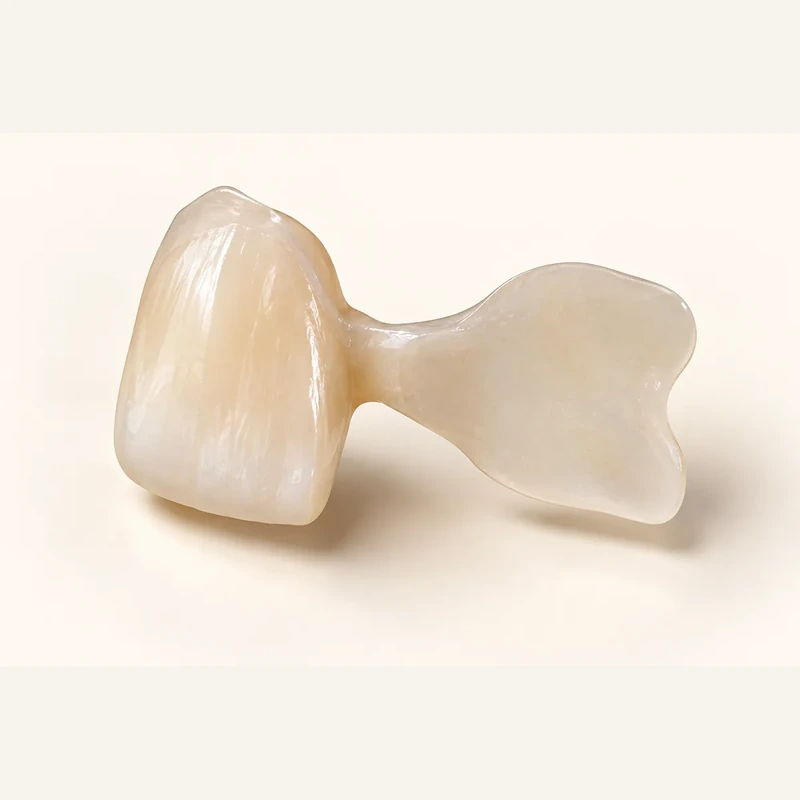
The pontic replaces the missing tooth. Its connected wing fits against the supporting tooth and is bonded in place. This bonding area transfers forces to the natural tooth.
Depending on the restoration, wings may be metal or ceramic. Their size and position must suit the available tooth tissue and opposing bite. More wings do not automatically mean greater security.
The bond can loosen. A mobile bridge needs prompt assessment. Keep any detached restoration and do not glue it yourself. Cleaning and regular reviews remain important.
Usually on the back of the supporting tooth.
Metal or ceramic, depending on the design.
Arrange prompt assessment and do not glue it yourself.
Three steps. No audio.
Each scene can also be selected manually.

Silent educational film with German on-screen text and simplified teaching images. Not a patient case or a promised treatment outcome. The full English explanation is available as text.
The wing attaches the bridge to a natural tooth. The pontic replaces the missing tooth. They are parts of the same restoration with different roles.
Usually not as it would for a full crown. Small adjustments may still be needed depending on space, bonding area and the planned restoration.
Single-retainer designs are established options for suitable anterior gaps. The number is chosen for the individual case; connecting two supporting teeth is not always advantageous.
Not necessarily. The bridge, supporting tooth and cause of debonding need assessment. Rebonding may be possible but is not always appropriate.
You can bring this question to your appointment:
How do my available bonding surface and bite support this particular wing design?
An individual assessment can clarify the findings and whether referral is needed.
Arrange an assessmentAppointment selection at DoctolibThe wing attaches the bridge to a natural tooth. The pontic replaces the missing tooth. They are parts of the same restoration with different roles.
Editorial research: . General information, not an individual diagnosis or treatment recommendation. Teaching illustrations are simplified and do not depict a patient case.
If you turn this on, this website stores which guides you open, separately from advertising preferences. The markers expire after a fixed 30-day period from activation. The list is not sent to us by this feature. You can turn it off here and delete the markers.
Other people using the same browser profile can also see the markers. German and English versions share one marker. Expired entries are removed the next time you open a page with this feature; deleting browser data may remove them earlier. “Viewed” means opened, not read or completed.