Possible sign?
Burning, redness or peeling.

Contact stomatitis is inflammation of the oral lining associated with a contacting substance. Irritation and contact allergy need to be distinguished. Burning, redness or peeling may occur but can also have other causes.
For training & practice ↓
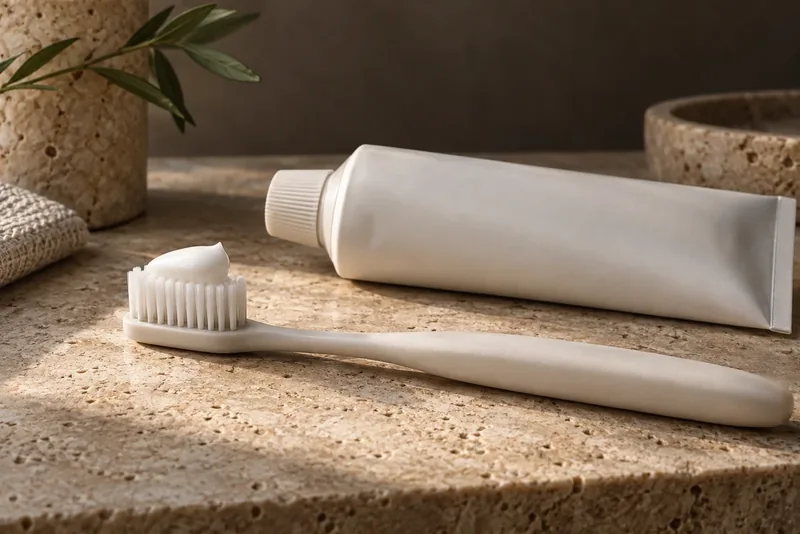
Was a new toothpaste, rinse, food or material used recently? Timing and location help the assessment.
Timing alone does not prove allergy. Friction, other conditions and irritating ingredients may also be involved.
Examination and, when appropriate, allergy testing guide management. Fillings or crowns should not be replaced on suspicion alone.
Burning, redness or peeling.
Only after appropriate assessment.
Seek immediate help for lip, tongue or throat swelling or breathing difficulty.
Three steps. No audio.
Each scene can also be selected manually.

Silent educational film with German on-screen text and simplified teaching images. Not a patient case or a promised treatment outcome. The full English explanation is available as text.
Similar symptoms can have different mechanisms. Burning alone does not establish contact allergy.
No. A coherent clinical association and targeted assessment are needed.
Product names or packaging, a medicine list and the symptom timeline. Do not deliberately re-expose yourself to a suspected substance.
Call 112 immediately for sudden marked swelling of the lips, tongue or throat, or breathing or swallowing difficulty. Do not wait for a dental appointment.
Editorially suggested question to discuss with Dr Niusha Barahmand Pour:
Does the timing fit a contact substance, or should other causes be investigated?
Have persistent irritation assessed. Acute lip, tongue or throat swelling or breathing difficulty requires an immediate 112 emergency call.
Discuss oral irritationAppointment selection at DoctolibSimilar symptoms can have different mechanisms. Burning alone does not establish contact allergy.
Editorial research: . General information, not an individual diagnosis or treatment recommendation. Teaching illustrations are simplified and do not depict a patient case.