Which parts work together?
The inner crown, outer crown and planned prosthesis.

A conical crown forms part of a double-crown system for removable prostheses. Its inner crown has slightly tapered sides. A matching outer crown is incorporated into the denture; seating the two together can create a wedging retention effect.
For training & practice ↓
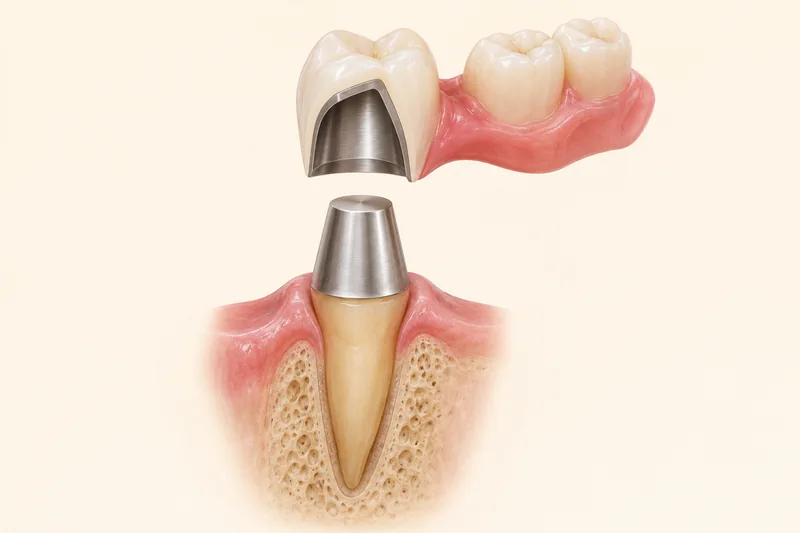
The inner crown is attached to a suitable abutment. The outer crown forms part of the removable denture and slides over the inner crown.
Conical crowns have slightly angled rather than parallel sides. Taper, material and fit influence the retaining force.
Abutments, crowns and the denture need cleaning and review. A loose inner crown or changed retention calls for assessment, not home adjustment.
The inner crown, outer crown and planned prosthesis.
People considering a removable restoration retained by double crowns.
Abutments, retention, fit, bite and cleaning access.
Three steps. No audio.
Each scene can also be selected manually.

Silent educational film with German on-screen text and simplified teaching images. Not a patient case or a promised treatment outcome. The full English explanation is available as text.
Conical crowns have angled contacting surfaces. Parallel-wall telescopes use a different geometry; both are double-crown designs.
Both belong to double-crown systems. In strict technical use, telescopic crowns have parallel walls and conical crowns have tapered walls. Everyday usage is less consistent.
No. Abutment distribution, periodontal support, available space, material and the ability to clean all matter. Studies of individual systems do not establish universal superiority.
Possible causes include altered fit or a loosened connection. The whole restoration needs assessment to identify the reason.
You can bring this question to your appointment:
How will this double crown provide retention, and how should its abutments be cleaned?
Discuss retention, cleaning and the condition of your denture.
Arrange a denture assessmentAppointment selection at DoctolibConical crowns have slightly tapered contacting walls. Parallel-wall telescopes use a different geometry; both are double-crown designs.
Editorial research: . General information, not an individual diagnosis or treatment recommendation. Teaching illustrations are simplified and do not depict a patient case.