
Dental knowledge · Everyday tips
Cleaning removable dentures: a routine suited to the material
Remove a removable denture from your mouth for cleaning and clear away deposits carefully every day. The material matters: a method suitable for a hard acrylic denture may damage metal or a soft liner. Written care instructions for your own denture are more useful than a one-size-fits-all home remedy.
Published on
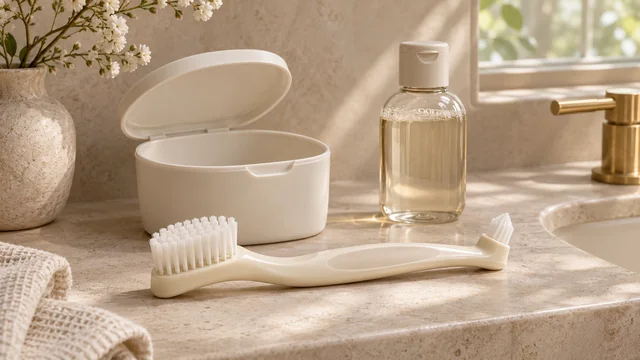 AI-generated
In this guide
First check: what is your denture made of?
Full dentures are often mainly acrylic. Partial dentures may also have metal frameworks, clasps or other connecting components. Two dentures that look similar can therefore need different care. If unsure, bring the name of your cleansing product and ask the dental team which materials your denture contains.
A soft liner is an additional layer on the surface that rests on the tissues. Temporary and permanent soft materials may require different care. Some must not be brushed like hard acrylic or immersed in standard cleansing solutions. Ask for specific instructions rather than simply repeating the routine used for a previous denture.
University of Bristol Dental School: Denture care – patient information
A clear routine in four steps
A consistent order makes daily care easier. The following is a guide for conventional hard denture surfaces; follow the individual instructions for soft liners or a specialised denture design.
- Prepare a safe space: put a towel in the basin or fill it with water so the denture is less likely to strike a hard surface if dropped.
- Remove and rinse: rinse away loose food after meals. Do not use boiling or very hot water.
- Brush carefully: use a suitable soft brush and a compatible non-abrasive product, including the fitting surfaces and spaces between teeth. Do not bend clasps. Rinse thoroughly afterwards.
- Care for your mouth too: brush remaining natural teeth with fluoride toothpaste and clean between them. Gums, tongue and palate also need gentle cleaning.
NHS: Dentures · Oxford Health NHS: Looking after your dentures · American Dental Association: Dentures
What can cleansing tablets do, and what should you avoid?
A compatible denture cleanser can supplement mechanical cleaning. Soaking does not automatically replace careful removal of deposits. Follow the product instructions for duration, concentration and material compatibility. Cleansing solutions must not be used in the mouth or swallowed; rinse the denture thoroughly before reinserting it.
Ordinary toothpaste may be too abrasive for dentures. Scouring powders and homemade bleaching solutions are not general denture-care recommendations either. Chlorine-containing products can particularly damage metal components. Vinegar, citric acid and baking soda are not universal solutions: use what is suitable for the specific denture design.
American Dental Association: Dentures · University of Bristol Dental School: Denture care – patient information · Oxford Health NHS: Looking after your dentures
Removing a denture and storing it correctly are different steps
Dentures should usually be removed at night unless the treating dental team recommends otherwise. However, there is no single storage rule suitable for every material. Ask specifically whether to store your denture dry or in water, which container to use and whether any additive is needed. With liners in particular, “always leave it in a glass of water” may be inappropriate.
NHS: Dentures · University of Bristol Dental School: Denture care – patient information
When cleaning alone is not enough
Persistent odour, hard deposits, sore spots, cracks or a loose fit should be discussed with a dental professional. Do not scrape with sharp objects or try to grind the denture into shape yourself. Extra adhesive is no substitute for checking the fit. Checks of the oral tissues and denture remain useful even when no natural teeth remain.
Three practical questions can guide your next appointment: is my cleanser compatible with the material? How should I clean each surface? How should I store the denture at night? If someone helps with your care, write down the agreed routine together or ask the dental team to demonstrate it.
Common questions
Can I use ordinary toothpaste?
For natural teeth, yes; for dentures, not automatically. Ordinary toothpaste can scratch the denture surface. Choose a suitable non-abrasive product and follow the material-specific instructions.
NHS: Dentures · Oxford Health NHS: Looking after your dentures
Is a cleansing tablet enough?
A compatible tablet supplements cleaning. Visible deposits on hard surfaces also need mechanical removal. Soft liners require separate instructions.
American Dental Association: Dentures · University of Bristol Dental School: Denture care – patient information
Can a metal denture go into any cleansing solution?
No. Chlorine-containing products in particular can damage metal. Use a product specifically suited to the denture and follow its instructions.
University of Bristol Dental School: Denture care – patient information
What if my denture has a soft liner?
Ask the dental team for the exact material and care instructions. Whether and how to brush, soak and store it depends on the liner material.
University of Bristol Dental School: Denture care – patient information
Related reading
Sources and further reading
Research and editorial date: 7 November 2026. General information; individual findings and recommendations require an examination.