Why?
To prepare a canal that needs treatment.

Motor-driven fine instruments shape the canal walls and make room for cleaning and filling. The clinician guides the instrument; the motor does not treat the tooth independently.
For training & practice ↓
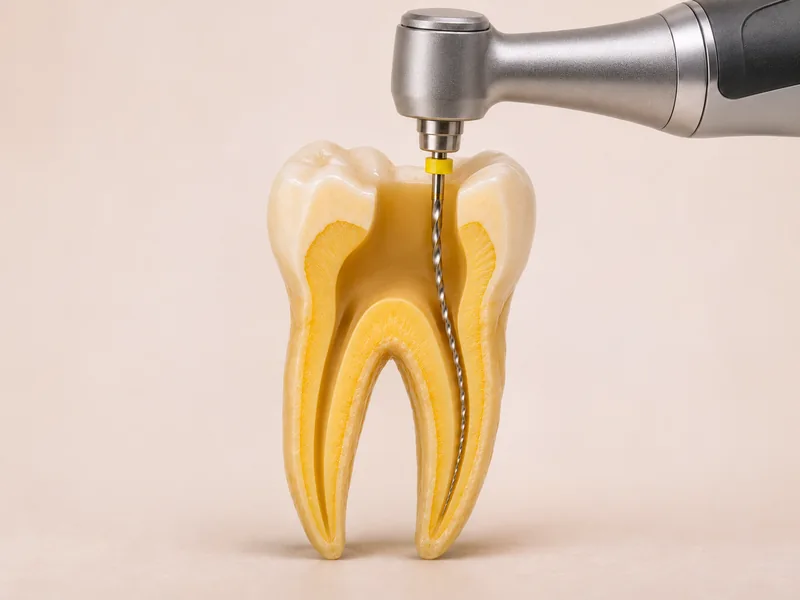
Access, curvature and working length are assessed before shaping. A curved root is not simply drilled straight.
Flexible instruments remove a limited amount of dentine. Canal anatomy and remaining tooth structure guide the approach.
Files cannot reach every side space. Irrigation and a suitable final seal remain part of treatment.
To prepare a canal that needs treatment.
Controlled instrumentation combined with irrigation.
An appropriate seal and agreed follow-up.
Three steps. No audio.
Each scene can also be selected manually.

Silent educational film with German on-screen text and simplified teaching images. Not a patient case or a promised treatment outcome. The full English explanation is available below.
Access, curvature and working length are assessed before shaping. A curved root is not simply drilled straight.
Flexible instruments remove a limited amount of dentine. Canal anatomy and remaining tooth structure guide the approach.
Files cannot reach every side space. Irrigation and a suitable final seal remain part of treatment.
Preparation shapes and cleans. Filling then seals the prepared canal space.
No. Selection, guidance and monitoring remain clinical tasks.
No. Mechanical shaping and chemical cleaning complement one another.
Instrument separation is a possible complication. Anatomy and loading affect risk; its significance requires individual assessment.
Editorially suggested question to discuss with Dr Niusha Barahmand Pour:
What is distinctive about the canal anatomy of my tooth?
The anatomy of your own tooth can make a discussion of root treatment more useful.
Discuss root canal treatmentAppointment selection at DoctolibPreparation shapes and cleans. Filling then seals the prepared canal space.
Editorial research: . General information, not an individual diagnosis or treatment recommendation. Teaching illustrations are simplified and do not depict a patient case.