Where is it?
In front of and below each ear.

The parotid is a major salivary gland in front of and below the ear, present on both sides. Its saliva travels through a duct to the inner cheek. Swelling in that region can have several causes.
For training & practice ↓
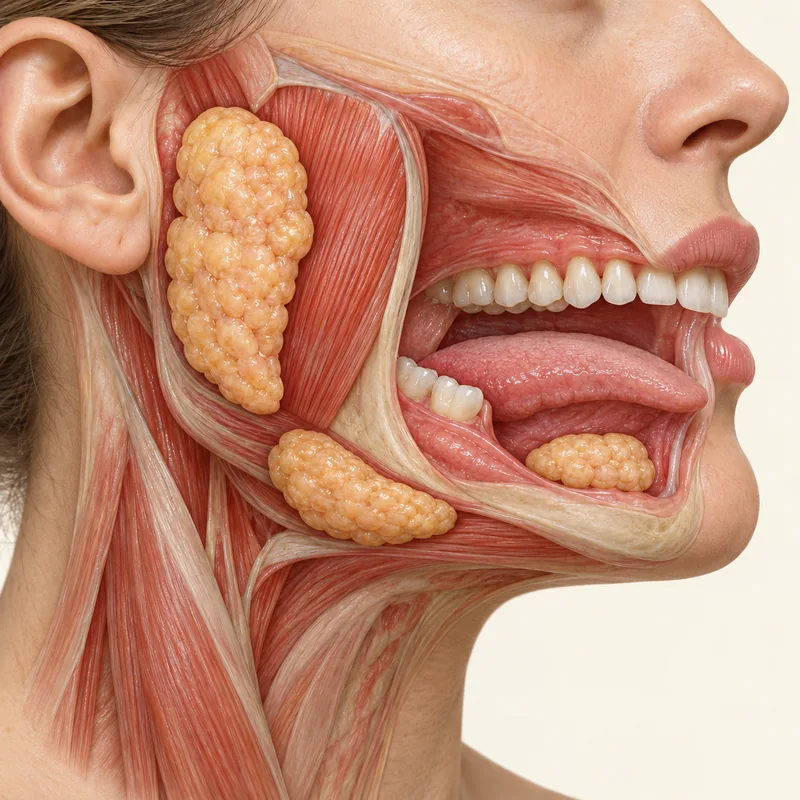
The gland lies at the side of the face. It is neither the ear canal nor the jaw joint, although symptoms may be felt nearby.
Its duct travels across the cheek region and opens opposite an upper molar. It does not open beneath the tongue.
Recurrent mealtime swelling, persistent lumps or new symptoms need medical or dental assessment. Do not squeeze or puncture the area.
In front of and below each ear.
Onset, side, relation to meals, pain, fever or a lump.
For rapidly painful swelling or fever; swallowing or breathing problems are urgent.
Three steps. No audio.
Each scene can also be selected manually.

Silent educational film with German on-screen text and simplified teaching images. Not a patient case or a promised treatment outcome. The full English explanation is available below.
The gland lies at the side of the face. It is neither the ear canal nor the jaw joint, although symptoms may be felt nearby.
Its duct travels across the cheek region and opens opposite an upper molar. It does not open beneath the tongue.
Recurrent mealtime swelling, persistent lumps or new symptoms need medical or dental assessment. Do not squeeze or puncture the area.
The gland produces saliva; the joint enables jaw movement. Pain location alone does not distinguish the cause.
No. Inflammation, drainage problems and other conditions may present similarly.
Not necessarily. Several major and many minor glands contribute to saliva.
Depending on findings, a dentist or doctor, with ENT or other specialist assessment where appropriate.
An editorially suggested question for a discussion with Dr med dent Niusha Barahmand Pour:
Do the findings point to the salivary gland or another structure?
New or recurrent swelling near the ear? Please call to clarify what assessment is appropriate.
Call the practice · 0221 669 401 80Telephone contactThe gland produces saliva; the joint enables jaw movement. Pain location alone does not distinguish the cause.
Editorial research: . General information, not an individual diagnosis or treatment recommendation. Teaching illustrations are simplified and do not depict a patient case.