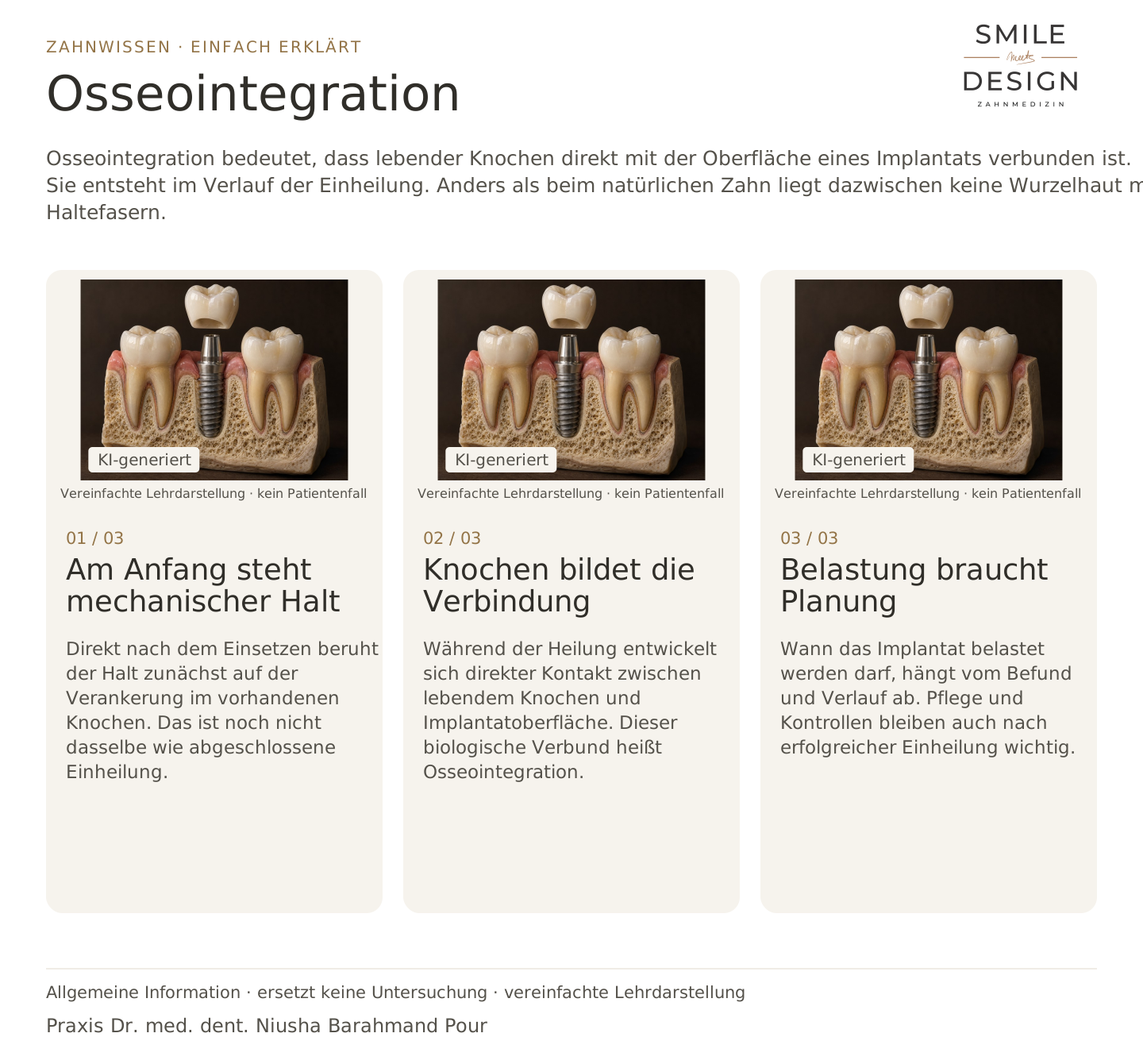
What connects?
Living jawbone and the implant surface form a direct connection.

Osseointegration means that living bone is directly connected to an implant surface. It develops during healing. Unlike a natural tooth, there is no periodontal ligament with supporting fibres between the implant and bone.
For dental trainees & teams
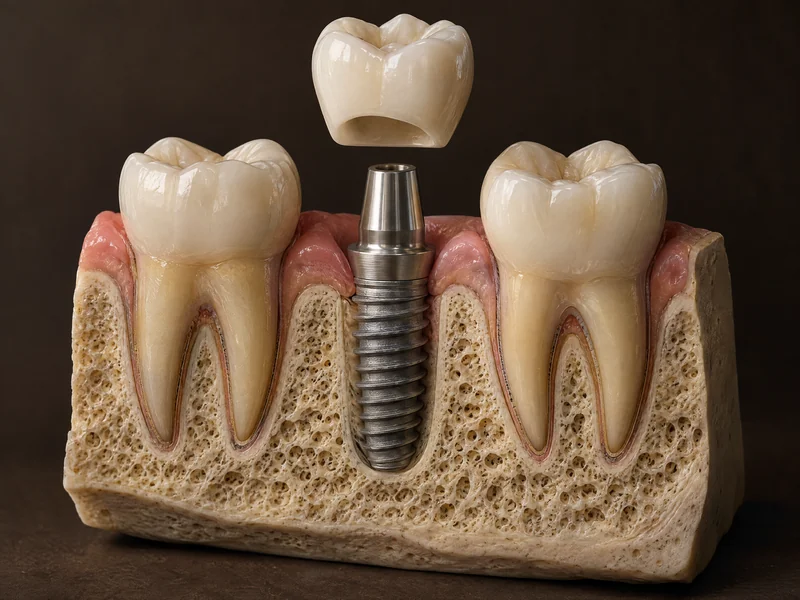
Immediately after placement, stability initially comes from engagement with the existing bone. This is not the same as completed healing.
During healing, direct contact develops between living bone and the implant surface. This biological connection is called osseointegration.
When an implant can be loaded depends on the findings and progress. Care and reviews remain important after successful healing.
Living jawbone and the implant surface form a direct connection.
Initial mechanical stability and biological integration are different processes.
Follow loading and care instructions and attend reviews; absence of pain alone does not demonstrate integration.
Three steps. Straight to the point.
Explanations are also shown on screen.

Silent film in German · English explanations in the three views above
Primary stability is initial mechanical stability. Osseointegration is the biological connection with bone.
No. A natural tooth is anchored by supporting fibres; an osseointegrated implant has direct bone contact.
Absence of pain does not prove that healing is complete. Assessment takes place at planned reviews.
Yes. Inflammation can damage the surrounding tissues, among other problems. Healing does not replace long-term care and reviews.
A question to discuss with Dr. med. dent. Niusha Barahmand Pour:
How will you assess when and how my implant can be loaded?
At the practice, the findings, personal wishes and possible next steps are discussed through a consultation and examination.
Questions about healing should be discussed with the team providing treatment.
Discuss implant questionsChoose an appointment on DoctolibBuild on the simple explanation with clinical terms, key distinctions and a knowledge question.
An implant and a natural tooth have different forms of anchorage, even though both may have a visible crown.
Editorial research: 23 October 2026. This explanation covers general principles and does not replace a personal examination. Suitable treatment is discussed following individual assessment.